
Accessory Dwelling Units
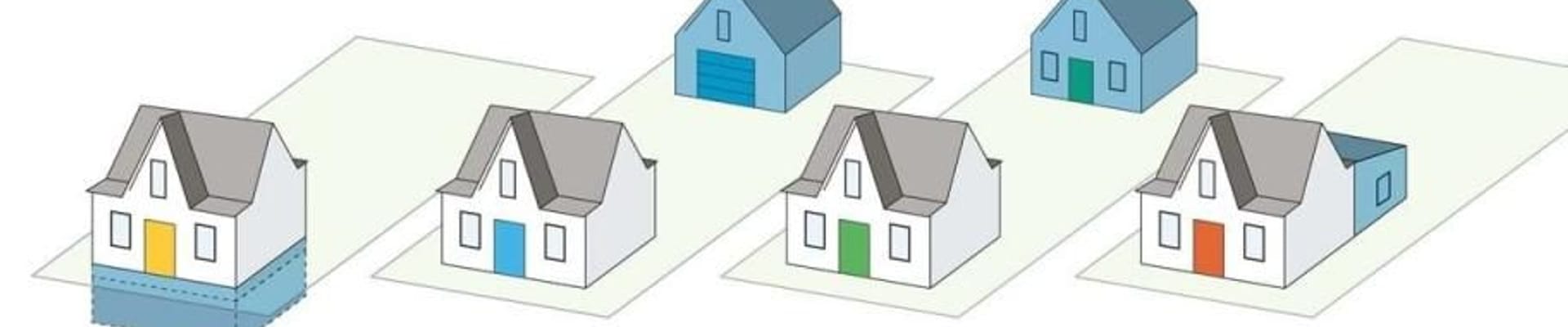
Charles County is updating its zoning regulations to expand allowances for Accessory Dwelling Units (ADUs), sometimes referred to as “granny flats”. ADUs are smaller, self-contained residential living units located on the same lot as a primary single-family home. Each ADU includes its own kitchen, bathroom, and sleeping area, allowing it to function as an independent living space.
Why are these changes being made?
Accessory Dwelling Units are an important piece of Charles County’s multifaceted approach to lowering the cost of housing. The Charles County Affordable Housing Strategy, published in 2025, identifies the expansion of ADUs as a short-term policy objective to implement within one-two years. Public engagement for the Affordable Housing Strategy indicated a high level of community support for allowing more
flexibility for ADUs.
“ADUs support affordability in two different ways: they create new, lower cost rental opportunities on under-utilized land, and they can help existing homeowners stay in their homes through additional rental income. Allowing ADUs in more places will both increase the housing supply and the diversity of housing available in Charles County.” - Charles County Affordable Housing Report 2025
In addition to local support for ADUs, staff is also amending the zoning regulations due to recent changes in state law. Maryland’s General Assembly passed HB 1466 during its 2025 legislative session. HB 1466 makes it the policy of Maryland to promote and encourage the creation of Accessory Dwelling Units (ADUs) on land with a single-family detached dwelling unit as the primary dwelling unit in order to help solve the state’s housing shortage and meet its housing needs. This legislation requires that counties and cities adopt rules enabling ADUs and conforming to certain state requirements for ADUs before October 1, 2026. For more information, check out the state’s ADU Bill (HB 1466).
What do existing rules say about ADUs?
Charles County currently allows limited Accessory Dwelling Unit construction. One of the biggest barriers to ADU construction is the requirement that any secondary dwelling unit that is detached from the main dwelling may only encompass 50% of the structure. This results in a requirement that a 1,000 square foot structure may only utilize 500 square feet for living space. Consequently, if a property owner wanted to construct a living space of 1,000 square feet, they would also need to provide a 1,000 square foot non-residential space, resulting in a total building size of 2,000 square feet.
This requirement for equivalent non-residential space in the same accessory building is not obligatory if the ADU is attached to the main dwelling. Changing the rules to eliminate this requirement for 50% living space and 50% non-residential space is the main focus of this zoning text amendment and would add flexibility for homeowners who desire to construct a detached accessory dwelling unit.
What is being proposed?
New zoning rules are proposed that would enable ADUs with greater flexibility than the county’s regulations currently allow. For an outline of the changes proposed, visit here.
How can I get involved?
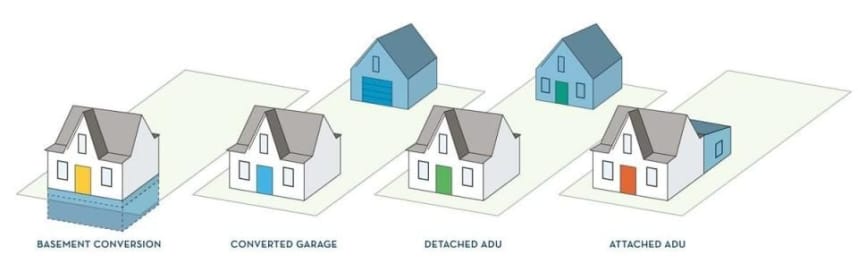
Share your thoughts on Accessory Dwelling units by completing the form below.
For information on how to make official comments or sign up to speak at public hearings, please visit our Planning Commission and Board of Commissioners procedures.
Opportunities to Engage
Share Your Thoughts on Accessory Dwelling Units
Review the draft Accessory Dwelling Unit (ADU) Zoning Text Amendment Proposal and use this open form to share your feedback!
Stay Informed
Get notified on upcoming engagements and the latest project related news.