
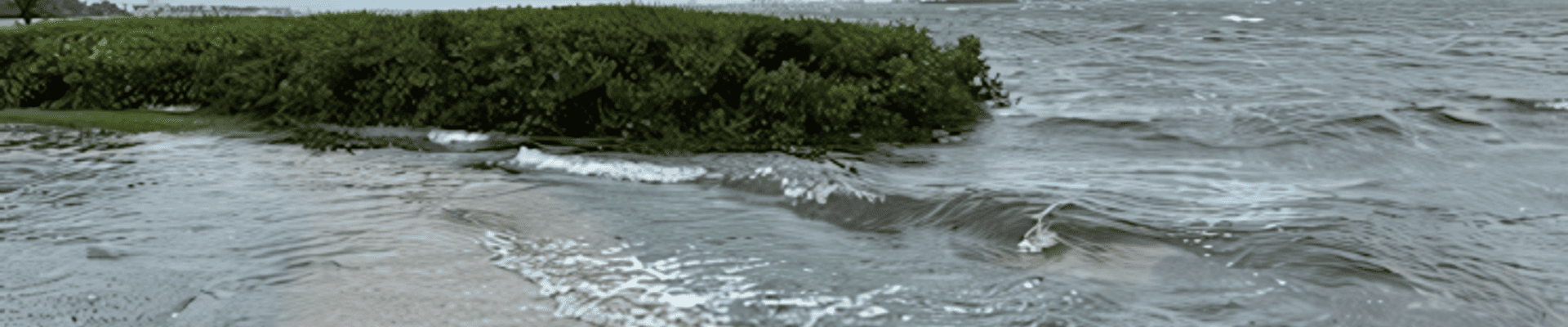
Protecting Our Coast: Facing Flood Risks Together
Overview
The City of Dunedin recognizes the heightened vulnerability of our community to severe weather events. To address these challenges proactively, the City is partnering with engineering consulting firm WSP to assess and mitigate future climate impacts on our critical assets within city limits. The Vulnerability Assessment serves as a foundational tool for developing tailored adaptation strategies and policies aimed at mitigating risks and enhancing resilience. The City of Dunedin was awarded a Resilient Florida Planning Grant for fiscal year 23-24 from the Florida Department of Environmental Protection (FDEP) through the Resilient Florida grant program. This grant allows the City to conduct a vulnerability assessment and develop an adaption plan. FDEP Grant award provides funding for the entirety of the project budget of $380,950.
What is a Vulnerability Assessment?
A Vulnerability Assessment determines the susceptibility of a community and critical public infrastructure within the community such as roads, marinas, emergency facilities, stormwater infrastructure, wastewater infrastructure, etc. to environmental hazards, particularly those exacerbated by climate change such as sea-level rise/tidal, storm surge and increases rainfall flooding. The ongoing Citywide Assessment aims to establish a standardized process for evaluating the resilience of our existing assets by systematically identifying vulnerabilities and identifying adaptation measures.
Exposure and Sensitivity Analysis
The Exposure Analysis refers to the evaluation and quantification of potential impacts or vulnerabilities to assets from specific hazards or stressors. It involves identifying and assessing the extent to which these environmental hazards impact assets.
The Sensitivity Analysis evaluates how variations in environmental hazards influence asset function. The methods employed include scenario analysis to explore outcomes under different future conditions, probabilistic approaches to assess uncertainty, and multi-criteria decision analysis to prioritize adaptation strategies. The results of the Sensitivity Analysis will guide decision-makers in identifying risk for individual assets.
Environmental Hazards
I. Tidal Flooding and Sea Level Rise
Sea level rise flooding results from the gradual increase in the average global sea level over time. This rise is primarily caused by climate change-related factors, including the thermal expansion of ocean water as temperatures warm and the melting of glaciers and polar ice caps. Unlike tidal flooding, which occurs periodically, sea level rise leads to a permanent increase in water levels along coastlines. As sea levels continue to rise, formerly dry areas become susceptible to regular inundation, leading to more frequent and severe flooding events.
Tidal flooding occurs when higher-than-normal tides inundate low-lying coastal areas. This type of flooding is influenced by natural tidal cycles driven by gravitational forces from the Moon and Sun king tides (exceptionally high tides due to lunar proximity) can exacerbate tidal flooding. In recent years, tidal flooding has become more frequent and problematic in many coastal regions due to the additional impact of sea level rise (SLR).
II. Storm Surge
Storm surge refers to a rapid and temporary rise in coastal sea level that occurs during storm events, particularly due to hurricanes. Storm surges can vary significantly in height depending on the intensity and size of the storm, the speed of its approach, and the shape of the coastline. They pose a significant hazard to coastal communities, often causing widespread flooding, erosion, and damage to infrastructure and property.
III. Rainfall Flooding
Climate change is shifting the frequency and intensity of storm events, causing more intense or prolonged periods of rainfall. Extended periods of rain saturate soils, increase water levels in rivers and streams, and exacerbate flooding risks. Urban areas, in particular, face additional challenges due to extensive pavement and reduced natural drainage. Impervious surfaces prevent water from infiltrating the ground, directing more runoff into already stressed drainage systems and exacerbating urban flooding.
Goals and Objectives
- Enhance Community Resilience: Improve the resilience of the City of Dunedin against climate change impacts, particularly flooding due to rainfall, sea level rise, and storm surge.
- Develop Comprehensive Vulnerability Assessment: Conduct a thorough assessment to identify vulnerabilities of critical and regionally significant assets.
- Inform Adaptation Strategies: Provide data-driven insights to guide the development of adaptation strategies that mitigate flood risks and enhance community preparedness.
- Facilitate Stakeholder Engagement: Inform and engage stakeholders.
Contact
For any questions about this project, please contact Michelle.Monteclaro@Dunedin.gov or Savannah.Bunch@Dunedin.gov
Supporting Links
Resilient Florida Program
https://floridadep.gov/Resilient-Florida-Program/GrantsResilient Florida Program Legislation
http://www.leg.state.fl.us/statutes/index.cfm?App_mode=Display_Statute&Search_String=380.093&URL=0300-0399/0380/Sections/0380.093.htmlNOAA Sea Level Rise Viewer https://coast.noaa.gov/slr/#/layer/slr/2/-9215585.569909774/3253613.8707017945/15/satellite/none/0.8/2050/interHigh/midAccretion
Stay Informed
Get notified on upcoming engagements and the latest project related news.
Project Timeline
Project Updates
Important Dates
City of Dunedin's Vulnerability Assessment Findings
The City's consultant, WSP will present the findings of the exposure and sensitivity analyses which is part of the flood modelling analyses for city-owned assets.