
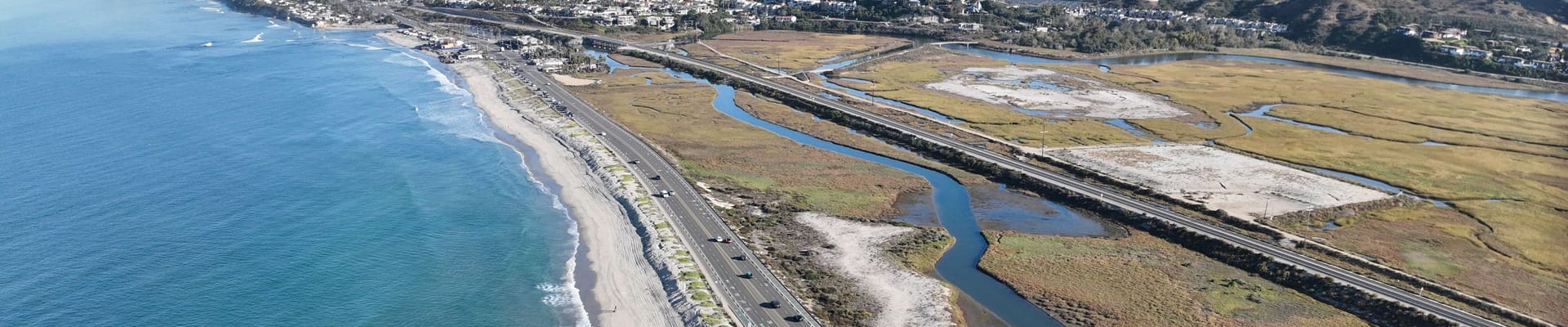
Resource Management Element Focused Amendment
Public Meetings
On August 20, 2026, the Planning Commission recommended approval of the Resource Management Element focused amendment with suggested modifications. The meeting agenda can be found here. More information, including agenda reports and meeting videos, can be found on the Meeting Agendas and Webcasts page.
The City Council will consider the item in Fall 2026, at a future date to be determined.
Overview
The City of Encinitas is conducting a focused amendment to the Resource Management Element of its General Plan to address equitable access to open space, rewilding, climate resilience, and habitat connectivity pursuant to Senate Bill (SB) 1425 and Assembly Bill (AB) 1889. The active involvement of community members, organizations, and other stakeholders throughout the Resource Management Element update process is a priority for the City.
Public engagement objectives for this project are to:
• Gather community input on goals, issues, priorities, and desired outcomes for consideration in the development of the Resource Management Element amendments
• Provide multiple opportunities for engagement to reach the broad range of Encinitas community members and stakeholders
• Utilize accessible engagement strategies for the intentional involvement of vulnerable and underserved communities
These objectives will be achieved through a variety of engagement activities including this website, in-person community workshops, and booths at City-sponsored events.
Background
Updating the Resource Management Element will bring it into compliance with SB 1425, enacted in 2022, and AB 1889, enacted in 2024. SB 1425 requires all General Plan open space elements to be updated to address (1) equitable access to open space, (2) rewilding, and (3) climate resilience. AB 1889 requires all General Plan resource management elements to be updated upon the next update of one or more elements to address habitat connectivity.
The planning process to identify focused amendments to the Resource Management Element includes analyzing existing conditions and identifying key issues and opportunities to inform potential policy changes related to equitable access to open space, climate resilience, rewilding, and habitat connectivity. These analyses will inform the Resource Management Element update, including environmental review and California Environmental Quality Act (CEQA) document preparation as needed.
The City’s public engagement process will follow the guidance outlined in Government Code Section 65565.5, which states the RME update must “address access to open space for all residents in a manner that considers social, economic, and racial equity, correlated with the environmental justice element or environmental justice policies in the general plan, as applicable.”
Community Outreach
Workshop #1 - April 30, 2025:
The first community workshop was held on April 30, 2025 at the City Hall Poinsettia Room. This workshop provided an opportunity for community members to learn about the project and provide feedback on equitable access to open space, rewilding, climate resilience, and habitat connectivity. Below are links to the workshop slideshow presentation and audio recording:
• Slideshow Presentation
• Presentation Audio
Workshop #2 - February 10, 2026:
The second community workshop was held on February 10, 2026 at the City Hall Poinsettia Room, along with a virtual meeting option. This workshop provided an opportunity for community members to review and provide feedback on the public review draft of the project. Below are links to the workshop slideshow presentation and audio recording:
• Slideshow Presentation
• Presentation Audio
Environmental Commission - February 12, 2026:
• Meeting Agenda
• Meeting Video
Pop-Up Community Outreach:
• Encinitas Arbor Day - April 5, 2025
• Cyclovia Encinitas - May 18, 2025
• Cardiff Farmer's Market - January 31, 2026
• Leucadia Farmer's Market - February 1, 2026
Key Terms
Conserved Lands: Publicly- or privately-owned lands or waters designated as open space, undeveloped parcels, or sensitive lands that are primarily managed for conservation and/or restoration and have ecological or cultural value. This also includes lands used for passive recreational uses such as beach recreation, hiking, wildlife viewing, and ecological education.
Conserved lands (for this Resource Management Element) do not include developed parks with active recreation facilities such as playgrounds, community centers, sports fields and sports courts, or dog parks. These types of uses are largely covered under the Recreation Element.
Coastal Ecology and Conservation Areas: Discrete geographic marine or estuarine areas, generally seaward of the mean high tide line or the mouth of a coastal river, including any area of intertidal or subtidal terrain, together with its overlying water and associated flora and fauna, that have been designated by law or administrative action to protect or conserve marine life and habitat. This includes the Swami’s State Marine Conservation Area (SMCA) Marine Protected Area, the Batiquitos Lagoon State Marine Conservation and Ecological Reserve and the San Elijo Lagoon State Marine Conservation Area and Ecological Reserve.
Inland Wetland Communities: Lands which are generally east of the Mean High Tide Line that protect coastal marsh, coastal riparian habitat and shallow estuary waters. This would include the creek and watershed areas of the coastal wetland communities.
Contact Us
Evan Jedynak
Senior Planner
Phone: (760) 633-2686
Email: ejedynak@encinitasca.gov
Stay Informed
Get notified on upcoming engagements and the latest project related news.