
Public Participation Plan
The plan was built on the ideas and input from hundreds of Pima County residents, from Ajo to Vail, Catalina to Arivaca Junction; community business and citizen groups; representatives from the other regional jurisdictions; and, over a hundred county staff members from a broad variety of departments..
Pima Prospers
Arizona statute (ARS §11-805) requires counties to provide effective, early, and continuous public participation in the development of the comprehensive
plan. This Public Participation Plan enables a proactive, open and inclusive process to meet statute requirements and effectively engage the public and other stakeholders to contribute to the planning process.
The objectives of this Public Participation Plan are to:
- Provide opportunities for community participation to all income, age, ethnic and special needs populations from all geographic and economic areas of the county, and from specific unincorporated communities
- Seek out involvement of those potentially impacted by policies or land use changes including local residents, business owners, jurisdictions, interest groups, and other stakeholders in the long-range planning process
- Provide on-going plan information and opportunity to provide comments in person, by mail or electronically over the next 1½ years through to plan adoption by board
Communications
The Public Participation Plan will use many of the same methods from the 2015 plan update for conducting outreach and communication with the public and stakeholder groups, as well as taking advantage of newer virtual methods of communication developed during the Covid-19 pandemic. These will include:
Website and Virtual Outreach:
• Create a plan update webpage using the Zencity Engage platform with a virtual landing page as the primary source of information for:
» plan updates
» meeting links, agendas and summaries
» a doption timelines
» stakeholder surveys and feedback
» i nformational videos
» all relevant comprehensive plan documents including drafts, land use maps, and hearings and public outreach calendars
• Use of a variety of traditional methods, including media releases, social media, direct mail, plan ephemera, and advertising to keep the public informed and to drive interested parties to the Engage landing page for detailed, up-to-date information
In Person Meetings and Events
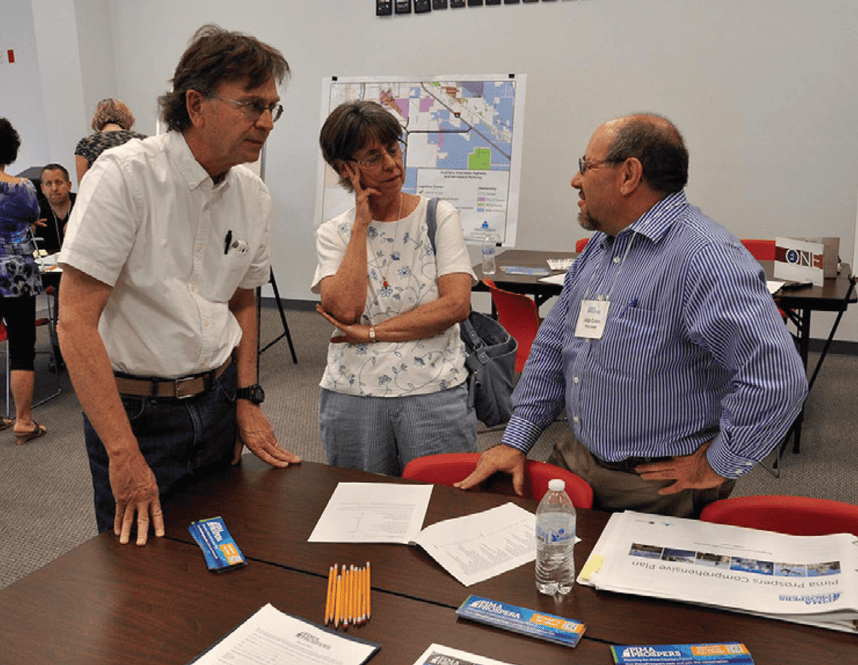
The Public Participation Plan anticipates public meetings, strategy workshops and community conversations, providing many opportunities for
public input both in person and virtual. These include:
• Comprehensive plan update countywide kick-off open house where county staff will explain the purpose of the plan update and solicit comment about strengths and weaknesses in the current plan
• Geographically focused public workshops and community conversations hosted at libraries, community centers, other public venues and virtually during the plan update process, concentrating on unincorporated and rural communities in the county (e.g. Ajo, Catalina, Summerhaven, Green Valley, Vail/Corona de Tucson, Three Points/Arivaca, Picture Rocks/Avra Valley)
• Issue-driven strategy workshops with University of Arizona Subject Matter Experts (SMEs) and key stakeholders to review and discuss recommendations for plan update policies and implementation actions
Public libraries are a traditional repository for information on major planning processes throughout the county, and this Public Participation Plan
assumes the same. For disadvantaged populations, libraries provide equal access to the internet and the online plan update landing page, to review draft and final documents and provide comments. Libraries, community centers and other public venues also serve as meeting places to discuss the plan update and aspects of the process.
State-required sixty-day agency review will transmit the draft comprehensive plan update to the following entities for their review and comment:
• Pima County Board of Supervisors
• Each incorporated municipality in Pima County
• Every other county contiguous to Pima County
• Pima Association of Governments, the regional county planning authority
• Arizona Commerce Authority (or as designated by the State of Arizona)
• Arizona Department of Water Resources for review of the water resources element
• DMAFB, for territory in the vicinity of a military airport, per ARS §28-8461
• Arizona Attorney General, due to DMAFB high noise/accident potential zones
• Any person or group that requests a copy of the draft plan update
Prior to the required public hearings (below), comments received from the public and stakeholder groups during the plan update and following the sixty-day review will be collected, collated and made part of the public record, noting which comments were considered for making proposed policy or implementation changes, and which were not used with a brief explanation as to why.
Public Hearings provide opportunities for oral and written comments for modifications to the draft plan update.
The Pima County Planning and Zoning Commission (commission) is required by law to hold at least one public hearing on the plan update following the sixty-day review period; however, additional hearings may be held, including informational study sessions brought by county staff. The commission makes a recommendation to the Board of Supervisors after reviewing the draft plan update, input from the public hearing, and sixty-day comment summary received prior to the hearing. The Pima County Board of Supervisors (board) is legally required to hold at least two public hearings regarding the plan update. At the first public hearing, the commission transmits their recommended draft of the comprehensive plan to the board for public review and consideration. At the second public hearing, the board receives the final draft plan update with the commission’s recommendation, updated public comments, and additional comments prior to or during the hearing itself. The board may adopt and approve, at their discretion, the final plan update at the second hearing.
Stakeholders
A list of stakeholders, both external and internal to Pima County, will be compiled to target outreach efforts, which will include plan update events or
public meetings in various county sub-regions and communities, all county-wide events, meetings and hearings. Stakeholder groups will include neighborhoods, business or trade groups, and social service entities. The following stakeholder groups will play significant contributing roles in the preparation of the comprehensive plan:
Arizona state agencies (Commerce Authority, Department of Water Resources, Attorney General) and local jurisdictions (incorporated cities and towns
within the county, adjacent counties) are transmitted the plan update during the sixty-day review period for review and comment. County staff has contact with adjoining county planning departments and regular coordination with incorporated communities in the county, and will involve other jurisdictions in the plan update process as required by statute. Local jurisdictions are also required by state statute to update their general plans for a targeted mid-2025 draft completion date, and county staff may coordinate with these jurisdictions on regional planning update issues.
Public land management agencies will be provided opportunities for comment and review at all stages of the planning process, to align with their planning efforts building a comprehensive plan that can be implemented and function regionally. These will include Arizona State Land Department (ASLD), federal land management agencies (Bureau of Land Management, National Park Service, USDA-Forest Service, US Fish & Wildlife Service), Arizona Board of Regents (University of Arizona), DMAFB, and Tucson Airport Authority. The Pascua Yaqui Tribe and Tohono O’odham Nation are not directly governed by county land use policy. However, plan policies may directly or indirectly affect their adjacent lands or delivery of services, or on lands not yet brought into the US Land Trust held for each tribal nation. County staff will also communicate with tribal planning staffs. State statute requires coordination with ASLD’s production of a conceptual land use plan for its lands held in trust for beneficiaries of the State Land Trust. If ASLD proceeds with a conceptual plan, staff will work to coordinate planning efforts; otherwise, staff will keep ASLD informed and offer opportunities to participate in the county comprehensive plan update process. Staff maintains an up-to-date contact list of public land managers and is in contact regularly via email to solicit comments for long-range and current planning cases in proximity to their land base. Staff will use the same process to keep land managers appraised of the plan update process; the County Administrator Liaison also maintains regular contact with a number of these stakeholders, namely DMAFB and ASLD.
Public and private utility providers, school districts, and fire, police and emergency responders provide vital public services that help maintain a healthy community and will have opportunities to provide comment and review at all stages of the planning process. Of these, water and electric providers’ input will be invaluable: water and energy are two required elements in the comprehensive plan, and regional water supply will be one of the critical topics in the plan update. County staff will mainly concentrate on outreach to water providers with an “assured” or “adequate” water supply designation from Arizona Department of Water Resources (e.g. Metropolitan Water, Tucson Water, Vail, Flowing Wells, etc.).
County staff has regular contact with various other interest groups throughout the county: these include homeowners’ and neighborhood associations, land developers, builders, realtors, environmental coalitions, economic development groups, and chambers of commerce. In addition, there are groups organized for unincorporated communities (Green Valley, Ajo, Flowing Wells, Summerhaven), general geographic areas (Picture Rocks, Tucson Mountains, Tanque Verde, Vail) and rural areas such as Three Points, Arivaca, and Catalina whose input would be of value. County supervisors and their staffs have requested these groups be included as part of stakeholder outreach for the plan update.
Residents, businesses and landowners make up the largest stakeholder group for the plan update – this will also be the stakeholder group that will
be most difficult to access. The 2015 plan update included online, printed and in-person (public meetings) contacts as a means to disseminate information and solicit comments from the public. Staff will likely offer hybrid in-person/online meetings for the public. County supervisors have requested in-person informational meetings for a number of regional community groups, and the proposed kick-off meeting, and public hearings before the commission and board should provide additional opportunities for the public to comment on the plan update.
Planning Team
The Planning Team will meet on a regular basis to monitor participation plan progress, identify strategic issues associated with development of the plan update, and ensure that project goals and objectives are addressed in an appropriate and timely manner. The main Planning Team for the plan update and public participation activities will be comprised of staff of the Planning Division of the Development Services Department; the Communications Department will also be a key participant in various modes of community outreach and public participation. However, much of the comprehensive plan update input and content will be generated by citizens, property owners, county staff, SMEs and stakeholder groups.
Stay Informed
Get notified on upcoming engagements and the latest project related news.