
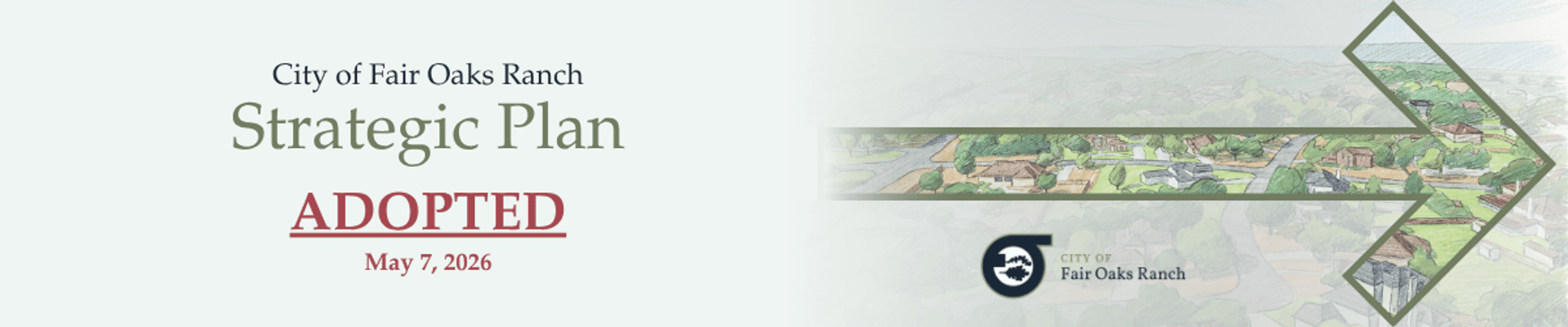
2026 Strategic Plan
The plan is adopted
On May 7, 2026, the Fair Oaks Ranch City Council unanimously adopted the 2026 Strategic Plan by Resolution 2026-31. The plan reflects more than five months of work, three community-wide surveys, public meetings, and stakeholder workshops — and it directly incorporates what residents told the City through this engagement process.
Across all three "Shape the Future of Fair Oaks Ranch Together" surveys, residents submitted more than 6,600 individual data points. Survey #3, summarized here, was the final round of community input before the plan went to Council.
Read the full plan here
The plan at a glance
The adopted Strategic Plan is built around the City's vision — "the ideal place to call home in the Hill Country" — and is organized into six priority areas:
Financial Stewardship — long-range financial planning and sustainable revenue strategies
Responsible Growth Management — disciplined adherence to long-range plans and protection of community character
Reliable Infrastructure — water, wastewater, drainage, roads, and City facilities
Public Safety — responsive policing, dependable Fire/EMS, and emergency preparedness
Operational Excellence — workforce, technology, transparency, and regional partnerships
Community Engagement — expanded participation, communication, and resident leadership
Each priority is supported by defined goals and measurable objectives, and the full plan can be found at:
What Survey #3 told us
The third survey drew more than 3,000 individual data points. Responses came from across every adult age group, with the strongest participation from residents 55 and older.
How well do the goals align with residents' vision?
On a 1-to-5 scale (1 = Not Very Well, 5 = Very Well), responses skewed strongly positive:
| Rating | Responses | |
|---|---|---|
| 5 - Very Well - | 103 | |
| 4 | 81 | |
| 3 | 77 | |
| 2 | 10 | |
| 1 - Not Very Well - | 1 |
Roughly two-thirds of respondents rated alignment a 4 or 5, with only 11 rating it below the midpoint. This is a strong vote of confidence in the direction Council ultimately adopted.
How well has the City kept residents informed?
The same 1-to-5 scale, with noticeably more spread:
| Rating | Responses | |
|---|---|---|
| 5 - Very Well - | 81 | |
| 4 | 65 | |
| 3 | 88 | |
| 2 | 32 | |
| 1 - Not Very Well - | 6 |
Sentiment is still net positive, but the middle and lower end carry more weight. About 38 respondents rated communication a 1 or 2, and the largest single group landed in the middle at "3."
What residents prioritized most
Respondents ranked their top five goals from a list of nineteen. Sorted by score, the top priorities were:
- Ensure reliable water infrastructure and regulatory compliance.
- Ensure reliable Fire and EMS services .
- Maintain a safe community with high resident confidence in public safety services.
- Ensure growth is guided by long-range plans and the community's voice through disciplined, proactive planning and consistent policy adherence.
- Protect natural resources and promote sustainable development.
The pattern is clear: core services and infrastructure reliability come first — water, public safety, and disciplined growth management — followed by stewardship of the natural character that defines Fair Oaks Ranch. These resident priorities map directly to Goals 3.1, 4.2, 4.1, 2.2, and 2.1 in the adopted plan.
Themes from written comments — and how the plan responds
More than 100 residents left open-ended feedback. A few themes came up again and again, and most are addressed by specific objectives in the adopted plan.
Water as the defining long-term issue. Residents repeatedly named water supply, conservation, rates, and dependence on Canyon Lake as their single biggest concern. Several asked the City to explore rainwater catchment options, offer rebates for residential systems, or balance growth with the city’s water supplies.
- The plan addresses this through Goal 2.1 (water conservation incentives, expanded public education, drought contingency plan evaluation) and Goal 3.1 (priority water capital improvement projects, structured valve exercising, asset inventory and lifecycle replacement).
Growth and development — slow it down, plan it carefully. Community feedback reflected strong support for maintaining the City’s low-density, residential character while allowing targeted, small-scale commercial development that complements the community and enhances quality of life. Residents expressed concern about higher-intensity commercial expansion and multi-family housing due to potential impacts on traffic, infrastructure, water demand, and overall community identity.
- The plan addresses this through Goal 2.2, which calls for updating the Comprehensive Plan and supporting master plans for transportation, drainage, fire/EMS, facilities, water and wastewater — and through Goal 2.3, which ties commercial development to community character via market analysis and partnership with the Municipal Development District.
Public safety as a foundation, not a goal. Many respondents described police, fire, and EMS as the bedrock that makes everything else possible.
- The plan addresses this through Goals 4.1, 4.2, and 4.3 — covering public safety staffing, community outreach, Fire/EMS contract performance, a long-term standard of cover plan, and a Continuity of Operations Plan.
Natural character and trees. Residents asked the City to prioritize oak preservation (with several specifically calling out Oak Wilt), trails, parks, and the hill country landscape.
- The plan addresses this directly through Goal 2.1, which calls for evaluating and improving the Oak Wilt program, evaluating a tree-planting rebate, and inventorying the City's tree canopy.
Communication effectiveness — the most common theme, with mixed sentiment. Many residents praised the City's outreach: emails, City Manager reports, multiple input opportunities, town halls, and the website. Others said they only learn about issues secondhand, find the website hard to navigate, or feel decisions are made before the public weighs in.
- The plan addresses this through Goal 5.2 (expanded online public records, digital services, and ADA website compliance by April 26, 2028) and Goal 6.1 (increased resident participation through surveys, micro polls, forums, advisory groups, the Citizen Leadership Academy, and expanded storytelling).
Spending and transparency. A recurring critique: Too much money on what residents view as non-essential projects— residents sometimes learn about projects after decisions appear final, without a clear understanding of why a project was prioritized, what it costs, or what benefit it delivers.
- The plan addresses both halves of this concern. Goal 1.1 commits the City to financial resilience, utility rates that support operations, and a modern ERP system that improves how the City tracks and reports on its finances. Goal 5.2 expands online public records access and digital services, and Goal 6.1 is built around closing the information gap before decisions are made — through earlier and more frequent resident input (surveys, micro polls, forums, advisory groups), expanded storytelling and digital outreach.
What happens next
With the plan adopted, the work shifts from listening to doing. Each goal in the plan has defined objectives that City staff will now build into work plans, budgets, and capital improvement schedules. Residents will continue to see opportunities for input — and, under Goal 6.1, can expect a repeatable resident satisfaction survey to track how the City is performing over time.
Read the plan. Stay engaged.
The 2026 Strategic Plan is your roadmap for the next three to five years — and your voice helped shape it. Here's how to stay involved:
Read the adopted plan. View the full Strategic Plan to see every priority, goal, and objective.
Sign up for City updates. Subscribe to email notifications and the City Manager's reports to get the latest on projects, meetings, and decisions before they happen — not after. Sign up here
Attend a Council meeting. Council meetings are open to the public, and public comment is welcome. Agendas are posted in advance on the City website.
Watch for the Citizen Leadership Academy. Launching as part of the new plan, the Academy will give residents a deeper look at how the City works and how to get involved in shaping it.
Keep the feedback coming. Surveys, micro polls, forums, and advisory groups are all part of the new engagement playbook. When the next opportunity comes around, take five minutes — it makes a difference.
Have a question or comment right now? Contact City Hall or visit the City's website to find your point of contact.