
Gypsy, Travellers and Travelling Showpeople Supporting Paper
This is a HTML friendly version of the gypsy, traveller and travelling showpeople supporting paper.
Leeds Local Plan
Title
LEEDS LOCAL PLAN (2024 to 2042)
Gypsy And Traveller And Showpeople Supporting Paper
Regulation 18 Consultation
June 2025
INTRODUCTION
This supporting paper seeks to provide evidence, supporting information and justification for the preferred Gypsy and Traveller (G&T) and Showpeople planning policy approach in the new Leeds Local Plan.
This paper sets out existing national and local policy and guidance which supports the Council’s approach, whilst also identifying any alternative approaches and planning mechanisms to deliver G&T pitches and Showpeople plots needed in Leeds.
WHY IS IT NEEDED?
NATIONAL CONTEXT
Local authorities have been required to assess and identify sites for the accommodation of G&T in their development plans (Local Plans) since 1994. From 2016, the Housing and Planning Act (section 124) requires Councils to consider the needs of people residing in or resorting to their district in respect of caravan sites and houseboats (which includes Romany Gypsies, Irish Travellers and Travelling Showpeople)
From 2015, the National Planning Policy Framework (NPPF) refers to the Planning Policy for Traveller Sites (PPTS), which sets out that the Government’s overarching aim is to ensure that there is fair and equal treatment for travellers, in a way that facilitates the traditional and nomadic way of life of travellers while respecting the interests of the settled community
The PPTS also sets out what local authorities should include in their Local Plans . The following paragraphs from the PPTS are relevant:
3. The Government’s overarching aim is to ensure fair and equal treatment for travellers, in a way that facilitates the traditional and nomadic way of life of travellers while respecting the interests of the settled community.
4. To help achieve this, Government’s aims in respect of traveller sites are:
- that local planning authorities should make their own assessment of need for the purposes of planning
- to ensure that local planning authorities, working collaboratively, develop fair and effective strategies to meet need through the identification of land for sites
- to encourage local planning authorities to plan for sites over a reasonable timescale
- that plan-making and decision-taking should protect Green Belt from inappropriate development
- to promote more private traveller site provision while recognising that there will always be those travellers who cannot provide their own sites
- that plan-making and decision-taking should aim to reduce the number of unauthorised developments and encampments and make enforcement more effective
- for local planning authorities to ensure that their Local Plan includes fair, realistic and inclusive policies
- to increase the number of traveller sites in appropriate locations with planning permission, to address under provision and maintain an appropriate level of supply
- to reduce tensions between settled and traveller communities in plan-making and planning decisions
- to enable provision of suitable accommodation from which travellers can access education, health, welfare and employment infrastructure
- for local planning authorities to have due regard to the protection of local amenity and local environment
For local authorities seeking to develop their evidence base for new planning policies, it states that:
7. In assembling the evidence base necessary to support their planning approach, local planning authorities should:
- pay particular attention to early and effective community engagement with both settled and traveller communities (including discussing travellers’ accommodation needs with travellers themselves, their representative bodies and local support groups)
- cooperate with travellers, their representative bodies and local support groups; other local authorities and relevant interest groups to prepare and maintain an up to-date understanding of the likely permanent and transit accommodation needs of their areas over the lifespan of their development plan, working collaboratively with neighbouring local planning authorities
- use a robust evidence base to establish accommodation needs to inform the preparation of local plans and make planning decisions
For plan making:
10. Local planning authorities should, in producing their Local Plan:
- identify and update annually, a supply of specific deliverable sites sufficient to provide 5 years’ worth of sites against their locally set targets
- identify a supply of specific, developable sites, or broad locations for growth, for years 6 to 10 and, where possible, for years 11-15
- consider production of joint development plans that set targets on a cross-authority basis, to provide more flexibility in identifying sites, particularly if a local planning authority has special or strict planning constraints across its area (local planning authorities have a duty to cooperate on planning issues that cross administrative boundaries)
- relate the number of pitches or plots to the circumstances of the specific size and location of the site and the surrounding population’s size and density
- protect local amenity and environment.
In conclusion, the PPTS requires local authorities to identify the needs of its G&T and Showpeople population in the same way that it would identify and plan for traditional housing.
LOCAL CONTEXT
The Council aims to ensure that every person and family in Leeds has some where safe and pleasant to live, and this includes the members of the Gypsy and Traveller and Showperson community. In order to achieve this we need to understand what the community needs, where new sites should be located and what they should look like. For housing purposes, the Council has a statutory duty (section 225 of the 2004 Housing Act) to carry out an assessment of Gypsy and Traveller (G&T) housing need.
A G&T plan review is also required due to SAP Policy HGR2. It states that:
THE SITE ALLOCATIONS PLAN WILL BE MONITORED AND SUBJECT TO A REVIEW DURING THE PLAN PERIOD, AS FOLLOWS:
1. MONITOR THE NUMBER OF PERMISSIONS FOR GYPSY AND TRAVELLER SITES GRANTED BY CORE STRATEGY POLICY H7 AND SAFEGUARDED THROUGH POLICY HG6(2),
2. ADOPT A PLAN REVIEW OF SITES FOR GYPSIES AND TRAVELLERS AGAINST CORE STRATEGY NEEDS IN POLICY H7 FOR PRIVATE AND PUBLIC PROVISION SHOULD THE QUANTUM OF SUCH SITES BE LESS THAN 13 AS AT 31st MARCH 2023
As the Council has not delivered 13 G&T sites through planning approvals by the 31st of March 2023, a G&T Local Plan and policy is required by Policy HGR2.
Identifying and meeting the local need for pitches and plots not only helps the G&T and Showpeople community, but helps the Council control the locations of pitches and save money by not having to spend money on roadside encampments due to clean up costs and providing amenities.
WHAT IS IT SEEKING TO ACHIEVE?
The new Leeds Local Plan has 35 objectives, of which objectives 4, 7 and 21 are relevant to G&T and Showpoeple planning policies.
OBJECTIVE | HOW G&T and SHOWPEOPLE POLICY WILL HELP ACHIEVE THIS OBJECTIVE |
4.Deliver permanent pitches for Gypsies and Travellers to meet their needs in suitable locations, alongside provision for negotiated stopping pitches for travelling families | Any new policy will directly address this objective, by aiding in the delivery of pitches in appropriate locations. This will be an evidence led policy, with an updated needs assessment dictating the number of pitches required to be planned for. Negotiated stopping protocol will be reviewed as part of this process, to ensure that the needs for Leeds families travelling around Leeds are also met. The Council will also directly local showpeople to understand whether extra plots are required. |
7. Deliver housing, in the right places, to maximise the benefits of investment, and realise opportunities for positive local change and respond to environmental constraints. | Any planning policy will contain criteria to help determine planning application for new pitches and plots are delivered in appropriate locations. The same criteria will also help allocate sites for pitch and plot delivery. |
21. Focus the majority of new homes in complete, compact and connected places where people have opportunities to walk or wheel between homes, shops, services and green spaces. | Whilst it is understood some member of the G&T community have preferences for rural living, it is important to deliver a wide range of sites and pitches in locations that are sustainable and accessible to local services, as would be expected for the deliver of bricks and mortar housing. |
POLICY APPROACH
PREFERRED APPROACH
The bare minimum approach would be to update the current polices within the plan with up-to-date evidence through the needs assessment. This would include updating need and re-assessing allocations and safeguarded land whilst re-appraising our approach to negotiated stopping.
The preferred approach is to do the above whilst addressing the barriers to delivering pitches (public, private and transient) experienced over the last plan period. This would involve exploring the delivery of pitches as part of mixed use developments. It would also require an update of the negotiated stopping strategy and consideration of more permanent transient sites
As it may be the case that the Council cannot identify enough pitches to meet the identified need, and the required quantum of private sites are not being submitted through call for sites process, mixed use allocations (alongside bricks and mortar residential) may be a solution. This approach would need to consider:
- whether it would be a requirement for all sites of certain sizes, or if we identify appropriate sites (with consultation with the G&T community). If we identify sites, then site requirements can be added that ensures early engagement with the G&T community and good master planning. G&T design guide can influence design and master planning principles.
- Pitches on mixed use employment sites as well as housing.
- Would increase the number of residential sites being needed to meet housing need as land would be taken up by pitches?
- Delivery of G&T pitches versus affordable housing on site? May have to prioritise one over the other on certain sites?
- If we include an offsite contribution clause, then we may need to evidence where commuted sums will be spent, which would require individual site allocations.
ALTERNATIVE APPROACHES
Reliance upon the NPPF and the Planning Policy for Traveller Sites (PPTS) for pitch delivery and meeting local needs would result in the Council having no control over the location and delivery of new G&T and Showperson pitches. It would also stymie the delivery of public owned pitches if none are identified. The Council do not see this as a reasonable alternative and therefore there are no reasonable alternatives to assess.
IS IT JUSTIFIED BY THE EVIDENCE?
HEALTH AND LIFESTYLE EVIDENCE
It is generally accepted that the Gypsy and Traveller communities experience the negative effects of health inequalities more so than the rest of the UK population. Data taken from the latest Census shows that both nationally and locally in Leeds, the Gypsy/Irish traveller community has a higher percentage of those found within the general health category of ‘bad’ (9% nationally and 6% locally) and ‘very bad’ (4% nationally and 3% locally).
Table 1General Health Census Data for the Gypsy and Irish traveller community compared to national levels
Area name | General health category | Gypsy or | Overall population count% |
England and Wales | Very Good | 45% | 48% |
England and Wales | Good | 27% | 34% |
England and Wales | Fair | 15% | 13% |
England and Wales | Bad | 9% | 4% |
England and Wales | Very Bad | 4% | 1% |
100% | 100 | ||
Leeds | Very Good | 51% | 50% |
Leeds | Good | 28% | 33% |
Leeds | Fair | 11% | 12% |
Leeds | Bad | 6% | 4% |
Leeds | Very Bad | 3% | 1% |
100 | 100 | ||
The “Health inequalities experienced by Gypsy, Roma and Traveller communities” briefing[1] prepared by the Friends, Families and Travellers group details health inequalities faced by the community:
- “Romany and Traveller people face life expectancies between ten and 25 years shorter than the general population.
- Romany and Traveller people experience significantly higher prevalence of long-term illness, health problems or disabilities, which limit daily activities or work.
- The health of a Romany or Traveller person in their 60s is comparable to an average White British person in their 80s.
- An All Ireland study found that suicide prevalence is six times higher for Irish Traveller women than women in the general population, and seven times higher for Traveller men.
- 60% of Roma Support Group’s migrant Roma beneficiaries are reported to have poor physical health, with 43% of Roma beneficiaries of the above reported to suffer from poor mental health.”
A briefing prepared by the Traveller Movement, which was titled “Making sense of the Census 2021 for the outcomes and experiences of Gypsy, Roma and Traveller people June 2023[2]” also provides a summary of health data research that concludes that within the Gypsy, Roma, and Traveller communities:
- “The health status of Gypsies and Travellers is much poorer than that of the general population
- Life expectancy for Gypsy, Roma, and Traveller communities is between 10-12 years lower than that of the general population
- One in five Gypsy and Traveller women will experience the loss of a child, compared with one in one hundred in the general population
- The suicide rate in Gypsy and Irish Traveller communities is approximately 6 times higher than in the general population”
The same briefing also highlights the difference in educational attainment between the G&T community and white British census subset:
Table 2: Educational Attainment figures comparing the G&T community to White British
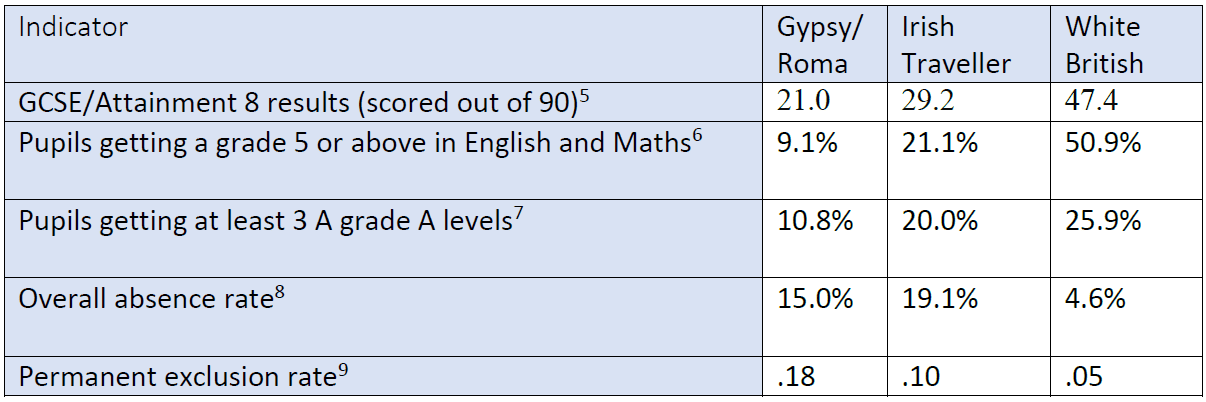
As the figures above demonstrate, the Gypsy, Roma and Traveller community generally receive lower grades than white British students whilst also experience a much higher absence rate.
As detailed above, the G&T community are seen to have worse health outcomes when compared to the general population. It is also seen that they have worse educational outcomes, with worse grades and more absences than their white British colleagues. A lack of a permanent address can result in more difficulties accessing healthcare services, whilst not having a permanent location to stay whilst not travelling can result in children lacking a permanent and stable school to attend. Ultimately, a lack of permanent sites and pitches for the G&T community will only exacerbate these issues and this reinforces the importance of the Council adequately planning and delivering their needs for sites.
HISTORY OF UNMET NEED
Leeds City Council (LCC) identified the need for 62 pitches for Gypsy and Travellers (G&T) through Core Strategy Policy H7 (2014). The Site Allocations Plan identified 49 of those pitches through safeguarding existing sites, new allocations and our negotiated stopping strategy. Upon adoption of the Site Allocations Plan G&T Policies in July 2019 the Council had a 5 year supply of G&T pitches, and a supply of pitches for years 6 to 10 of the plan. This approach was found sound by the inspector and in line with national guidance (PPTS paragraph 10a and b). The Council acknowledged that it did not have enough pitches for the whole plan period up to 2028 and included policy HGR2 within the SAP which requires a plan review of sites if 13 private pitches have not been delivered by March 2023.
From adoption of the SAP in July 2019, the Council has not approved any new permanent private or public G&T pitches and therefore the Council currently (2023/2024) has a G&T 5 year supply position of 2.3 years (Appendix 1). The lack of delivery has largely been a result of a lack of funding available to deliver the 17 identified public pitches within the plan and private applications predominantly coming forward within the Green Belt and protected green spaces. There is also a long waiting list for pitches on existing G&T sites at Kidacre Street and Cottingley Springs. Following an appeal (APP/N4720/W/24/3347444), a G&T pitch in Kippax was granted temporary approval after the application was refused at plans panel due to its location upon designated local green space. The Inspector concluded that Council’s supply position was ‘very significant’, ‘there is a clear lack of pitches for Gypsies and Travellers in the Council area’ and ‘lack of pitch provision in the Council area is stark’. The Council’s most up to date supply position and list of known sites can be found within Appendix 1 and Appendix 2 of this paper.
In conclusion, since adoption of the SAP, the Council has struggled to maintain a 5 year supply of pitches and meet the need identified through the Core Strategy. Whilst the Council’s updated needs assessment has yet to be completed, it is an almost certainty that the Council will have to identify and plan for numerous new G&T pitches. Therefore, the policy approaches set out within this document consider that a significant number of new pitches will need to be delivered and that the historical barriers to delivery (such as lack of funding for public sites and Geen Belt restrictions for private sites) remain.
With regards to Showpeople, the Council met it’s identified need through Site Allocations Plan. Whilst delivery of the site at Phoenix Avenue, Mickelfield (SAP Site HG8 – 6 plots) has stalled, the Council still believe that the site is suitable and available for a Showpeople site.
Further details of the Council’s historical delivery can be found within the Authority Monitoring Report and Sustainability Appraisal Baseline report[3].
UPDATED NEEDS ASSESSMENT METHODOLOGY
LEEDS GATE ASSESSMENT
The Council needs to ensure that every person and family in Leeds’ has some where safe and pleasant to live, and this includes the members of the Gypsy and Traveller and Showperson community. To positively and accurately understand how many sites and pitches are needed in Leeds up to 2042, the Council needs to calculate that need using demographic projections and understand the current conditions on existing sites and pitches. Many local authorities either calculate this themselves or use external consultants, however Leeds Council have a good relationship with a local charity called the Leeds Gypsy and Traveller Exchange (Leeds GATE) who have agreed to conduct part of the needs assessment themselves.
An accurate needs assessment requires a close relationship with the G&T community in order to understand their true needs. This is often done through direct contact with the community. Unfortunately, there is often distrust within the G&T community and their local authorities, so collecting accurate information can at times be difficult. Leeds GATE are a longstanding and experienced charity found within Leeds who have the ability to work and contact the existing G&T community, and are therefore the most appropriate organisation to contract for this type of assessment. Leeds City Council have had a positive history of working with Leeds GATE on projects, which has been recognised nationally as good practice, and the previous needs assessment for the Core Strategy (2014) was also done with GATE’s cooperation.
For housing purposes the Council has a statutory duty (section 225 of the 2004 Housing Act) to carry out an assessment of Gypsy and Traveller (G&T) housing need. The National Planning Policy Framework (NPPF) states that the Planning Policy for Traveller Sites (PPTS) sets out how travellers’ housing needs should be assessed. Paragraphs 7 and 10 of the PPTS set out requirements for policies within the Local Plan and this is the basis for understanding what a needs assessment will be required to calculate as there is no nationally published guidance. The needs requirement for the Core Strategy figure was found to be sound and acceptable, and that was a joint operation between the Council and Leeds GATE. Therefore, it is seen as appropriate to work with Leeds GATE once again to produce a needs assessment.
Leeds GATE are a charity found in Leeds and are a grassroots organisation led by Gypsy and Traveller people in partnership with others in and across West Yorkshire. Throughout the last 20 years of operation, Leeds GATE has a demonstrated an award-winning track record of community activism, social action and member led innovation. Their access and trust to the Leeds G&T community is unparalleled and often attempts to consult by Local Authorities or private organisations can be difficult due to distrust found within the community. Therefore to ensure the most accurate information is collected through the needs assessment, Leeds GATE’s ability to communicate and provide outreach with Leeds’ G&T community is of vital importance. It should also be noted that the relationship, and projects delivered, between LCC and Leeds GATE has been noted nationally as an example of good practice by “Kicking the can down the road: New report on site provision over the past 60 years[4]”.
Initial meetings between LCC and Leeds GATE have resulted in the following needs assessment requirements for which they will be procured for:
- Home visits for those living on existing private yards/pitches
- Facilitated group sessions
- Outreach on existing LCC owned G&T sites and pitches
- Lee Gap Fair consultation event
- Evening consultation event
- Roadside families outreach
- Telephone Outreach
The Council will use GATE’s assessment to corroborate and check against a needs figure calculated using demographic changes and considering the previous Local Plan’s unmet need. Further details on this can be found below. The Leeds GATE needs assessment will result in an accurate G&T needs assessment which will help the Council understand the number of pitches required to deliver through the plan period (up to 2042). The new Leeds Local Plan can then provide the planning policies and allocations to adequately deliver that need, resulting in the delivery of quality G&T pitches in the right places and ensuring a positive outcome for Leeds’ G&T community.
LEEDS COUNCIL ASSESSMENT
As stated above, the needs assessment for G&T pitches will be the result of a joint approach between the Council and Leeds GATE. Leeds GATE’s assessment will help provide accuracy and sense check the needs figure produced by the Council. The Council’s need figure will be calculated using the following methodology:
- Leeds City Council Waiting List for pitches. This includes those doubling up on existing pitches, those who may be roadside or those from outside the district needing a Council owned pitch in Leeds.
- Existing sites that have been subject to a planning decision that was either refused or granted temporary permission.
- Re-assessing unmet need carried over from the Core Strategy and Site Allocations Plan allocations.
- The need created from those requiring negotiated stopping pitches (one household per pitch).
- The needs created from households on existing pitches (one household per pitch).
Once completed, the Council will publish the needs assessment within the next round of public consultation alongside potential methods of pitch delivery and an assessment of sites submitted.
For Showpeople, the Council will conduct a targeted survey which will ask Leeds based Showpeople if further pitches and land is required.
SITE ASSESSMENTS
Sites are expected to be submitted through the call for sites process and those found from working within the community and the Council’s links through Leeds GATE. Currently, a high level assessment is ongoing to identify and assess sites identified at this stage of the process. A more formal site assessment methodology statement and site assessment analysis will be produced for the next round of consultation. This site assessment process will follow similar principles to the methodology for traditional housing, with an additional bespoke assessment (including permanent/negotiated stopping) made for a G&T or showperson use. The pool of sites subject to assessment will be formed from:
- Call for sites process: Two sites have currently been submitted for assessment.
- Outreach events with Leeds GATE: Those within the G&T community can submit sites through GATE. Group events with Council officers can also be used to find and identify potential land for pitches.
- Internal Council owned land search: Working in conjunction with the Council’s Asset Management service, the Council are exploring the suitability of a wide range of sites, including land on the void list and agricultural holdings that are no longer needed.
- Re-assessment of previous allocations and safeguarded pitches: Pitches and plots allocated and safeguarded through Site Allocations Plan (SAP) policies HG6, HG7 and HG8 will be reassessed to ensure that they are still available and deliverable.
- Planning Applications: Those who have submitted planning applications that have been granted temporary planning approval or refused will be surveyed as part of the needs assessment. They will also be asked whether they would want their site formally submitted and assessed through the site assessment process.
HOW WILL IT HELP DELIVER THE COUNCIL'S CORPORATE STRATEGY?
Ensuring that the new Leeds Local Plan delivers sufficient G&T sites and pitches of the right quality in the right places helps meet all 3 of the Council’s pillars. It would Improve the health and wellbeing of the G&T community by providing safe (and well designed) places to live and promote inclusive growth by helping improve and provide places to live for a marginalised community. It would also help deliver the key 5 outcomes of the Health and Wellbeing Strategy for the G&T community
Any proposed G&T policy that will identify and deliver pitches will help meet the Council’s goals and objectives in the following ways:
LEEDS BEST CITY AMBITION:
- Improve the health and wellbeing of the G&T community by providing safe (and well designed) places to live
- Promote inclusive growth by helping improve and provide places to live for a marginalised community.
CHILDREN AND YOUNG PEOPLE’S PLAN:
- Allocation and delivery of G&T sites and pitches will help children within that community feel more safe from harm (no longer have to live roadside), have access to education, have more chance at a health lifestyle and have more fun by living within a community.
HEALTH AND WELLBEING STRATEGY:
- By providing the G&T community places to live, it would help deliver the key 5 outcomes of the Health and Wellbeing Strategy.
HOW ARE WE GOING TO MEASURE THE IMPACT?
Presently, the current G&T and Showpeople planning policy impact is published in the Authority Monitoring Report annually. The up to date 5 years land supply position is published alongside delivered pitches and plots. This evidence is vital for both applicants and planning officers in making planning decisions, and therefore it is envisioned that the monitoring will continue to take place in this format.
Once any policy Is adopted, there are also Council working groups that can monitor delivery of sites and aim to overcome any potential obstacles to delivery. These are an internal site delivery team and external Council Member led working group with local G&T community stakeholders attending.
If the Council fails to identify enough sites to deliver the amount of pitches and plots needed within the plan period, a policy requiring a plan review (such as SAP Policy HGR2) may need to be considered.
HOW WILL IT BE IMPLEMENTED?
The policy will be used to assess planning applications for G&T pitches and Showpeople plots. It will also identify the number of pitches and plots required over the plan period, which can hold material weight in planning applications if the Council fails to maintain a 5 year supply of pitches.
EQUALITY, DIVERSITY, COHESION AND INTEGRATION
The Public Sector Equality Duty (Equality Act 2010) requires, in the exercise of its functions, have due regard to the need to—
- eliminate discrimination, harassment, victimisation and any other conduct that is prohibited by or under this Act;
- advance equality of opportunity between persons who share a relevant protected characteristic and persons who do not share it;
- foster good relations between persons who share a relevant protected characteristic and persons who do not share it.
The Equality Act proceeds to state that:
Having due regard to the need to advance equality of opportunity between persons who share a relevant protected characteristic and persons who do not share it involves having due regard, in particular, to the need to—
(a)remove or minimise disadvantages suffered by persons who share a relevant protected characteristic that are connected to that characteristic;
(b)take steps to meet the needs of persons who share a relevant protected characteristic that are different from the needs of persons who do not share it;
(c)encourage persons who share a relevant protected characteristic to participate in public life or in any other activity in which participation by such persons is disproportionately low.
Romany Gypsies and Irish and Scottish Travellers are recognised ethnic minorities for the purpose of the Public Sector Equality Duty, and as set out within the evidence section of this paper, the inequalities faced by this community are often a consequence of a lack or permanent and secure accommodation. Therefore it is vital that the Council identify suitable land and sites to meet the needs of the community in order to help address those inequalities
APPENDIX 1: 5 YEAR SUPPLY POSITION 23/24
SAP Ref | Address | Status | No of pitches (towards supply only) |
| Council | Private | 18/19 (delivered prior to SAP) | 19/20 (SAP ADOPTION) | 20/21 | 21/22 | 22/23 | 23/24 | 24/25 | 25/26 | 26/27 | 27/28 | 28/29 |
HG6-1 | Cottingley Springs (expansion) | Allocation | 2 | X | 0 | 0 | 0 | 0 | 0 | 0 | 0 | 2 | 0 | 0 | |||
HG6-2 | Kidacre Street | Allocation (8 pitches built) | 13 | X | 8 | 0 | 0 | 0 | 0 | 0 | 0 | 0 | 5 | 0 | |||
HG7-1 | West Wood, Morley | Allocation | 5 | X | 0 | 0 | 0 | 0 | 0 | 0 | 0 | 0 | 0 | 0 | 5 | ||
HG7-2 | Tong Road, Wortley | Allocation | 5 | X | 0 | 0 | 0 | 0 | 0 | 0 | 0 | 5 | 0 | 0 | |||
HG6-4 | Nepshaw Lane | Allocation (1 existing pitch tolerated) | 1 | X | 0 | 1 | 0 | 0 | 0 | 0 | 0 | 0 | 0 | 0 | |||
HG6-9 | Dunningley Lane | Allocation (2 existing pitches tolerated) | 2 | X | 0 | 2 | 0 | 0 | 0 | 0 | 0 | 0 | 0 | 0 | |||
HG6-11 | White Rose Farm | Allocation (2 existing pitches tolerated) | 2 | X | 0 | 2 | 0 | 0 | 0 | 0 | 0 | 0 | 0 | 0 | |||
HG6-12 | Scarecrow Farm | Allocation (1 existing pitch tolerated) | 1 | X | 0 | 1 | 0 | 0 | 0 | 0 | 0 | 0 | 0 | 0 | |||
HG6-13 | Urn Farm | Allocation (2 existing pitches tolerated) | 4 | X | 0 | 2 | 0 | 0 | 0 | 0 | 0 | 2 | 0 | 0 | |||
HG6-15 | Thorpe Lane West | Allocation (2 existing pitches tolerated) | 2 | X | 0 | 2 | 0 | 0 | 0 | 0 | 0 | 0 | 0 | 0 | |||
HG6-16 | Thorpe Lane East | Allocation (1 existing pitch tolerated) | 2 | X | 0 | 1 | 0 | 0 | 0 | 0 | 0 | 1 | 0 | 0 | |||
N/A | Land off Hollinhurst | Planning Permission | 1 | X | 1 | 0 | 0 | 0 | 0 | 0 | 0 | 0 | 0 | 0 | |||
Total |
| 40 |
|
|
| 9 | 11 | 0 | 0 | 0 | 0 | 0 | 10 | 5 | 0 | 5 |
5 YEAR SUPPLY POSITION | ||||
PUBLIC AND PRIVATE | ||||
Pitch requirement* | 53 | |||
Pitches delivered (2012 - 2023) | 20 | |||
Remaining pitch requirement | 33 | PUBLIC AND PRIVATE | ||
Remaining years of the Plan | 5 | EQUIVALENT SUPPLY | ||
Pitch requirement per year | 6.6 | PITCHES INC. | 15 | |
5yr requirement | 33 | YEAR SUPPLY | 2.3 | |
*Does not include negotiated stopping requirement (9 pitches)
APPENDIX 2: LEEDS GYPSY AND TRAVELLER SITES: CURRENT STATUS AS OF NOVEMBER 2024
Interactive Map for sites: Leeds Site Allocations Plan - Adopted
COUNCIL OWNED/RUN SITES
SAP/PLANNING REF | ADDRESS | PITCHES TOWARDS MEETING CORE STRATEGY NEED | DELIVERED AND FURTHER DETAILS |
HG6-1 | Cottingley Springs (expansion) | 2 (41 existing pitches) | 0 |
HG6-2 | Kidacre Street | 13 | 8 (temporary planning permission for 10 years and expires in 2026) |
HG7-1 | West Wood, Morley | 5 | 0 |
HG7-2 | Tong Road, Wortley | 5 | 0 |
COUNCIL OWNED/RUN SITES: PERMANENT REPLACEMENT FOR KIDACRE STREET
SAP/PLANNING REF | ADDRESS | PITCHES | DELIVERED AND FURTHER DETAILS |
HG6-3 | Tulip Street | 8 | 0 |
PRIVATE SITES
SAP/PLANNING REF | ADDRESS | PITCHES TOWARDS MEETING CORE STRATEGY NEED | DELIVERED |
HG6-4 | Nepshaw Lane | 1 | 1 |
HG6-5 | Roseneath Place, Wortley | 0 (1 pitch on site) | 0 |
HG6-7 | Knotford Nook, Otley | 0 (1 pitch on site) | 0 (Brother of existing onsite household was looking to move onto site). |
HG6-8 | Springfield Villas, Gildersome | 0 (2 pitches on site) | 0 |
HG6-9 | Dunningley Lane | 2 | 2 |
HG6-11 | Scarecrow Farm | 2 | 2 |
HG6-12 | White Rose Farm | 1 | 1 |
HG6-13 | Urn Farm | 4 | 2 |
HG6-15 | Thorpe Lane West | 2 | 2 |
HG6-16 | Thorpe Lane East | 2 | 1 |
Land off Hollinhurst | 1 | 1 |
SITES WITH TEMPORARY PLANNING PERMISSION
SAP/PLANNING REF | ADDRESS | PITCHES TOWARDS MEETING CORE STRATEGY NEED | DELIVERED AND FURTHER DETAILS |
REDBANK STABLES, VALLEY ROAD, PUDSEY | N/A | Yes, but doesn’t count towards supply as temporary. | |
SANDGATE STABLES, KIPPAX | N/A | N/A |
PLANNING APPLICATIONS TO BE DETERMINED
SAP/PLANNING REF | ADDRESS | PITCHES TOWARDS MEETING CORE STRATEGY NEED | DELIVERED AND FURTHER DETAILS |
NINNEVAH LANE, ALLERTON BYWATER | N/A | N/A |
PLANNING APPLICATIONS REFUSED
SAP/PLANNING REF | ADDRESS | PITCHES TOWARDS MEETING CORE STRATEGY NEED | DELIVERED AND FURTHER DETAILS |
22/02121/FU | OLD TELEPHONE EXCHANGE | N/A | Application also dismissed at appeal. |
[1] Briefing: Health inequalities experienced by Gypsy, Roma and Traveller communities - Friends, Families and Travellers
Discover more

Statement of Representation
Providing details about the purpose of the consultation, how to view the material, how to submit comments, accessibility and privacy notice.

Archived 2025 Consultation Material
This is for information only

Further information
Explains the work already undertaken on the Plan and the new plan-making process

Leeds Local Plan Issues & Options Consultation Report
Summary of the Leeds Local Plan Issues & Options Consultation Summer 2025

Leeds Local Plan Scoping Consultation Document
We would like your views on which general topic areas the Leeds Local Plan should cover and how you would like to be consulted as the plan is developed.
Stay Informed
Follow our projects to get notified of upcoming engagements and the latest project related news.