
Infrastructure Supporting Paper
This is a HTML friendly version of the infrastructure supporting paper.
Leeds Local Plan
Infrastructure Supporting Paper
Introduction
The term ‘infrastructure’ has a very wide meaning and relates to all facilities and services which are necessary for successful communities to function. Infrastructure is essential to support social, economic, and environmental objectives. It includes a very wide range of aspects within transport, such as roads, railways, buses and public transport systems, cycle and pedestrian provision, parking, and less visible measures such as travel cards or real-time information. It also includes education and health facilities, greenspaces, leisure and cultural facilities, and utilities.
Infrastructure planning is an important part of local planning, ensuring that new development is supported by adequate infrastructure. Local plans incorporate infrastructure planning to address the needs of the area and guide future development. This involves identifying existing infrastructure, anticipating future needs, and developing plans for its delivery. A positive approach to infrastructure planning is proposed. This paper will set out the approach to infrastructure planning as part of the Leeds Local Plan for when development sites are identified.
New development should contribute to the provision of infrastructure, taking account of local and strategic needs and financial viability. This may be achieved on-site or off-site through planning conditions or legal agreements and/or through contributions to the Community Infrastructure Levy (CIL). However other forms of infrastructure will need a coordinated, multi partner approach as it is delivered and managed by bodies that sit outside of the Council, such as the NHS and utilities providers. This means that there are limits to how much the Council can directly control. Funding is also a key issue nationally. According to the National Infrastructure Commission (NIC) the UK is not investing enough in national infrastructure. The NIC indicates that investment needs to significantly increase to reach £70-80 billion per year in the 2030’s, up from around £55 billion per year over the last decade. This requires a substantial increase in both public and private funding.
National Planning Policy context
The National Planning Policy Framework (NPPF) (December 2024) sets out government’s planning policies for England and how these are expected to be applied. The NPPF is also a material consideration in planning decisions. It sets out requirements for engagement with infrastructure providers throughout the framework and emphasises the importance of aligning growth and infrastructure in order to achieve sustainable development (paragraph 11).
When LPAs prepare local plans, the NPPF states “Plans should: be shaped by early, proportionate and effective engagement between plan-makers and […] infrastructure providers and operators” (paragraph 16c). Paragraph 26 confirms: Effective and on-going joint working between strategic policy-making authorities and relevant bodies is integral to the production of a positively prepared and justified strategy. In particular joint working will help to determine where additional infrastructure is necessary. In relation to LPA plan-making and decision making, paragraph 129c states sets out that Planning policies and decisions should support development that makes efficient use of land, taking into account the availability and capacity of infrastructure and services both existing and proposed as well as their potential for further improvement.
In addition, the infrastructure funding statement (IFS) provides an annual overview of what infrastructure has been provided as part of the planning process in terms of planning obligations. This may be achieved on-site or off-site through planning conditions or legal agreements and/or through contributions to the Community Infrastructure Levy (CIL). An integrated approach to section 106 and CIL will be sought.
Approach to infrastructure Planning
At this stage the Local Plan (Regulation 18 Issues and Options) is at an early stage and development sites have not yet been decided. As we progress towards a preferred portfolio of site we will use the IDP and ongoing conversation with delivery partners and external organisations to assess the suitability of sites and identify site specific requirements. This will be an integrated approach looking at the impact not only of individual sites but the cumulative impacts on the requirements for education, transport, health and utilities.
The infrastructure delivery plan (IDP) is a strategic document which outlines the infrastructure needed to support development, identifying existing needs, shortfalls, and planned changes, It essentially serves as a roadmap for delivering infrastructure, detailing what is required, where it's needed, and when it's needed. The Leeds IDP will support the local plan by including:
- Physical infrastructure - such as transport (public transport major schemes, railways, buses, cycling, pedestrians, airport, highways (strategic and local), utilities (energy, information technology telecommunications, digital provision)
- Social infrastructure – such as community infrastructure, health, culture, housing, emergency services (police, fire and rescue, ambulance services).
- Green infrastructure – such as flood defences, waste management, minerals and regeneration initiatives and green/ blue infrastructure
An infrastructure background paper to support the IDP will also be prepared, and this will set out the approach for education, transport and health infrastructure matters. This will focus on the impact of proposed growth (new sites).
When will engagement take place with providers and infrastructure consultees
Early engagement with all infrastructure providers has commenced as part of the early Scoping Regulation 18 stage and will continue throughout this current consultation exercise. Providers and stakeholders will be engaged in the process so that issues relating to infrastructure are integral to the shaping of Local Plan policies and sites, guiding infrastructure requirements arising which need to be addressed for sites to be considered suitable for development.
The following section will focus on the key areas of infrastructure setting out the context and approach to how infrastructure will be facilitated.
TRANSPORT
A transport provision background paper will be presented at the next stage of the Local Plan. This will set out what the impacts of the proposed development sites contained within the Leeds Local Plan and the impact these will have upon the transport system of Leeds. It will document the current conditions for travel, provide an overview of planned interventions and a forecast of conditions at the end of the plan period in 2042 if all development is delivered.
Who will deliver transport Planning
Transport planning is critical to supporting the development of all sites. This will be prepared in partnership with Leeds City Council, West Yorkshire Combined Authority, and Transport for the North who are all play key roles in transport planning. Leeds City Council's Highways and Transportation department, along with partner organisations, manages various services for safe and efficient travel. The West Yorkshire Combined Authority oversees a broader strategic plan for West Yorkshire, including Leeds. Transport for the North focuses on regional transport infrastructure, including Leeds. The consideration of transport matters will relate to highways, public transport, buses, railways, cycling and pedestrian access. There will be a focus on sustainable transport and local living as transport modes become more sustainable.
Leeds Inclusive Growth Strategy (2023-2030) - Public Transport
One of the aims of the Inclusive Growth Strategy is to improve transport and connectivity to create a city where you don’t need a car, bringing jobs and opportunities closer to people. Leeds and the wider region require an integrated transport system including high speed rail, buses and a new Mass Transit system (MRT) so we can become as productive as other parts of the UK including the South- East and other similar sized European cities. Over £750 million in transport upgrades have been achieved since 2018 including Park and Ride facilities and improving bus journeys. The Connecting Leeds Transport Strategy sets out proposals to make Leeds into a city where you don’t need a car, ensuring walking and cycling are the first choice for the shortest trips. This will help to achieve Vision Zero by 2040, creating safe and healthy environments where active travel is prioritised and road danger is eliminated.
At the same time as the Leeds Local Plan is being prepared a joint development plan document (between the five West Yorkshire Local Planning Authorities) is also being considered. This would support the delivery of MRT system across West Yorkshire.
The Leeds Public Transport Investment Programme (LPTIP) focuses on improving bus services, bus priority corridors, bus park and ride, and rail connectivity, including new stations. LPTIP is a multi-year initiative, led by the West Yorkshire Combined Authority and Leeds City Council, aiming to significantly enhance public transport and active travel across Leeds. The core goals include improving the bus network, reducing journey times, and making travel more accessible and convenient for all residents. Buses provide a lifeline for communities, and the West Yorkshire Combined Authority is working to support bus franchising which would give our region control over setting fares and routes. This will allow the services to be operated in the interests of local bus users, reducing car dependency and benefiting those people on lower incomes who make a lot of use of public transport.
West Yorkshire Transport Strategy 2040
The West Yorkshire Combined Authority’s (WYCA) Transport Strategy 2040 has details of how WYCA and local authorities intend to create a world-class, modern and integrated transport system. The Strategy supports the Leeds City Region Strategic Economic Plan and is focused around six core themes which include:
• inclusive growth, environment, health and wellbeing
• road network
• places to live and work
• one system public transport
• smart futures
• asset management and resilience
Transport for the North – Strategic Transport Plan
Transport for the North work to aid the development and delivery of transport infrastructure across the North of England. Their second Strategic Transport Plan recognises that future transport investment programmes must deliver transport decarbonisation, inclusivity, greater biodiversity, and sustainable growth in economic productivity.
The Connecting Leeds Transport Strategy sets out the vision for Leeds to be city where you don’t need a car, where everyone has an affordable zero carbon choice in how they travel. The strategy sets out how we plan to tackle the climate emergency, deliver inclusive growth and improve health and wellbeing.
Highway schemes
A pipeline of highway and transportation schemes has been identified in partnership with the Leeds City Council (Transport policy) and West Yorkshire Combined Authority for strategic and local schemes and proposals, with some securing funding and others seeking funding. As part of the infrastructure background paper Transport provision will be coordinated as the Local Plan progresses, to understand what the future pipeline of capital schemes will be.
EDUCATION
What is education infrastructure?
Education infrastructure consists of the following key areas:
- Early Years Education
Leeds has a wide range of registered childcare settings including school-based nurseries, private, voluntary and independent nurseries, children’s centres, childminders and settings such as pre-schools/play-groups. The Childcare Act 2006 and 2016 place a duty on Local Authorities to secure childcare free of charge for children of qualifying working parents from aged 9 months, to secure childcare free of charge for parents of 2-year olds living in the most deprived areas, to secure universal childcare free of charge for parents of 3- and 4-year-olds and to secure sufficient childcare for parents to enable them to work or undertake education or training which could assist them to obtain work, including wraparound care.
- Primary Education
There are 222 state funded primary schools in Leeds including schools that have primary provision as part of through-schools, 2 infant schools and 2 junior schools. Bearing in mind the existing context of primary school places linked with changing birth rates and migration, demand arising from new housing presents a considerable challenge. Primary schools need to be located close to the communities they serve. When considering options for provision, the existing estate will always be considered for expansion, however, in many cases this may require relocation, or significant rebuilding, for which there are cost implications. The Council is active in considering its own assets especially prior to any disposals, to ensure that the potential for school provision on the sites is considered at an early stage.
- Secondary Education
There are 44 state funded secondary schools in Leeds, including schools that have secondary provision as part of through-schools. Secondary school place delivery planning is more complex than for primary, with children more able and willing to travel longer distances to school. Opportunities for expansions of existing schools or new schools would be considered, and as most secondary schools in Leeds are now Academies any additional or new places would be developed in partnership with the DfE/Academy Trusts.
- Further and Higher Education
Leeds has a strong higher education sector with three universities: the University of Leeds, Leeds Beckett University, and Leeds Trinity University. The city is also home to Leeds City College, Leeds College of Building, Leeds College of Art, the Leeds College of Music, and the Northern School of Contemporary Dance. The University of Leeds is one of the largest universities in the UK and is one of the largest employers in the city. The Universities have their own estates strategies and priorities identified to maintain and improve their built estate and infrastructure.
Who Provides Education infrastructure?
Local authorities have a statutory duty to ensure a sufficiency of education provision. However, where a local authority identifies the need for a new school it must seek proposals to establish an academy (free school) via the ‘free school presumption’ process or via the Department for Education’s centrally delivered route (if available). This can open opportunities to acquire privately owned land and buildings which may not feature in this Local Plan. Given the long term nature of the LLP and the likelihood of changes to the statutory and educational context of school place planning, as well as the possibility of further changes up or down in the birth rate, it is therefore not necessarily an issue to progress with new allocations without fully sufficient school provision being identified at this stage, however these risks are highlighted so that informed choices can be made in considering the infrastructure needs surrounding new growth.
Establishment of new school provision is subject to a statutory process involving the Department for Education (DfE) who manages the application process for establishing new schools, including free schools1 and provides funding to schools once they are established.
Identifying Infrastructure Needs Arising from New Housing
New education provision will be supported subject to need, site constraints and location in relation to new planned housing growth. The Local Plan currently allocates some sites for school facilities (either as part of larger housing sites or dedicated sites suitable for school use) as identified through the Site Allocation Plan. The infrastructure needs arising from new site allocations through the Local Plan will be considered and set out in the Infrastructure Background Plan (including the Infrastructure Delivery Plan) when we publish the preferred draft of the Leeds Local Plan.
Over the last 15 years the birth rates in Leeds have gone through significant change. Births peaked at over 10,300 in 2012/13 following several years of sustained growth, however since 2016/17 births have fallen with the latest births in 2023/24 being 8501. When considering options for education provision linked to future housing growth, a review of the demographic position would be undertaken once more detail about the sites and capacity was known. This would help assess whether existing schools/providers could meet any additional demand for places in existing or expanded buildings and/or the identification of sites for new school places was needed. A more detailed plan would then be developed, bearing in mind the complex nature of education place planning within the context of changing birth rates and migration levels.
There is at this early stage there is some uncertainty about the impact of new housing on this scale in terms of pupil yield. For many years now the council has used a pupil yield of 25 primary aged pupils per 100 houses, and 10 secondary aged children. Adjusted by the number of year groups this equates to 3.5 children per year group in primary and 2 in secondary. These figures, particularly for primary, are not dissimilar to those used by other authorities, and have generally served Leeds well in planning school places.
Whilst the impact on primary school places from new housing is relatively immediate, the different rates at which houses sell, the life stages that families initially occupy houses, and the length of time families tend to stay in an area are among many factors that can take time to establish and influence school place demand, particularly for secondary. Historically there has been a small (around 1.5%) drop off in cohort sizes between year 6 and year 7, as some pupils access provision in the independent sector or out of the Leeds area, however, there has been a noticeable change in this with the transfer rates between year 6 and year 7 being around 99.3% over the last four years. This is due to net migration increasing. Whilst there is some doubt as to whether the pupil yield would be as large as assumed when whole new communities are being created and significant housing areas are being developed, a more cautious approach would help ensure that the authority was not left with a strategic shortfall of provision, and proposals would only be brought forward where the demand was confirmed. This reinforces the need to ensure that planning conditions insist on the need for a school to be factored in, but not necessarily enacted.
How do we engage with the provider
The involvement of the Sufficiency Team, Children & Families in responding to individual planning applications and individual site-specific enquiries is well established and requests for contributions towards education provision is sought through development/S106 monies (legal agreement) contributions where needs arise as a direct outcome of a proposed development.
The Leeds Local Plan consultation provides further opportunity for to engage with education partners to ensure that the Local Plan is fully aligned with strategies and explore how the LLP can plan in new school provision alongside S106 developer contributions.
HEALTH AND WELLBEING INFRASTRUCTURE
What is health infrastructure?
In the context of the UK planning systems, “health infrastructure” refers to the physical facilities, systems and services that support health care delivery. This can include a wide range of buildings and services from hospital buildings, clinics, GP surgeries, dentists, pharmacies as well as centres that offer counselling, therapy and other health programmes.
Who Provides it?
In the UK, the National Health Service (NHS) is the primary provider of health infrastructure. The NHS manages a vast network of hospitals, clinics and other facilities across England ensuring access to health care for all residents based on clinical need. In England the operational responsibility of the NHS sits with ‘NHS England’ who are guided by legally binding objectives and budgets set by the UK Government.
At the local level “Integrated Care Systems” are responsible for commissioning or planning health and care services in their respective areas based on a 5-year plans setting out the expectations for implementing priorities outlined with national plans or strategies, such as the NHS Long Term Plan in England.
The “Integrated Care System” for Leeds is the ‘West Yorkshire Health and Care Partnership’ within which is the Leeds integrated care board committee and the Leeds Health and Care Partnership (LHCP) which includes health and care organisations from across Leeds who are working together to improve the health of people in the district. This partnership includes health and care organisations from across Leeds (LCC; Health Watch Leeds; NHS Leeds (ICB Leeds/ Leeds Teaching Hospitals NHS Trust/Leeds & York Partnership Foundation NHS Trust and Leeds Community Healthcare NHS Trust); Forum Central (Leeds Third Sector health and care); Local Care Partnerships and Leeds GP Confederation. (See also Annex 1 which sets out more details).
General Practitioners (GPs) work under the General Medical Services Contract negotiated between the British Medical Association and NHS Employers. The contract is held with practices, not individual GPs. Specialized care is provided across the United Kingdom by NHS or independent sector hospitals. In England and Northern Ireland, NHS-owned hospitals are called trusts. Some NHS hospitals also run satellite clinics to provide these services closer to patients.
Public financing, collected through general taxation, is the primary source of funding for health in the United Kingdom. The three largest taxes, which account for approximately two thirds of revenue, are income tax, national insurance contributions and value-added taxes. Once revenue is collected by His Majesty’s Revenues and Customs (HMRC), it is distributed by HM Treasury to the Department of Health and Social Care (DHSC) in England and the devolved administrations according to the Barnett formula. According to this, the Treasury determines what changes in spending will be made in England and then distributes funds according to comparability percentage which takes account of which powers are devolved and population proportions. The DHSC then allocates funding to NHS England and arm’s length health agencies.
A report, The United Kingdom: Heath System Summary, 2022[1] identifies that the number of doctors (2.95 per 1000 inhabitants; 2019 data) and nurses (7.78 per 1000; 2018 data) in the United Kingdom is still lower than many other high-income countries. Despite an ongoing policy agenda to shift care from hospital closer to home within the community, most of this increase in physician numbers has been concentrated in hospital consultants. This is a trend seen across the UK as challenges in improving recruitment and retention of the GP workforce continue.
In Leeds there are seven hospitals across five sites:
- Leeds General Infirmary (LGI) - located in Leeds City Centre and has been on site for over 250 years
- Leeds Children’s Hospital – located alongside the LGI it is one of the UKs largest specialist children’s hospitals.
- Leeds Dental Institute- located alongside the LGI
- St James’s University Hospital (Jimmy’s) – Located in Harehills and international famous as one of the country’s largest teaching hospitals.
- Chapel Allerton hospital – provides outpatient and inpatient services
- Seacroft Hospital – offering wide range of outpatient services as well as prosthetics and Leeds Fertility
- Wharfedale Hospital – located in Otley
In Leeds, there are 93 GP practices, which care for around 900,000 people. All practice populations in Leeds are covered by a primary care network (PCN). This is a group of practices which works together and with community, mental health, social care, pharmacy, hospital and voluntary organisations in their local areas. Note that no data is available on patient registrations or waiting lists.
Dentistry is delivered by independent dental practices, that enter into a contract with integrated care boards (ICBs), who are responsible for commissioning NHS dental care under delegation from NHSE.
In Leeds there are 135 dentists across Leeds, of which 38 are private only.
Planned Health Infrastructure
The Council and the Leeds ICB have a shared legal duty to prepare and publish a Joint Health and Wellbeing Strategy. The Joint Strategic Assessment (JSA), July 2024 is an assessment of the current and future health and social care needs of the people of Leeds. It is the responsibility of the Health and Wellbeing Board and its purpose is to inform and guide the planning and commissioning of health, well-being and social care services enabling them to plan for the future.
The JSA can be used to support local decision-making, focusing leaders on the priorities for action and providing the evidence base for decisions about local services. The JSA does not intend to set out direct policy responses or advice but instead provide a reliable source of both qualitative and quantitative data and analysis about key demographic, socio economic and health trends in Leeds. The JSA takes a broad view of a wide range of key indicators and information across the city considering social determinants of health and wellbeing.
Fairer, Healthier - Leeds as a Marmot City
Leeds is part of a growing network of Marmot places[2] across England and Wales. The city’s two-year partnership with Professor Michael Marmot and the Institute of Health Equity has involved a ‘whole system review’ of approaches to addressing health inequalities in Leeds. The IHE have, however, challenged Leeds to go further – to join up across sectors, scale up programmes to meet increasing need in the city and be even bolder in approaches. The Fairer, Healthier Leeds: Addressing Health Inequalities report sets out 15 high-level system recommendations under three broad headings:
- ‘leadership and accountability’;
- ‘effective partnerships’ and
- ‘research and monitoring’.
These recommendations are supplemented by detailed reports on housing and on children aged 0-5 years. In combination, these provide a framework for going further and faster to embed health equity and address health inequalities. The Fairer, Healthier Leeds (Marmot City) indicator set has been developed to track progress over the next 5 – 10 years. The indicators have been drawn from those reported via the Social Progress Index, Health and Wellbeing Strategy and Public Health performance report, and mapped against the Marmot 8 principles. Crucially, with the exception of two developmental indicators they can be disaggregated by either ward or IMD decile. This enables close analysis of inequalities in the social determinants of health and in health outcomes.
Alongside the JSA is the Leeds Health and Wellbeing Strategy 2023-2030 and the Healthy Leeds Plan 2023-2028, both have been developed with partners from across the city.
Leeds Hospital investment
Planned investment for building a new hospital building at Leeds General Infirmary which is proposed to include a new adults’ hospital and a new home for the Leeds Children’s hospital and one of the UKs largest single site maternity and neonatal centre was first unveiled in 2018/19 and outline planning consent was secured in 2020. However, plans have been placed on hold under a government review of the New Hospital Programme[3] and in January 2025 the Secretary of State for Health and Social Care, made an announcement in the House of Commons that the new hospital at Leeds General Infirmary has been placed in Wave 2 which aims for construction between 2030 and 2035.
Dentists
The government announced its ‘dental recovery plan’ in 2024 which sought to support the NHS to ensure easier and faster access to NHS dental care across England. The plan focuses on prevention and good oral health in young children’s as swell as delivering an expanded dental workforce. The health service aims to build a pipeline of new dentists and other dental care professionals by up to 40% by 2031/32 as part of the NHS Long Term Workforce Plan[4].
Identifying Infrastructure Needs Arising from New Housing
Based on the Housing growth for the Local Plan period to 2042 (adjusted needs requirement – 18,146) we anticipate that this would equate to approximately 10 new GPs across the plan period. This is based on a full time GP, with approximately 1800 patients. This addition is not a significant number for the population of Leeds however other costs associated with improving the built quality of GP practices also need to be a consideration.
We will continue to work with the health sector having set up a Planning and Health Infrastructure Task & Finish group between Planning and PH Leeds and includes NHS England and Leeds Health and Care Partnership representatives to try to identify the needs for health facilities arising from new housing growth. This is a challenging process given the complex structure and funding of the health sector.
New health provision will be supported subject to need, site constraints and location in relation to new planned housing growth. The Local Plan does not currently allocate land specifically for health facilities because providers plan for their own operating needs and local demand. Existing practices such as GP surgeries and dentists determine for themselves (as independent businesses) whether to recruit additional clinicians in the event of their practice registered list growing. Practices can also consider other means to deal with increased patient numbers, including increasing surgery hours. It is up to individual practices how they run their businesses to respond to increased patient numbers. New practices are unable to open without the support of NHS England. Practices consult with the NHS about funding for expansion, however funding is limited.
How do we engage with the provider
The involvement of the health sector in planning applications in responding to individual site specific enquiries has admittedly been a little hit and miss. However, in partnership between Planning and PH Leeds a system of consultation and monitoring planning applications has been set up and has now been in place for over a year.
There is currently no policy seeking development contributions specifically for health infrastructure, though we have successfully collected S106 monies (legal agreement contributions) towards site specific health infrastructure where this has arisen as a direct outcome of a proposed development. Notwithstanding this, developers have always been encouraged to consult with the relevant Integrated Care Systems (for GPs) and NHS England (for dentists) to ensure consideration of health provision in association with proposed developments.
The Community Infrastructure Levy (CIL) in Leeds provides a list of projects or types of infrastructure to be wholly or partly funded through the CIL including public health facilities. To date all of the Strategic CIL monies) has been ring fenced to schools’ provision. However, there are competing demands for the fund from other infrastructure types including public transport, flood alleviation and health. Through this LLP we will be undertaking a review of CIL.
As is set out in this consultation under the topic of Placemaking and Health & Well-being we are asking questions about how the Local Plan can set out policy(s) to secure provision of new health infrastructure. The topic paper on Community Facilities explores, particularly for larger sites and high density and mixed-use schemes, opportunities for the Plan to set out and include either policy and/or site requirements that seek to safeguard land and/or allowing flexibility for commercial and community uses in ground floor spaces/premises which should remain available and marketed for a certain period post full occupancy of schemes. This would tie into the complex funding arrangements summarised above that GPS and dentists apply for funding after residents are registered with practices.
The Leeds Local Plan consultation provides further opportunity for us to engage with health partners to ensure that the Local Plan is fully aligned with Health Infrastructure strategies and explore how CIL and S106 developer contributions could be further unlocked.
UTILITIES INFRASTRUCTURE
The provisions of utilities is an essential component of infrastructure provision. This includes energy, electricity, gas, renewable energy and district heating. The supply of energy for Leeds is a complicated process involving a number of different stages, suppliers/companies, scales, and provision which covers a much wider area than the Leeds District. Ofgem is the regulating body for the whole of the UK gas and electricity markets and governs elements including the level of infrastructure investment and the prices charged by the private companies. There is currently sufficient energy supply to adequately serve the Leeds Metropolitan District. The majority of the power comes from sources which are centrally generated and distributed i.e. the national grid, power stations, and the distribution network.
Who will deliver utilities infrastructure
Responsibility for the physical infrastructure for gas transportation for Leeds is Northern Gas, for electricity it is Northern Power Grid. When developing new sites, developers normally pay directly for energy infrastructure necessary within their sites, and also the costs of the connections necessary to enable energy supplies to be provided from outside the site, including new sub-stations as necessary.
There is a move towards renewable energy sources with some consumers now being more self sustaining and relying less on the grid. As the world considers how to establish a path towards limiting global temperature rises by reducing greenhouse gas emissions, it is widely acknowledged that the power generation sector plays a critical role. The sector's role is critical because decarbonising the rest of the economy is dependent on increasing demand for renewable electricity, which accounts for one-third of total global carbon emissions (for example in electric vehicles and residential heating). The Department for Energy security and net zero published ‘National Policy Statement for Renewable Energy Infrastructure’ Updated 17 January 2024. This sets out that here is an urgent need for new electricity generating capacity to meet our energy objectives. The paper recognises that Electricity generation from renewable sources is an essential element of the transition to net zero and meeting our statutory targets for the sixth carbon budget. The analysis suggests that demand for electricity is likely to increase significantly over the coming years and could more than double by 2050. This could require a fourfold increase in low carbon electricity generation, with most of this likely to come from renewables.
In addition, the Leeds PIPES district heating network is a key component of Leeds' strategy to reduce carbon emissions and can provide a cost-effective and reliable heating solution for new developments.
All utility providers will be consulted at Regulation 18 stage as part of the site allocations process to ensure that they are an integral part of site development from early stages of site identification through to the later stages of site development. This will ensure a coordinated approach to the provision of utility infrastructure.
Waste and Waste Water
Yorkshire Water (YW) is the designated Water and Sewerage Company (WaSC) responsible for services in the Leeds District. It operates under the regulation of Ofwat, the UK's water industry regulator. Ofwat oversees the level of infrastructure investment and pricing structures water companies are allowed to charge. As part of its regulatory obligations, YW must produce a five-year Asset Management Plan (AMP). This plan outlines the investment required to meet customer service standards and comply with environmental and legislative requirements.
YW provides water to approximately 760,000 residents in the Leeds district, excluding rural areas with private supplies. The water is sourced from various locations like reservoirs, groundwater, and rivers. It is then treated at several Water Treatment Works (WTWs) in Leeds, including Headingley, Reva, Eccup, Kirkhamgate, Bramham, and Thorp Arch.
Who will deliver waste and waste water
YW supplies clean water to the whole district (with the exception of rural sites on a private supply). This water is taken from a variety of sources, including reservoirs, groundwater and rivers. It is then treated at one of the Water Treatment Works (WTW); within Leeds these include Headingley, Reva, Eccup, Kirkhamgate, Bramham, and Thorp Arch. YW has a statutory duty to provide clean drinking water to a minimum standard; this is set and monitored by the Drinking Water Inspectorate. Leeds is also connected to the Yorkshire Water Grid system which allows the pumping of water across the operational area, therefore mitigating the risk of limited public water supply during drought conditions.
YW are also responsible for the public sewerage network that transports foul and surface water flows from properties. Waste flows are also treated at the waste water treatment works (WWTW) across the district. There are 16 WWTW within Leeds, with the main works at Knostrop serving approximately 593,000 people. The waste is treated and the final effluent discharged to the local watercourse at a consent and quality standard agreed with the Environment Agency for both hydraulic level of flow and quality.
Digital Connectivity
The Council has worked in partnership with network providers and operators to ensure that digital connectivity is a vital utility which is increased in profile and partnership working with all the main network providers to deliver District wide coverage. The government's target is for next-generation, gigabit broadband to be available to 85% of the UK by 2025 and nationwide by 2030. 95% of households in Leeds have gigabit broadband coverage, 91% had full fibre and 99% had fibre. This meant 96% of households had access to ultrafast broadband, and 99% had access to superfast broadband. Broadband coverage has significantly improved over the last five years and since 2012. Average download internet speeds are now 188.4 Mbps (an increase of 182% in the last five years alone) and upload speeds of 66Mbps (an increase of over 400%).
Once sites have been developed network providers will be consulted so that development plans can be aligned with future housing growth. Leeds City Council’s ambition is for every premise in the Leeds district to be able to receive a gigabit capable connection. In order to deliver against this ambition Leeds City Council will work with network builders to facilitate their investment in commercial rollout activity as well as working with other West Yorkshire authorities and the Combined Authority to participate in Government subsidy schemes such as Project Gigabit.
FLOOD DEFENCES
In little over a decade from conception to completion, and at an overall cost of £200 million, Leeds City Council has led on a phased approach to reduce the risk of flooding from the River Aire in Leeds, working in partnership with the Environment Agency. The scheme provides a 1-in-200-year standard of protection, with allowance for climate change to 2069, protecting over 4,000 residential and 1,000 business properties, along with 33,000 jobs and key infrastructure for the Leeds City Region. The first phase, completed in 2017, provides a 1-in-100-year standard of protection for the city centre. This saw the introduction of pioneering technology that placed Leeds at the cutting edge of national flood defence schemes. This includes the removal of a large section of Knostrop Cut, as well as two moveable weirs and linear defences. These allow for a high standard of protection, whilst blending into the surroundings and retaining access to the waterfront for everyone in the city.
Phase 2 completed in 2024 and has constructed a range of defences over a 14km stretch between Leeds and Apperley Bridge in Bradford. With a range of linear defences that similarly blend into the surroundings, flow control structures on three goits, and a large flow control structure on the outskirts of Calverley. This structure is the largest single element of the scheme, a 200m long, 6.2m high embankment containing two large flood gates, which raise from the riverbed when needed to create a temporary storage area of over 1.8M m3 (over 720 Olympic swimming pools). The scheme has also utilised a catchment-wide approach, Natural Flood Management measures offer a 5% reduction in peak flows, providing the essential climate change allowance for both phases.
Interventions across the catchment include the planting of over 750,000 trees and aeration of over 1,200 hectares of soil, the equivalent of 1,700 football pitches. These works slow the flow of water, with the added benefits of habitat creation, carbon sequestration and increased resilience in farmland. The benefits of the NFM project will require maintenance as they continue to grow beyond the completion of the hard engineering and will be managed going forwards by the Aire Resilience Company (ARC). ARC is proposed to be formalised as a Community Interest Company in early 2025, this is an innovative Green Finance vehicle and one the Council will need to support to ensure it succeeds.
There are no plans for Phase 3, given that the first two phases have achieved project objectives.
WASTE MANAGEMENT
Leeds is shifting towards a more efficient and environmentally responsible waste management system, as outlined in the Leeds Natural Resources and Waste Local Plan (NRWLP) adopted in January 2013. This plan focuses on reducing landfill waste and increasing recycling capacity, aligning with the council's Integrated Waste Strategy. The NRWLP details how these objectives will be achieved, including strategies for resource management, energy, and waste.
EMERGENCY SERVICES
Provision for emergency services must be considered as part of site development to ensure that any growth is considered and planned for.
Police
In Leeds, the West Yorkshire Police are actively involved in community policing, including high-visibility patrols and engaging with businesses. They are also addressing crime hotspots and implementing proactive patrols in areas with reported anti-social behaviour. Furthermore, West Yorkshire Police is working on a new Police and Crime Plan, which involves community consultation and needs assessment to address issues like serious violence. Police services across the Leeds District are provided by West Yorkshire Police. The City and Holbeck Police Divisional Headquarters at Elland Road became operational in 2014. West Yorkshire Police have a building works program to address improvements, refurbishments, and decorations in their facilities.
Fire and Rescue
West Yorkshire Fire and Rescue Service (WYFRS) provides fire and rescue services for Leeds and the surrounding areas. The service aims to reduce foreseeable risks within Leeds, ensure staff are highly trained, and have access to the best resources.
The increase in the number of households across Leeds will place increased demands on emergency services resources, and as growth develops across the city there will be the further need for re-assessment of provision.
WYFRS is also working on strategic changes and expansions, including a new fire service headquarters, a new fleet of fire engines, and new or rebuilt fire stations.
Ambulance Service
Ambulance accident and emergency services and patient transport services are provided by the Yorkshire Ambulance Service. Ambulance provision in Leeds is being enhanced through a combination of new infrastructure, strategic planning, and integration with other healthcare services.
The Trust is currently working towards becoming a NHS Foundation Trust, which is a membership organisation free from central government control. Although data for the Leeds District has not been collated, the Service operates from 62 ambulance stations across the county, and 19 hospital based patient reception centres, and has a fleet of over 500 emergency vehicles and 460 patient transport service vehicles. The communication centres are based outside the District, in York and Wakefield.
GREEN AND BLUE INFRASTRUCTURE
Green and blue infrastructure refers to a wide range of green spaces and bodies of water that provide many benefits for both people and the environment. These areas are mainly made up of parks, gardens, general amenity space, allotments, trees (green infrastructure) and rivers, streams, ponds, and wetlands (blue infrastructure).
The importance of protecting, enhancing, and delivering new areas of green and blue infrastructure was highlighted during the pandemic and is a priority for a healthy, attractive, and sustainable city in the future. Good quality, easy-to-reach green space is important for helping people live healthier lives. Greenspace plays a key role in placemaking and living in a Complete, Compact and Connected settlement. It is important that people in Leeds are able to access Green Space within a 10 minute walking time from where they live.
Residential sites that are proposed for development (based on the number of units) will be required to provide green space in line with local planning policy as part of the planning application process. Green Space will generally be required on-site but there may be special occasions where off-site provision or a commuted sum will be considered. The obligations for the commuted sum will form part of a s106 agreement.
DEVELOPER CONTRIBUTIONS
The Community Infrastructure Levy (called ‘the levy’ or ‘CIL’) allows local planning authorities to raise funds from developers who are creating new buildings in their area. The funds raised will go towards strategic infrastructure that is needed to support the growth of the city, such as schools and transport improvements. There is also a neighbourhood which is spent to support local priorities. The CIL is applied as a charge on each square metre of certain types of new buildings.
Planning obligations or Section 106 agreement (Town and Country Planning Act 1990) are legally binding agreements on the land to which the planning permission relates. If the land is sold, the new owner becomes responsible for the Section 106 Agreement. They are made between a local planning authority (LPA) and a landowner when granting planning permission and are used to seek both physical on-site obligations and off-site financial contributions, to help make sure that new development enhances local communities and mitigate the impact of developments on the local area. Infrastructure includes roads, parks, public transport local employment initiatives, and affordable housing.
Infrastructure Funding Statement
The demand for infrastructure across Leeds is inevitably wide ranging. The Community Infrastructure Levy (CIL) and section 106 developer contributions provide one component that contributes to the delivery of infrastructure within Leeds. Local Planning Authorities are required to prepare an infrastructure funding statement (IFS) which identifies the different types of infrastructure, the delivery plans, funding for implementation and responsible agencies. This is important to evidence the deliverability of policy and development proposals, including new housing development, proposed in the local Plan. The infrastructure funding statement (IFS) provides an annual overview of what infrastructure has been provided as part of the planning process, this was last updated in January 2025. It sets out what has been secured in terms of planning obligations for the last financial year. This may be achieved on-site or off-site through planning conditions or legal agreements and/or through contributions to the Community Infrastructure Levy (CIL). An integrated approach to section 106 and CIL will be sought. In the 2024–25 financial year, Leeds generated substantial income through Section 106 (S106) agreements raising over £16 million in invoices and receiving over £12 million. Leeds remains committed to sustainable development, ensuring contributions are collected and invested effectively to enhance residents’ quality of life and accommodate future growth.
Mechanisms for Delivery
The IDP will set out a range of mechanisms for delivery of the Local Plan, including developer contributions through the Community Infrastructure Levy and Section 106 or 278 Agreements, and any external funding that is not controlled by Leeds City Council. This includes bidding to a range of national Government supported borrowing and grants, grants from other external bodies, generation of capital receipts, the New Homes Bonus, and other innovative sources of funding and borrowing. The Councils Capital Programme also seeks to invest in major infrastructure recognising the needs of Leeds as a growing city.
The Core Strategy embeds the requirement to plan for infrastructure needs arising from the planned growth within the Spatial Vision and Objectives, and Spatial Policies 1, 6, 8, and 11. Policy ID1 summarises the methods for delivery and implementation of the Core Strategy
POLICY ID1: Implementation and Delivery Mechanisms
The Council will undertake to ensure the delivery and implementation through a variety of mechanisms, initiatives, and investment decisions, including:
• Partnership working,
• Working with communities, including through neighbourhood planning,
• Use of Council assets,
• Supporting evidence,
• Further guidance and development management,
• Bidding for funding sources and promoting the City for this purpose,
• The use of innovative funding opportunities (such as financing to help stimulate local investment),
• Development Fund, New Homes Bonus, Community Infrastructure Levy,
• Asset Leverage - either directly using City Council assets or through an Asset Liquidity,
• Vehicle / Joint Venture,
• Linking greenfield and brownfield development,
• Recognising the need for contingency planning,
• Allowable Solutions.
The majority of infrastructure is delivered and managed by bodies that sit outside of the Council, such as the NHS and utilities providers. This means that there are limits to how much the Council is able to directly control. The LLP will take on a place-leadership role and manage this through the development of an Infrastructure Study and Delivery Plan. These will provide an overarching framework for other service providers’ plans and programmes, to bring them into one place and ensure that all providers are planning for the proposed levels and locations of growth. These documents will be undertaken in partnership with a number of key providers, including the energy and utilities companies operating in the area, Highways England, telecommunications providers, the NHS and the Environment Agency, as well as wider services within the Council, including Children’s Services and Highways.
The delivery of, and funding for, necessary infrastructure improvements will come from a variety of sources. This includes continued investment in infrastructure provision (to both address existing issues and cater for future growth) by the infrastructure providers, as well as through seeking and bidding for funding from Government to support specific projects or programmes. The development industry will also contribute towards the provision of infrastructure necessary to support growth in three main ways:
• Community Infrastructure Levy: The Council requires the majority of developments to pay payments to the ‘Community Infrastructure Levy’ and this is used to deliver strategic infrastructure.
• S106 contributions: Developers also provide financial contributions through Section 106 (or s.278 for highways) legal agreements where it is considered that a development will have impacts that cannot be mitigated through conditions in the planning permissions. This can support the provision of infrastructure required as result of the development, such as highways, green space and education.
• Direct delivery by developers: In some instances developers also deliver new or improved infrastructure directly as part of their development (e.g. highways improvements).
It is, however, recognised that securing all of the funding needed to enable the improvement of infrastructure over the plan period is likely to be challenging, and requires the IDP to identify and prioritise ‘essential’ requirements as well as ‘desirable’ improvements
What we will do next
At this stage in the plan-making process no decisions have been made about where sites will be developed. As such, the work to date has focussed on the baseline capacity of infrastructure across the District. As the plan develops, this will be refined and the specific impacts on the plans proposals will be assessed and enable the infrastructure constraints and requirements arising from this to be identified within the Plan including site requirements for individual sites.
The infrastructure needs arising from new site allocations through the Local Plan will be considered and set out in the Infrastructure Background Plan (including the Infrastructure Delivery Plan) when we publish the preferred draft of the Leeds Local Plan.
We will continue conversations with infrastructure providers, partners and stakeholders as this will be particularly important as we work towards the next stage of the plan in terms of identifying a preferred portfolio of sites and ensuring that we fully consider the infrastructure needs (site specific and cumulative) of new development.
This will ensure that we set out where sites can help with the infrastructure impact. This is further set out in the Site Assessment methodology. When choosing sites, we will try to use the most environmentally and socially sustainable sites first, based on the site assessment impacts that considered environmental, social and economic impacts. Where sites can address needs on site we will seek to set this out as site requirements. This could also take the form of developer contributions.
In addition to this there are several policy approaches proposed in the Local Plan that further help to assess the social and environmental impacts of new development proposals. This includes the proposals around assessing whether sites fall within “areas of good walking and wheeling and cycling accessibility” under the Council’s ‘Complete Compact and Connected’ principles. This is set out in more detail in the Spatial Strategy and Place-making topics of the LLP. This seeks that where access to essential facilities doesn’t exist whether improvements can be made to access facilities (pedestrian/active travel/public transport connections) or where contributions (either through provision of land or premises and/or financial) can be made to help secure gaps in provision. Noting here, as we have done above, that some decisions on say the size of GP practice goes beyond the influence of Planning.
The Work undertaken to map Complete Compact and Connected takes the current position of known facilities (GPs, dentists, pharmacies, primary schools, nurseries, community facilities etc) into account when mapping how walkable a location is. These walkability scores have been used in the site assessment process.
We are further proposing amendments to the Leeds Local Plan within the topics that intersect with issues surrounding Health & Well-being, which primarily aims to support preventative health and well-being strategies – proactively seeking to improve and maintain health before a problem develops. In other words, the topics of housing, employment, green space, social and community facilities and climate change and environmental impacts (air quality, noise, amenity) set out areas that clearly relate to and have influence on helping to prevent illness in the first place. i.e. through design of spaces and buildings that promote active live styles and that are safe.
In this context the LLP is also proposing to introduce a new policy that will assess the health and well-being impacts of larger scale development through the requirement of new development to submit a Health Impact Assessments. This seeks to focus on applicants being able to demonstrate that schemes contribute to reducing the causes of ill health, improving health and reducing health inequalities and this can include identifying where there needs to be support towards the provision of health infrastructure. This is set out in more detail in the placemaking topic.
Annex 1: Leeds Health and Care Partnership
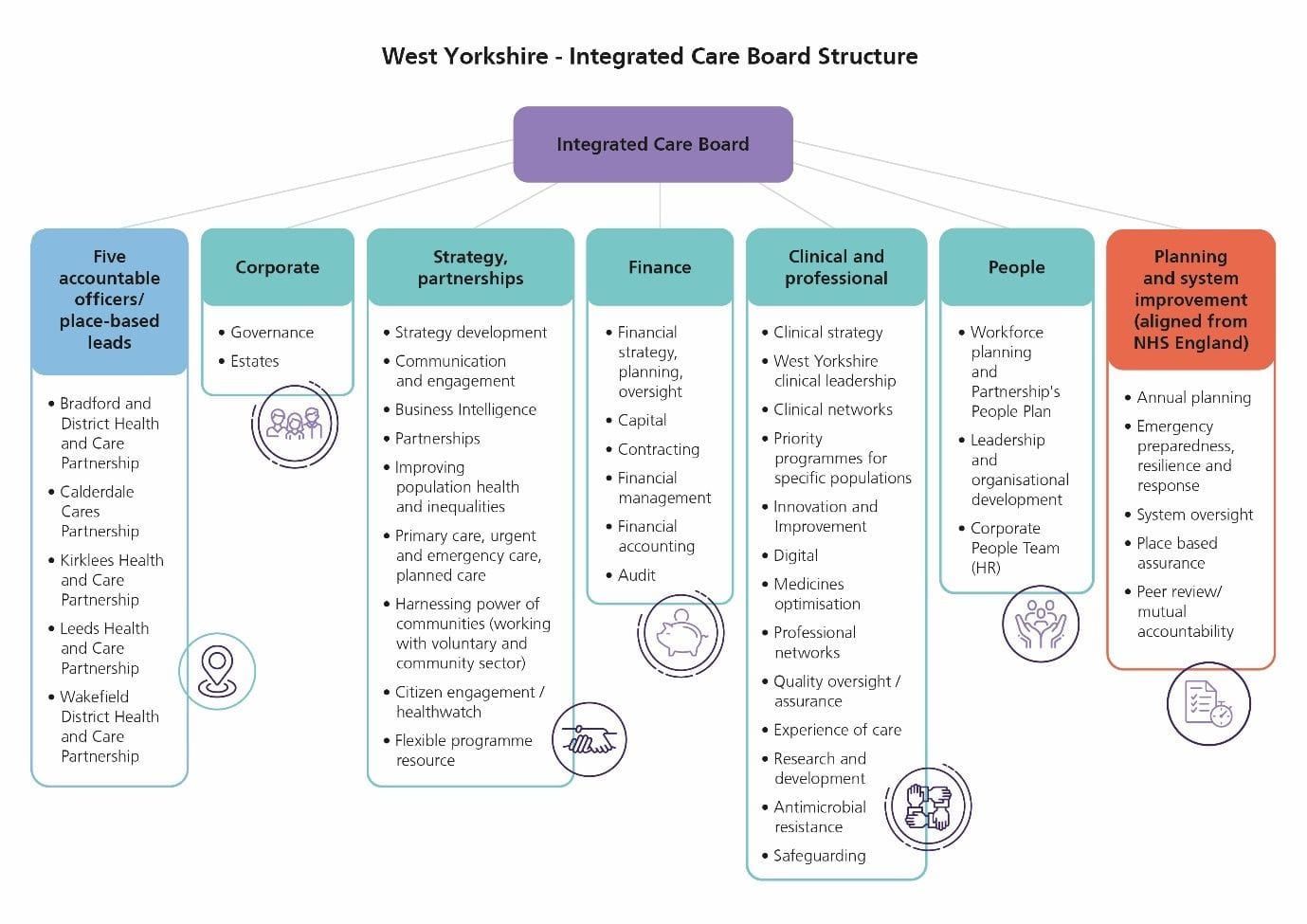
Source: West Yorkshire Health & Care Partnership
Leeds office of the NHS West Yorkshire Integrated Care Board (the ICB in Leeds)
On 1 July 2022, individual clinical commissioning groups (CCGs) were replaced by integrated care boards (ICBs).
ICBs have taken over responsibility for planning and buying (commissioning) NHS services from CCGs. They work at a regional level to help join up services and improve people’s health, but also delegate some funding and decisions to local places – in our case, Leeds – so that we can work with our partners to plan and fund services that make a difference to our residents.
The role of the ICB in Leeds is to support the Leeds Health and Care Partnership (LHCP) and the West Yorkshire Integrated Care Board (WYICB) to :
- Make sure the health and care system in Leeds meets its legal duties, especially those relating to quality, safety and finances.
- Help improve health outcomes and reduce health inequalities by developing and embedding population health planning in Leeds. This is a way of working that helps services understand current health and care needs and predict what local people will need in the future. It means we can tailor better care and support for people, design more joined-up and sustainable health and care services and make better use of public resources.
- Work with organisations and the public to develop joined up health and care services that focus on the people who use them (patient-centred care). We want to make sure people are supported to develop the knowledge, skills and confidence they need to more effectively manage and make informed decisions about their own health and health care and are always treated with dignity, compassion and respect.
Leeds Teaching Hospitals NHS Trust
The Leeds teaching Hospital NHS Trust is one of the largest and busiest acute hospital trusts in the UK. In fact it is one of the largest teaching hospitals in Europe. It is a regional and national centre for specialist treatment, a renowned biomedical research facility, and the local hospital for the Leeds community.
Leeds and York Partnership Foundation NHS Trust
Leeds and York Partnership NHS Foundation Trust is the main provider of specialist mental health and learning disability services in Leeds. It also provide specialist services across York, the Yorkshire and Humber region, and some highly specialised national services.
Leeds Community Healthcare NHS Trust
LCH was formed in 2011 to provide community healthcare services for the people of Leeds. It delivers services in or close to people’s homes and work with the whole family. The 3,000 strong workforce includes nurses, therapists, pharmacists, non-registered and registered clinical staff – all supported by the corporate head office.
Yorkshire Ambulance Service NHS Trust are the provider of NHS 111 for our region.
Leeds City Council (LCC)
LCC has a responsibility for both commissioning care and support services and providing public health services and legal duties to protect and improve health and wellbeing for Leeds residents.
The council’s priority is to improve and protect the health of the public across the whole city, and to tackle health inequalities and improve the health of the poorest the fastest. It does this by providing services to help people have healthy, physically active lifestyles and using its knowledge and understanding of Leeds communities to lead local action in addressing major public health challenges in the city such as smoking, alcohol and drug misuse and obesity.
We also support older people; people with mental health problems, sensory impairments, physical disabilities, or learning disabilities; and other people with special needs. We are responsible for protecting them from abuse and neglect, and enabling vulnerable adults to have a better life and to live independently in their local community, by ensuring they get the right care and support in the right place.
The Director of Public Health, and the Director of Adults of Health, represent the Council on the Leeds Committee of the West Yorkshire Integrated Care Board.
Forum Central
Acts as a voice for Leeds’ third sector in health and care. Our vision is for a better quality of life for people in Leeds. We are a member-based network and work with third sector organisations to link the fantastic work happening across the city with that of other organisations and strategic developments happening in health and social care.
We promote and support partnership working across the city and provide information for and about the third sector. We do this through our specialist networks including: communities of interest, learning disabilities, men’s health, mental health, older people, and physical and sensory impairment.
We support the third sector in Leeds in current and developing health and care structures, including local care partnerships (LCPs) and the Leeds Health and Care Partnership.
Your Healthwatch Leeds
Is an independent champion, listening to people’s health and social care experiences (good or bad). Working together with local services and organisations, they ensure that peoples voices are at the heart of shaping the health and social care services in Leeds. They provide an information, advice and signposting service to help understanding on how to access health and care services in the Leeds area.
Local care partnerships (LCPs)
LCPs build on Leeds strong history of the City Council, NHS and third sector (community organisations) staff working together. There are 15 LCPs covering all of Leeds. Recognising the city’s diversity, they are tailored to local need and the features of that particular community.
All LCPs share the same key feature – a range of people working together, regardless of the employing organisation, to deliver joined-up collaborative care that meets the identified population’s needs. Each partnership includes statutory organisations, third sector (community groups) and elected members.
The LCP model is strongly rooted in the Leeds Health and Wellbeing Strategy and is also a key part of delivering the Healthy Leeds Plan.
Leeds GP Confederation
The Leeds General Practice (GP) confederation is a member-led organisation that unites over 90 GP practices throughout Leeds. It exists to improve people’s health and wellbeing and to ensure the unified voice of general practice in Leeds is at the centre of the health and care system. It does this by strengthening and sustaining primary care, delivering high-quality services, and working as a system partner for Leeds. With the Confederation’s support, practices in Leeds can flourish and focus on caring for their communities.
Discover more

Statement of Representation
Providing details about the purpose of the consultation, how to view the material, how to submit comments, accessibility and privacy notice.
Archived 2025 Consultation Material
This is for information only

Further information
Explains the work already undertaken on the Plan and the new plan-making process
Leeds Local Plan Issues & Options Consultation Report
Summary of the Leeds Local Plan Issues & Options Consultation Summer 2025

Leeds Local Plan Scoping Consultation Document
We would like your views on which general topic areas the Leeds Local Plan should cover and how you would like to be consulted as the plan is developed.
Stay Informed
Follow our projects to get notified of upcoming engagements and the latest project related news.