

Employment Supporting Paper
This is a HTML friendly version of the employment supporting paper.
Leeds Local Plan
Employment Supporting Paper
Why is it needed?
Adopted Local Plan:
The Core Strategy was adopted in November 2014 and set out the Council’s approach in accommodating for enough employment land in the Leeds District in line with the overall spatial vision for that Plan, as well as seeking to safeguard existing employment land and industrial uses from other uses.
Whilst noting the importance of other sectors, the Core Strategy defined ‘employment’ to cover office uses (former B1a use class) and general employment uses (which covered research and development, industrial, distribution / warehousing uses as well as waste uses – use class B2 and B8 and former use classes B1b and B1c). This set a requirement for a minimum of 706,250 square metres (sqm) of office floorspace and 493 hectares of general employment (industrial and waste uses) land for the Plan Period covering 2012-2028.
The Site Allocations Plan (SAP) was adopted in July 2019 and identified and allocated sites suitable for employment uses across the District to meet these requirements, including allocations carried forward from the UDP (first adopted in 2001) and allocations made within the Aire Valley area as part of the Aire Valley Leeds Area Action Plan (AVLAAP) (adopted in 2017). The SAP Remittal process released a further 21ha of industrial land at Barrowby Lane in January 2024.
The evidence that primarily underpinned the adoption of the Core Strategy was an Employment Land Review which was first commissioned in 2006 prepared by Arup to assess the likely demand for office, industrial and warehousing space in Leeds compared to potential supply, and which was updated and reviewed in 2010 to reflect changing circumstances and forecasts. A 2017 review was also undertaken to primarily support the adoption of the SAP and AVLAAP and which assessed all employment sites in the supply to ensure these were suitable, available and achievable.
There is a clear need to update the evidence base and baseline position in order to review and update employment requirements to ensure that the Local Plan helps meet current and future employment needs and growth over the next Plan Period, particularly reflecting anticipated population and housing growth in the District, emerging modern employment uses in Leeds over the next Plan Period, and working patterns and trends, to ensure we continue to deliver the right jobs in the right places.
In addition, the Core Strategy introduced a safeguarding policy (Policy EC3) seeking to protect existing employment land from other uses, although the implementation of this has proved somewhat ineffective due to the policy wording not being direct or clear enough and evidence suggests this has not stopped the loss of employment land across the District.
The Core Strategy and the Natural Resources and Waste Local Plan also recognises the importance of rail freight can have for employment uses in Leeds, particularly moving goods more sustainably and reducing traffic on roads, although there is a lack of a clear policy approach in identifying, enhancing or protecting the few brownfield and vacant sites in Leeds that benefit from access to the railway network / rail sidings. These sites could particularly be most appropriate in supporting logistical and distribution uses. This is also the same for wharf sites that are accessible to the canal and waterways network and provide water freight opportunities to move goods (particularly aggregate on barges from other authorities).
There is also a clear need to update the existing policy wording and requirements to effectively safeguard existing employment land to protect locally important jobs, as well as to identify and protect strategically important sites that offer important rail and water freight opportunities in Leeds.
The wider economic context has also significantly changed since the adoption of the above Local Plan documents which the next Plan will have to consider, as well changes in Governments which has influenced national policy, and the introduction of the West Yorkshire Combined Authority in 2014 with a West Yorkshire Mayor first elected in 2021 which has guided regional policy and strategies, set out below.
National economic changes:
The last decade has seen significant changes and impacts upon the national economic market, having prolonged and far-reaching implications on the regional and local economy and employment market.
Brexit
Following a referendum in June 2016, the United Kingdom left the European Union on the 31st January 2020 with a subsequent transition period in which a withdrawal agreement was agreed on 30th December 2020 and came into force on 1st May 2021. This created a somewhat uncertain time for the UK economy before, during and after this time, with businesses having to plan, adapt and operate within new legislation in a relatively short time. The Office for Budget Responsibility sets out the latest economic assumptions on Brexit that underpin their forecasts (last updated February 2025), and assumes that: long-run productivity will reduce by 4%; exports and imports will be 15% lower in the long run; new non-EU trade deals will not have a material impact as these will be replicating existing deals the UK benefitted from with the EU; and net inward migration will considerably decrease and settle at 315,000 a year in the medium term (with the ONS estimating current net migration to be 728,000), although with this being influenced beyond just Brexit.
The impacts on local businesses in Leeds as a result of Brexit have been explored and captured within the commissioned ‘Preliminary Strategic Review of Employment Land’ report prepared by Mott MacDonald and Aspinall Verdi, which is outlined in more detail below, although with the general impacts including: reducing and impacting the movement of goods and services between Europe leading to a weaker export market; labour shortages; reduced investment opportunities; and with 11% of local businesses surveyed by the Leeds City Region referencing the general impacts of Brexit as being a barrier of growth between 2021 and 2024.
Covid-19 pandemic
At a similar time, the United Kingdom went into lockdown in March 2020 as a response to the global Covid-19 pandemic, which closed all but essential businesses with varying levels of national and regional restrictions between early-2020 and mid-2021.
This resulted in wide-ranging temporary disruption and some permanent changes to the national economy which impacted local businesses, including: reduced employment levels and productivity as premises were closed; changes in working habits with a continued increased trend in working from home and exacerbating the pre-Covid trend for higher quality and more flexible and modern co-working office spaces; impacts upon the construction and property sector delaying development; some industries and businesses, particularly in the hospitality sector, not being able to sustain the pandemic and having permanently closed; and reduced international trade opportunities, particularly importing and exporting goods with China.
The ‘Preliminary Strategic Review of Employment Land’ report identifies and explores the above impacts on local businesses and the general economy in Leeds, with 43% of businesses surveyed by Leeds City Region in 2021 seeing a drop in productivity and was the main barrier to growth with 38% of businesses identifying this as a reason. The report does however recognise some opportunities and benefits, including: the potential of some jobs and offices relocating to cities like Leeds with remote working; lockdown restrictions helping to drive efficiency measures and increased productivity for 11% of surveyed businesses in Leeds; and an increase in demand for warehousing space due to increased online spending.
Cost of living and rising inflation
A cost-of-living crisis has also emerged in the United Kingdom, as a combined result from the economic impact of Covid-19 and rising inflation, as well as economic instability caused by Brexit, economic shock from the September 2022 ‘mini-budget’, and the Russian invasion of Ukraine which impacted the European supply and pricing of gas.
This has led to increasing costs and uncertainty for businesses and employees, including rising travel and rental costs which has restricted the growth and investment available for businesses, increased costs of goods and raw materials, and increased workforce costs particularly with the minimum wage increase, factors which are reflected in the workshops conducted within Aspinall Verdi’s ‘Leeds Employment Land Update’ Report.
Global trade
More recently, and with less certainty on the short and long-term impacts, the start of April 2025 saw the United States imposing trade tariffs on most countries, with the U.K. having a 10% tariff imposed on most imported goods, which may have some wider impacts upon the global and national economy and trade.
In addition, May 2025 saw the U.K. agree to a new deal with the European Union which amongst other key factors will allow greater access to the EU market.
National and regional policy and strategies:
National Planning Policy Framework (2024):
The National Planning Policy Framework (‘NPPF’) was first published in 2012, and sets out the national planning policies for England across a number of planning topics, including for the economy and employment, and provides guidance on how these are to be applied. This sets out the requirements and framework for what local planning policies and guidance should seek to achieve.
The NPPF sets out the aims of sustainable development, based on three objectives: economic, social and environmental. The economic objective states that the planning system shall “help build a strong, responsive and competitive economy, by ensuring that sufficient land of the right types is available in the right places and at the right time to support growth, innovation and improved productivity; and by identifying and coordinating the provision of infrastructure”.
Local planning policies should help create the conditions in which businesses can invest, expand and adapt, and significant weight should be given to supporting economic growth, productivity and innovation. A clear economic vision and strategy should be set to encourage sustainable growth, and sites and criteria should be identified to meet anticipated needs over the plan period. Development would need to meet the needs of a modern economy, with identified locations for the specified uses of: laboratories, gigafactories, data centres, digital infrastructure, freight and logistics, and making provision for the specific locational requirements for: clusters of creative or technology industries, storage and distribution operators at a variety of scales in suitably accessible locations, and other industries of local, regional or national importance.
Invest 2035: The UK’s Modern Industrial Strategy
This Green Paper sets out the Government’s 10-year industrial strategy to drive economic growth and investment for businesses, including the support of net zero and regional growth. The strategy identifies eight growth-driving broad sectors to deliver this:
- advanced manufacturing,
- clean energy industries,
- creative industries,
- defence,
- digital and technologies,
- financial services,
- life sciences, and
- professional and business services, with later priority to be given to subsectors.
The strategy will concentrate efforts on places with the greatest potential for these growth sectors: city regions, high-potential clusters, and strategic industrial sites. Leeds has been highlighted as being home to diverse and successful creative industries clusters, and world-leading clusters in financial services.
The West Yorkshire Plan:
This sets out an overall vision to create a brighter West Yorkshire that works for all – an engine room of ideas and creativity, where anyone can make a home, with five missions to deliver this vision. Mission 1 seeks for a prosperous and inclusive economy with well-paid jobs, recognising the region’s importance of advanced manufacturing, digital, healthcare, finance and FinTech, and the voluntary and community sector.
Other supporting plans and documents underpinning The West Yorkshire Plan include:
- the Leeds City Region Strategic Economic Plan (2016-2036) which plans for the delivery of up to 35,000 jobs and £3.7bn of annual economic output by 2036 through ‘good growth’,
- the West Yorkshire Combined Authority Strategic Economic Framework (2020) which priorities productivity, inclusive growth, climate emergency, transport, and investment and powers, and
- the Employment and Skills Framework (2021) which sets strategic priorities and indicative actions for employment and skills, highlighting STEM-intensive (engineering and manufacturing, infrastructure skills, digital skills, and health and social care), health and other key employment sectors (hospitality, retail, social care and leisure).
The West Yorkshire Combined Authority are also preparing plans for bringing mass transit to the region, with public consultation on route options commencing in summer 2024. The outcome report from this consultation identifies the most supported route for the Leeds Line running from St James Hospital to the City Centre via East Parade and Infirmary Street (L1) and down to White Rose via Elland Road (L6) with future plans to run down to Dewsbury, and for the Bradford Line to run from the City Centre to Bradford via Stanningley and Armley (B1). This presents opportunities for growth and development to take place along these route corridors in Leeds to take advantage of this accessibility, as outlined in the West Yorkshire Mass Transit Vision 2040.
High Speed Two:
In November 2016, Phase 2b of High Speed Two (‘HS2’) was announced, covering the preferred route for a new high speed rail link between Crewe to Manchester (western leg) and West Midlands to Leeds (eastern leg). Subsequent safeguarding directions came into force in 2017 which sought to restrict new development coming forward within the safeguarding area where the preferred rail link and buffer was to be built. In October 2023, it was announced by the Government that the entirety of Phase 2 of HS2 was cancelled.
Safeguarding directions for Phase 2b covering Leeds was updated in May 2023, and still remain in force (as of May 2025) whilst a Government review is conducted in exploring high speed rail and line upgrades as part of Northern Powerhouse Rail. A map of the current HS2 safeguarded area in Leeds can be seen below, covering a significant portion surrounding Leeds Station and the southern end of the City Centre, with the line running on a south-eastern curve along Hunslet with a further significant portion of land within and adjacent to Stourton, and the line running down to Woodlesford and Methley, with a second line running north from Methley to north of Garforth and Micklefield.
Figure 1: HS2 Safeguarding Area in Leeds |
This predominantly has implications for some allocations identified within the AVLAAP, as well as some sites identified in the SAP to the north of Garforth, with 48ha of allocated land lying within the HS2 safeguarded area. For land within and adjoining the safeguarded area, this has provided uncertainty for landowners and developers and which has likely constrained and stalled development within the Aire Valley, which typically consists of the larger and flatter allocated sites more suitable for industrial development. This has likely led to an undersupply of suitable land for employment market needs across the District until this was addressed through an additional allocation of 21 hectares of land at Barrowby Lane in January 2024 through the SAP Remitall process. This has meant that, across the current Plan Period, only 61% of planned general employment land came forward.
Whilst the HS2 safeguarding areas are reviewed by the Government, any new Plan would need to consider the implications of this constraint in any policy direction and requirements.
Is it justified by the evidence?
An extensive range of evidence and data has been prepared and used to inform the development of employment policy options, including the various approaches in updating the employment land requirements, analysis on employment windfall development, reviewing the existing employment supply, and methodology used for safeguarding existing employment land.
Preliminary Strategic Review of Employment Land – Mott MacDonald & Aspinall Verdi (2022):
The Council commissioned Mott MacDonald in 2022 to undertake a strategic preliminary review of the employment land market in Leeds with a review period of 2017 – Q1 22, providing an insight into recent economic implications, including Brexit, Covid-19 and HS2 uncertainty, which was based upon desktop research, real estate database analysis and workshops conducted with office and industrial agents and developers undertaken by Aspinall Verdi. This has provided necessary qualitative and contextual information to help inform LLP2042.
The key considerations and implications for LLP2042 and industrial and office requirements raised from this study have been set out in more detail within the draft Employment Land Needs Assessment.
Employment land requirements:
Any update to the existing employment requirements and policies must be underpinned by the latest and most relevant evidence, in line with national planning guidance.
A draft Employment Land Needs Assessment (‘ELNA’) has been prepared by the Council setting out the full context and evidence in support of the proposed employment policy approaches, with the key evidence sources being highlighted and summarised below:
Option 1a – Employment Forecasts:
This option uses the 2025 West Yorkshire Regional Econometric Model (REM) by Experian which forecasts full-time employment growth across various sectors, including offices, industrial and logistics. This is then translated into a floorspace figure based upon job densities by employment sector. This provides a net change figure.
For industrial and logistics, this predicts a drop in employment by 1,900 between 2024 and 2042, translating to a net floorspace reduction of 110,000sqm (6,000sqm each year).
For offices, this predicts an increase in employment by 16,000 between 2024 and 2042, translating to a net floorspace increase of 240,000sqm (13,000sqm each year)
Option 1b – Employment Forecasts – adjusted for actual delivery over past ten years:
This option adjusts the past changes in employment from the REM and compares this against actual completion delivery over the last ten years (2015-25), and the annual difference between the employment change and delivery is used to adjust the forecasts set out in 1a. This converts the net change figure into a gross figure.
For industrial and logistics, the REM showed a loss of 1,000sqm pa over the last ten years comparing to actual delivery of 65,000sqm (a difference of 66,000sqm). Adjusting this with 1a, the 60,000sqm requirement would translate to a net requirement of 1,080,000 sqm (land equivalent of 309ha) between 2024 and 2042.
For offices, the REM showed an increase of 32,000sqm pa over the last ten years comparing to actual delivery of 30,000sqm (a difference of -2,000sqm). Adjusting this with 1a, the 28,000sqm requirement would translate to a net requirement of 200,000sqm (11,000sqm pa), which has been discounted as this would be unrealistically low for the next Plan Period.
Option 1c – Employment Forecasts – adjusted for estimated employment space losses:
This option uses the loss of industrial floorspace stock measured over the last ten years from the Valuations Office Agency to adjust the employment forecasts from 1a.
For industrial and logistics, average losses over the last ten years was 65,000sqm which translates to a requirement of 1,170,000sqm new industrial space to replace losses between 2024-42. When accounting for the 110,000sqm reduction in employment forecasted in 1a, this translates to a net requirement of 1,060,000sqm (land equivalent of 303ha).
For offices, average losses over the last ten years was 35,000sqm which translates to a requirement of 630,000sqm new office space to replace losses between 2024-42. When accounting for the 240,000sqm requirement forecasted in 1a, this translates to a net requirement of 870,000sqm (48,000sqm pa).
Option 2a – Take-up based:
This option uses completion data monitored within the Economic Land Availability (ELA) over the last ten years, and carries this trend over for 2024-42.
For industrial and logistics, 65,000sqm was completed on average in the last ten years, translating to a requirement of 1,170,000sqm (land equivalent of 334ha) between 2024-42.
For offices, an average of 30,000sqm was completed in the last ten years, translating to a requirement of 540,000sqm between 2024-42.
Option 2b – Take-up based – adjusted for known constraints on land delivery:
This option uses past take-up from 2a, and is adjusted for the estimated additional completions that would have occurred on existing employment land that has been sterilised from development since 2015 as a result of HS2 Safeguarded Land.
For industrial and logistics, 48ha of allocated land has been impacted by HS2 Safeguarded Land (which could accommodate 170,000sqm of space) which could have delivered up to 17,000sqm to past take-up, resulting in an increased requirement of 1,480,000sqm (land equivalent of 423ha).
No land for office allocations have been constrained by safeguarding or similar constraints.
Option 2c – Take-up based – adjusted to national and regional averages:
This option benchmarks the changes in employment floorspace stock over the last ten years as measured from the Valuations Office Agency to comparators (national, regional, West Yorkshire, and Core Cities average) to establish any underperformance that could indicate constraints to the supply in Leeds (such as availability and quality of sites) which can be adjusted to the take-up figure in 2a.
For industrial and logistics, Leeds has an existing stock of 5.2 million sqm of industrial floorspace and lost 5.2% of industrial floorspace in the last ten years. Taking the difference of this change and applying this to Leeds’ existing stock, this equates to:
- +/- 0% for West Yorkshire - equating to 490,000sqm new floorspace needed in Leeds to meet this between 2024 and 2042
- +4.2% for Yorkshire and Humber - equating to 880,000sqm new floorspace needed in Leeds to meet this between 2024 and 2042
- +3.8% for England - equating to 850,000sqm new floorspace needed in Leeds to meet this between 2024 and 2042
- -4.2% for the Core Cities - equating to 90,000sqm new floorspace needed in Leeds to meet this between 2024 and 2042
Adjusting the difference between the past take-up of 1.48m sqm in 1a and the national average of 0.85m sqm, this results in a requirement of 2,020,000sqm (land equivalent of 577ha).
For offices, Leeds saw a loss of 4.1% of office floorspace in the last ten years, which compares to:
- -5.8% for West Yorkshire
- -6.4% for Yorkshire and Humber
- -7.7% for England
- -7.1% for the Core Cities
Therefore, whilst the stock of office floorspace has fallen in Leeds, this has compared favourably to the trends seen elsewhere, and there is no clear justification for adjusting the take-up using this method.
Review of current supply sites:
An Employment Supply Site Review has been conducted by the Council to review all sites within the existing employment supply for office and industrial uses to determine which sites remain, available and achievable to likely come forward for delivery over the next Plan Period to help meet future employment needs.
Sites were reviewed based on their deliverability, using information on the site status and activity, with sites that were reviewed as ‘certain’, ‘probable’ or ‘possible’ being considered likely for development, and those reviewed ‘unlikely’ or ‘not deliverable’ as requiring further action or engagement if the site was to be considered to be taken forward for the next Plan.
Following this Review, the 127 sites were reviewed as following:
Table 1: Employment Sites by Deliverability (sqm) | ||||||||||||
Type of site | Certain | Probable | Possible | Unlikely | Not deliverable | TOTAL | ||||||
Office | Number of sites | 3 | 7% | 21 | 48% | 5 | 11% | 12 | 27% | 3 | 7% | 44 |
Floorspace (sqm) | 25,397 | 4% | 440,859 | 64% | 35,035 | 10% | 129,732 | 15% | 31,915 | 7% | 662,938 | |
Industrial | Number of sites | 4 | 5% | 27 | 33% | 24 | 29% | 21 | 25% | 7 | 8% | 83 |
Floorspace (sqm) | 83,363 | 8% | 542,236 | 55% | 323,445 | 11% | 133,559 | 22% | 7,179 | 5% | 1,089,782 | |
Land capacity (ha) | 18.4 | 7% | 135.1 | 52% | 91.7 | 12% | 37.8 | 24% | 1.3 | 5% | 277.3 | |
TOTAL | Number of sites | 7 | 6% | 48 | 38% | 29 | 23% | 33 | 26% | 10 | 8% | 127 |
Floorspace (sqm) | 108,763 | 6% | 983,117 | 57% | 358,485 | 21% | 263,303 | 15% | 39,097 | 2% | 1,752,765 | |
This leaves approximately 500,000sqm of office floorspace and 950,000sqm of industrial floorspace in the existing supply that can contribute in addressing future employment needs across the next Plan Period.
A full schedule of sites reviewed is available within the appendices of the draft Employment Land Needs Assessment, including a schedule of all completed sites between April 2024 and March 2025, to align with the plan baseline date of 1st April 2024.
Need for new allocations to meet future employment requirements:
Taking the above into account, the preferred option in identifying future employment needs for industrial & logistics uses would be setting a range between the approach set out in Option 2b (82,000sqm each year) as a minimum delivery target for monitoring purposes, and with further potential need identified in Option 2c (112,000sqm) to provide the upper range and as the basis for making new allocations to reflect previous constraints in Leeds.
This requirement would be met through actual completions for 2024/25, deliverable extant planning permissions, and existing allocations that remain suitable, availability and deliverable, which would leave a residual requirement for 1,040,000sqm (297ha land equivalent) of new industrial & logistics land allocations.
For offices, the preferred option in identifying future employment needs would be the approach set out in Option 2a (30,000sqm) as a minimum delivery target for monitoring purposes, given there is no clear indication of constraints in the supply and has performed relatively well against other comparators to suggest any adjustment is necessary.
This office requirement would also be met through actual completions for 2024/25, deliverable extant planning permissions, and existing allocations that remain suitable, availability and deliverable, which is considered sufficient in meeting this identified need with continued delivery and opportunities available within the City Centre and further potential growth to be encouraged in the expanded City Centre and in existing out of centre business parks in sustainable locations. This results in no need in identifying further specific allocations of land for office use.
Additional employment floorspace/land needs:
Another consideration needing to be made when allocating new land to support delivery targets is whether a margin of choice should be added to the base requirement. This helps provides flexibility to allow the market to operate more efficiently, recognising that not all sites will be suitable for specific user requirements and provision of a wider range and choice of sites offer a better chance of meeting targets. Otherwise, every site in the Plan would need to be delivered to meet the identified needs, which is not a realistic assumption as sites can stall or come forward as other uses, as past trends have shown.
Windfall development:
Past data suggests that some land not identified in the Plan can continue to contribute to meeting plan requirements, coming forward as windfall development on non-allocated land, such as redevelopment or infill occurring in existing industrial areas or changes of use and extensions of existing buildings.
A detailed analysis of windfall development has been made, and is set out in the draft ELNA.
This shows that an average of 15,700sqm of industrial and logistics space comes forward as windfall each year, amounting to an additional 290,000sqm for 2024-2042. It is assumed that there is currently around three years of windfall development in the existing supply, and to avoid double counting, the total windfall figure would be 220,000sqm. This scale of windfall development would therefore be considered as part of the margin of choice.
No further allocations are proposed for office use, and as such previous windfall delivery would not be relevant to highlight in this paper.
HS2 Safeguarded Land:
Around 48ha of existing employment land falls within the HS2 Safeguarding Directions, which has restricted development coming forward and essentially sterilised this land since 2015. The future of this land still remains uncertain and still remain in force, awaiting a final government decision on the future of rail connections into Leeds. This means there is a possibility that some or all safeguarded will be released during the next plan period.
The suggested approach is to therefore treat the 48ha of HS2 safeguarded land as a further margin of choice to the land supply, and in addition to the windfall allowance above.
Taking into account the potential and uncertainty associated with windfall development and HS2 safeguarded land, the preferred approach is to plan to meet the industrial employment land requirement through the contribution from existing supply that remains suitable, available and deliverable and new employment allocations made through LLP2042. Windfall development and the potential release of HS2 safeguarded land would help provide a margin of choice of at least 10% of the requirement.
Given the preferred option is to not identify on additional land for office use, and rely on development coming forward within the City Centre, the expanded City Centre area and growth within existing office business parks, there is no need in setting a margin of choice for offices.
Safeguarding existing employment land methodology:
In order to assist with the development of policy options to safeguard employment land in Leeds, an exercise has been undertaken to identify areas of existing industrial use of particular importance. This would allow us to identify areas we may want to designate and safeguard as part of LLP2042 to protect valuable existing industrial land and premises across the District and the industrial jobs and opportunities associated with these places.
Data from the Valuations Office Agency (2023) has been used for this exercise, in order to plot existing industrial businesses and to identify high concentrations of rateable value (i.e. business tax) paid. A high concentration of rateable value (approximately over £500K) was used as an indication of the importance of the industrial premises, rather than simply a count of individual premises as this does not reflect the size or scale of the business operations, which would provide a proxy for the scale of employment.
Once these initial clusters were established, boundaries were then drawn to include all industrial buildings and associated curtilage, excluding other uses (such as residential and greenspace).
This resulted in the creation of 107 individual boundaries defining the extent of existing industrial areas of particular importance across Leeds, shown below in Figure 2 and accessible as an online interactive map viewable here with details on the boundaries. The majority of these boundaries are located within the Main Urban Area of Leeds, particularly to the south from Cross Green and Stourton to Holbeck and Wortley to the west, with some industrial areas around Morley, Pudsey, Garforth, Yeadon and Wetherby. Opportunity will be provided at the Regulation 18 (Issues and Options) consultation to comment upon these identified boundaries, including amendments to existing boundaries, removing identified boundaries or creating new boundaries based on local information.
Figure 2: Identified Industrial Areas of importance |
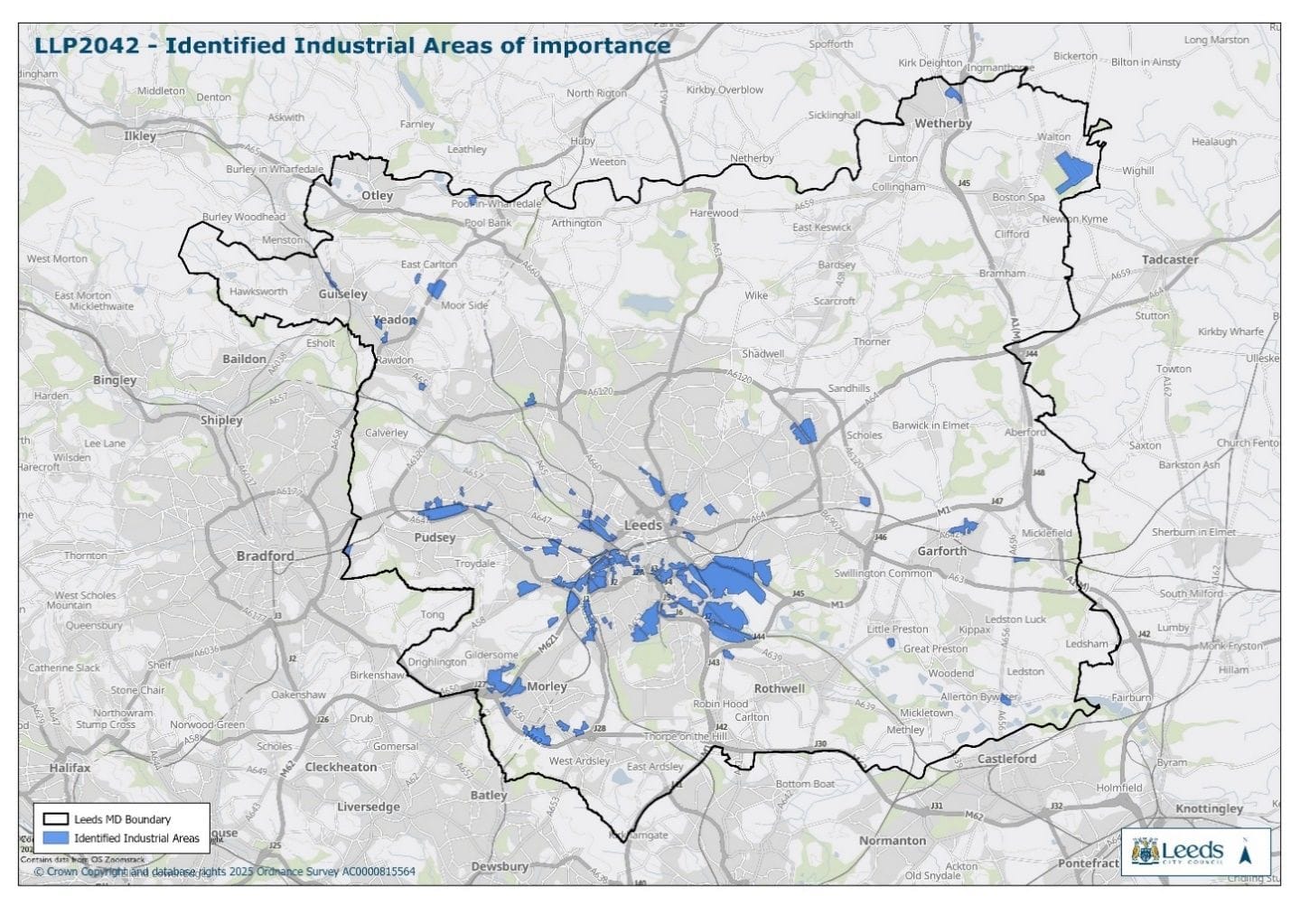
It is anticipated that these boundaries will be used to define the extent of industrial areas that will be considered for safeguarding as part of LLP2042, with industrial and logistic uses considered acceptable in these areas, and proposals for other uses will only be considered acceptable if this would not undermine the role of the industrial area. Subject to public consultation, this could include having a policy introducing criteria that would need to be met, including: remaining ancillary or supporting the existing employment use, no harm on amenity, and no harm on transport or parking, as well as defining what uses would be considered acceptable or not within these areas.
These current boundaries will also need to be taken into consideration against other uses and align with the overall strategy of LLP2042, particularly for any safeguarded areas within the expanded City Centre and opportunity areas, where the loss of employment land might be considered appropriate to allow for anticipated redevelopment opportunities.
The aim of this policy would be to clearly safeguard and protect these industrial areas over the next Plan Period from other uses and to reduce the overall net loss of industrial land and premises in Leeds, where these are considered to be of particular importance. This would provide security and confidence for businesses operating within these defined areas, but would also allow for flexibility for industrial premises outside of these defined areas for potential redevelopment to other uses (such as housing and leisure), particularly in areas of opportunity identified in the Local Plan.
How will it help deliver the Council's corporate Strategy?
The Council’s ‘Best City Ambition’ sets out a positive ambition for Leeds to be the Best City in the UK - underpinned by the three pillars: health and wellbeing, inclusive growth, and zero carbon.
These policies actively support the growth of the local economy, by ultimately ensuring Leeds has enough land to meet anticipated demand for jobs. This seeks to increase the number of jobs available in Leeds and will provide a range of local job and skill / training opportunities for residents, and protect existing jobs within identified safeguarded areas. These new job opportunities shall be located all across the District to ensure that these are accessible to all. This will therefore play a role in helping to reduce inequality across Leeds by improving employment and skill levels, and will help increase pay and quality of life for workers.
These policies will also promote and support the transition to a low carbon economy, recognising the impacts that such employment uses can have on the environment, but encouraging sustainable and innovative technologies and design to help reduce emissions and the use of resources to drive this economic growth, and wherever possible, locate these employment opportunities in accessible and sustainable locations to reduce the need to travel by private car. The Plan will also take advantage of rail and water freight opportunities to support the sustainable movement of goods in and out of the district and reduce the number of HGVs on our roads.
How are we going to measure the impact?
The delivery of employment land will continue to be monitored through the Economic Land Availability, which uses planning application data and information available through other sources to pick up new planning applications for office and industrial uses and monitor the status of these, including the construction and completion status, to provide a live supply position for every quarter.
The Authority Monitoring Report also reports the annual supply position, and provides commentary on the delivery coming forward over the short and long terms and compares this against anticipated Plan delivery. The AMR also monitors socio-economic factors such as employment levels and average pay.
Monitoring indicators will be established at a later stage of the Plan preparation process in order to monitor and implement these policy options. This could include monitoring the level of employment delivery across office and industrial / logistic uses and to ensure job opportunities increase across the District by continuing to monitor employment levels and average pay.
This will be implemented through allocating the most appropriate sites in the right locations to meet demand based on robust and up-to-date evidence, and the policies will be implemented through the Development Management process to be used in the determination of planning applications, wherever appropriate. Precise and clear wording will be used to ensure for effective implementation, supported by concise and relevant supporting wording.
Equality, diversity, cohesion and integration
These policies seek to ensure enough jobs are available in Leeds and are located in the most appropriate and accessible locations, providing a wide range of jobs and opportunities for all residents in Leeds, with policies supporting inclusive growth across all of Leeds.
Discover more

Statement of Representation
Providing details about the purpose of the consultation, how to view the material, how to submit comments, accessibility and privacy notice.

Archived 2025 Consultation Material
This is for information only

Further information
Explains the work already undertaken on the Plan and the new plan-making process

Leeds Local Plan Issues & Options Consultation Report
Summary of the Leeds Local Plan Issues & Options Consultation Summer 2025

Leeds Local Plan Scoping Consultation Document
We would like your views on which general topic areas the Leeds Local Plan should cover and how you would like to be consulted as the plan is developed.
Stay Informed
Follow our projects to get notified of upcoming engagements and the latest project related news.