

Visitor Economy and Culture Supporting Paper (including short-term lets)
This is a HTML friendly version of the visitor economy and culture supporting paper (including short-term lets).
Leeds Local Plan
Visitor Economy and Culture Supporting Paper (including short-term lets)
LEEDS LOCAL PLAN (2024 to 2042)
Visitor Economy and Culture Supporting Paper
(including short-term lets)
Regulation 18 Consultation
June 2025
Why is it needed?
Context:
Leeds is a vibrant city: a key regional retail destination with modern shopping centres and Victorian arcades complemented by a strong food, leisure, music and nightlife scene, celebrating a rich history with diverse cultures, all set within a unique geography with a thriving urban centre characterised by a modern skyline intermixed with historic architecture surrounded by towns, villages and rural areas with their own character and history to showcase.
Leeds therefore attracts a number of visitors, with 15 million domestic day trips made each year (the 4th most visited city in the country) and a further 2 million domestic overnight trips. This contributes greatly to the local economy, with over £1.3bn being spent in the city by domestic visitors. Leeds also benefits from being connected internationally with Leeds Bradford Airport, attracting a further 290,000 international visitors in 2022 (the 11th most visited city in the country by overnight visitors).
Key attractions for both visitors and residents include:
- Museums at Royal Armouries, Leeds City Museum, Leeds Art Gallery and Leeds Industrial Museum,
- Renowned venues such as the First Direct Arena, Leeds Grand Theatre & Opera House, Leeds Playhouse and Brudenell Social Club,
- Historic estates at Kirkstall Abbey, Temple Newsam and Harewood House,
- The British Library site in Boston Spa which is undergoing expansion and a new British Library North site planned at Temple Works in the City Centre.
- Leeds’ waterways, including the River Aire, the canal and Leeds Docks, also offer unique waterfront opportunities, particularly with the Leeds Dock Water Taxi.
Leeds also demonstrates its ability to host large events, including one of the country’s biggest music festivals, Leeds Festival, which attracts around 100,000 visitors; and UKREiiF, which attracts over 16,000 attendees each year. Leeds has also hosted one-off sporting events such as IRONMAN Leeds triathlon in 2025, Tour de France in 2014 and several iterations of the World Triathlon Championship Series and Tour de Yorkshire.
Adopted Local Plan:
Despite the significance of the visitor economy and visitor numbers into Leeds, the current Local Plan lacks a clear policy direction on supporting or protecting tourism-related facilities and attractions. The Local Plan has a general approach in directing main town centre uses (which encompasses most tourism-related development) to the City Centre and town and local centres, with some extant tourism and leisure designations carried forward from the UDP that were identified in the 1990s. The extant policies which have direct influence and specific policy wording on the visitor economy and culture in Leeds are:
UDP:
- LT3 - The retention and enhancement of existing visitor attractions and facilities including the built heritage of the City Centre will be encouraged. The creation of a wide range of new attractions and facilities will be supported as opportunities arise. Effective visitor and site management and promotion will need to be considered.
- LT4 - In aiming to secure the positive benefits of tourism for residents and visitors, the city council will pursue opportunities for the development of major cultural and sporting facilities. Locations need to be easily accessed by the regional road and public transport.
- LT5 - The City Council, in partnership with public and private agencies, will pursue actively opportunities for the development of purpose built facilities for exhibitions, concerts and conferences.
- LT5a - Land in the vicinity of Elland Road football stadium is reserved for leisure and tourism proposals which would enhance the regional and national role of the city.
- LT5b - Provision of leisure and tourism facilities will be supported on the following sites or areas:
2. Middleton Broom / Middleton Park
3. Parlington
5. Dick Lane, Pudsey
6. Barrowby Hall, Garforth
- LT6 - The tourism potential of the waterways corridor will continue to be recognised. Appropriate leisure developments will be promoted, and priority given for environmental improvements. In considering development proposals in the waterways corridor, the likely impact on tourism potential will be an important consideration.
- LT6a - Appropriate waterways related leisure developments will be supported within the lower Aire Valley, in particular at Fleet Lane, Oulton.
Aire Valley Leeds Area Action Plan (AVLAAP):
- AVL15 – Tourism and Recreation in Aire Valley Leeds – New visitor centre and attraction at Skelton Lake, improvements to Trans Pennine Trail and support for river boat / water taxi services and additional boat moorings
- SG4 – New visitor destination at Skelton Lake
National Policy:
There is also a lack of clear direction on the visitor economy within national policy, with the National Planning Policy Framework generally supporting development which supports economic growth, encourages leisure development within centres, and enables sustainable rural tourism and leisure development which respects the character of the countryside. However, the Government recognises the importance of culture, heritage, sport, and the visitor economy, as set out in the English Devolution White Paper (December 2024) which recognises the importance of these sectors for regional economies, and plans to work with Mayors and Local Authorities on funding and help support local areas to grow and develop their culture, sports, heritage, and tourism offer and deliver Local Growth Plans.
Regional Policy:
The West Yorkshire Plan sets out the vision, ambitions and missions to drive the work needed to transform lives and communities across the region. Mission 2 (a happy West Yorkshire – great places and healthy communities) recognises the importance of cultural and creative industries and access to cultural, heritage and sporting assets.
In addition, the West Yorkshire Local Visitor Economy Partnership have developed a Destination Management Plan for West Yorkshire, which highlights the regions’ strengths, challenges and opportunities on the visitor economy. In response. it sets out a strategy across three priorities:
- increase awareness and appeal of the region as a destination
- develop the region’s product and places (including conferences, venues and events), and
- manage the visitor economy effectively, in order to grow the region’s £5.77 billion visitor economy.
From the above information and policy context, there is therefore an opportunity for LLP2042 to support the sustainable growth of the visitor economy in Leeds, with the introduction of new policies and updating existing policies wherever appropriate. This will help drive economic growth for the local and regional economy and help improve the health and quality of life for residents.
What is it seeking to achieve?
The aim of this suite of policies is two-fold – to encourage economic growth in Leeds through an expanded visitor economy offer while improving access to leisure and culture for residents of Leeds and the surrounding area, which is known to have a positive impact on wellbeing. It will seek to achieve this by exploring policy options to support the right development to come forward in the most appropriate places and to protect and enhance existing cultural premises of importance across Leeds.
Visitor economy and culture:
We need to consider the approach taken to cultural and tourism-related development which might come forward outside of centres, including the potential for one-off larger-scale attractions which cannot be accommodated within centres. A criteria-based policy might be necessary in order to ensure this type of development comes forward in the most appropriate locations to meet a range of needs on varying scales.
We also need to consider any opportunities through the planning process protect and safeguard existing cultural and tourism-related premises from other uses. This could also be a criteria-based policy which sets out exceptions where changes of use might be appropriate. Alternatively, a spatial policy could protect defined areas from changes of use (such as Mabgate) based on a robust methodology.
We also need to review the tourism and leisure designations in the UDP, and whether we carry these forward, update them or remove them from the Local Plan. These designations are:
- Middleton Broom / Middleton Park,
- Parlington,
- Dick Lane Pudsey,
- Barrowby Hall Garforth,
- Elland Road,
- Skelton Lake, and
- Thwaite Mills Museum and Skelton Lake area (for potential river boat stops)
Overnight accommodation:
There is also an identified policy gap in the approach taken to the provision of overnight accommodation outside of centres. Current policy directs this type of development to centres, and proposals out of centres must undergo a sequential test and be considered on their own merits. There is otherwise no clear approach to guide applicants or help officers when determining applications for such proposals. The types of various overnight accommodation that may need consideration include:
- hotels outside of centres,
- glamping / cabin / pod style accommodation, and
- hospitality venues with similar locational requirements in rural locations.
Therefore, more specific and robust policy wording setting out where and when each of these types of overnight accommodation would be appropriate may be necessary in order to support the visitor economy across all of Leeds, as well as by supporting the rural economy, in the most appropriate and sensitive locations and in line with the approach for rural and Green Belt land.
Short-term lets:
Another area where the Local Plan lacks direction is the emergence of short-term lets in Leeds, and how local planning policy considers proposals for these. With the complexities of this specific issue, including the benefits and harm of this type of accommodation as well as the current national policy context and implications for LLP2042, a separate supporting paper on short-term lets has been prepared and is attached below.
Is it justified by the evidence?
Data from Visit Britain demonstrates Leeds as being a strong and important visitor destination for both day visitors and overnight stays, with 15 million domestic day trips and £823 million of subsequent spending and a further 2 million overnight visitors spending £489 million each year on average between 2021 and 2023. This ranks Leeds fourth for the most visited city in the country for day trips and fifth for overnight trips, outperforming more ‘typical’ visitor destinations such as seaside cities or those which benefit from large visitor attractions. This suggests Leeds’ attraction as a city break, benefitting from a strong retail, leisure and cultural core with museums to attract and satisfy visitors. Leeds also benefits from close proximity to an international airport to attract international visitors, with 290,000 international visitors in 2022, although with Visit Britain recording the majority of these to be visiting for family / friends (51%) or work purposes (17%) and only 17% for holiday, and ranking 11th nationally.
Data on the current supply of hotels and subsequent rooms is available with access to the AM:PM database, using CoStar data provided by STR. As of March 2025, Leeds had a total supply of 79 hotels providing 7,108 rooms. 15 new hotels are in the recorded pipeline, anticipated to provide a further 1,484 rooms (73 rooms within the next year). This is supplemented by supply and completions monitored through planning applications within the Economic Land Availability, as well as anecdotal information from LCC Visitor Economy team which suggests low supply and delivery of hotels not meeting demand; particularly during large events (such as REIFF) and a short supply of 3* and a lack of 5* hotels.
The 2024 Night Time Industry Association report states that although revenue in the night time economy recovered in 2022, inflation and the cost of living crisis meant a real-terms cut, and investment in the Night Time Economy has not been possible.
longer-term changes in young people’s habits that have diversified the late-night market and increased popularity of competitive socialising venues, experience-led and immersive concepts…Mainstream clubs that are well capitalised will survive but will still struggle, with late bars with DJs, the cost-of-living crisis, sophisticated in-home entertainment plus wellness and sleep trends further eating into their clientele…Demand for daytime clubbing events for both older and younger audiences will grow…There will be an expansion of immersive clubbing experiences catering to neurodiverse audiences and incorporating elements of multi-sensory activities and self-care to improve mental wellbeing (rave spas, chill-out spaces, quiet socialising).
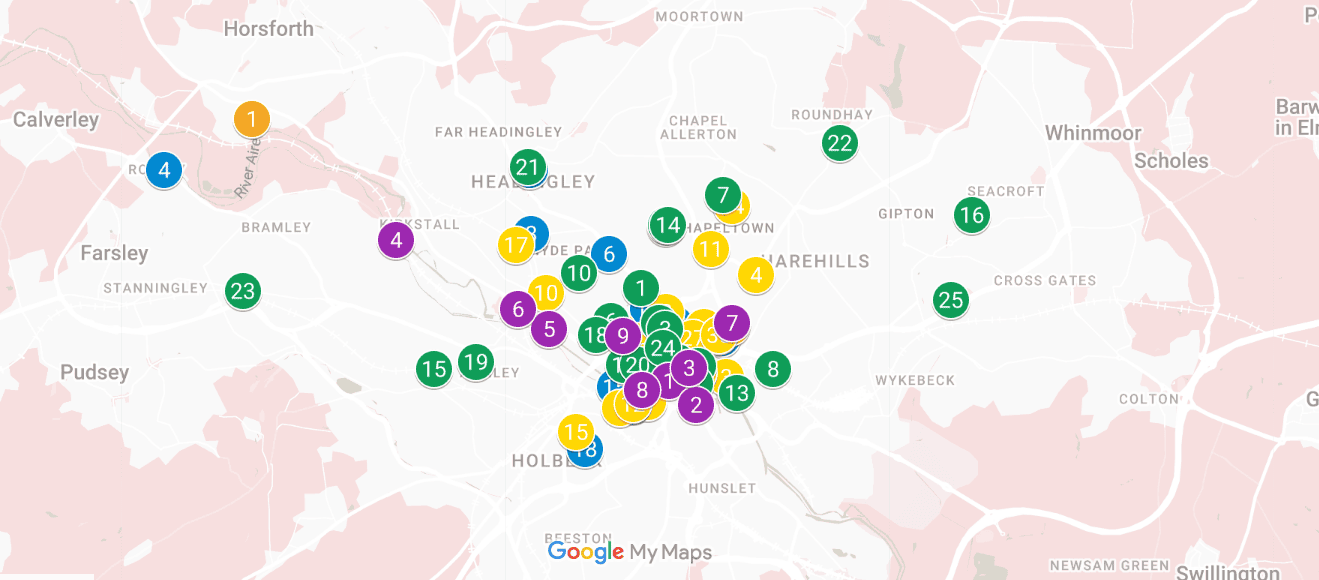
No Space Left to Play maps lost cultural spaces in Leeds. Below is the map as of April 2025:
How will it help deliver the Council’s Corporate Strategy?
The Councils current corporate strategy is the Best City Ambition. The three pillars are Health and Wellbeing, Inclusive Growth, and Zero Carbon
- Health and Wellbeing:
To realise this ambition, Team Leeds will focus on… ensuring children have the best start in life and enjoy a healthy, happy childhood, where their right to play and have fun is protected… creating a well-connected and welcoming city where …people of all ages can enjoy activity that supports their mental and physical health
Encouraging tourism, leisure and culture development in Leeds will mean an increase in facilities, both for local people and visitors. Access to leisure and culture will help increase the health and wellbeing of residents and visitors.
- Inclusive growth:
To realise this ambition, Team Leeds will focus on:
…maximising the potential of our city centre and local high streets to sustainably grow our economy, create jobs and deliver for people by investing in quality infrastructure, a transport system that will benefit our future and a vibrant public realm… championing Leeds on the global stage by showcasing the talent and opportunity we have in the city, welcoming inward investors that want to create good jobs locally and attract top international talent
An expanded and diverse visitor economy would encourage spending and investment into Leeds, particularly for local businesses, and help drive economic growth for the local economy. Prioritising Leeds as a visitor destination may also help increase investment opportunities on the public realm and transport connections, helping not only visitors but residents within Leeds. This would also help increase job opportunities across the District, particularly within the tourism, leisure and culture sectors, helping drive up flexibility, choice and options for workers but noting these jobs can typically be lower paid.
- Zero Carbon
to realise this ambition, Team Leeds will focus on:
…creating a safer and more walkable city to reduce unnecessary travel… investing in our public spaces and infrastructure to prepare Leeds for future climate impacts, helping us adapt to climate change in a way which also improves quality of life for everyone
Increased tourism-related development is likely to be focused in well-connected areas of Leeds, particularly in the City Centre, with well-connected public transport access through rail and bus. However, public transport in some areas of Leeds is recognised to be poor, particularly in the more rural areas, with improvements to the network being necessary although the opportunities of major rail and mass transit improvements that this can bring to Leeds is recognised as well as a higher number of visitors potentially supporting the delivery of public transport schemes and investment. Promoting Leeds as a city break may also attract more domestic ‘staycations’ within the UK, helping to lower the carbon emissions of visitors. Emissions associated with Leeds Bradford Airport would also need to be considered against zero carbon travel, although a locally accessible airport helps reduce the emissions that would otherwise occur travelling to other regional airports.
In terms of sustainable tourism, the Global Destination Sustainability (GDS) Movement gives Leeds a GDS Index score of 48%, performing well for environmental and social factors and less well for supplier and destination management factors. However, this score places Leeds behind the 53% average of the Core Cities measured, ranking 5th out of 7.
How is it consistent with the NPPF?
Supporting the visitor economy will significantly help strengthen and diversify Leeds’ local economy and drive economic growth through increased employment, business numbers and spending: a key driver of the current Government and national policy on the economy.
Promoting and enhancing cultural premises would help improve access and increase the number of cultural and community facilities in Leeds, which will help grow the creative employment industries which is highlighted within the NPPF (para.87a) and the National Industrial Strategy (Invest 2035) as a key sector, helps improve the health, wellbeing and quality of life of residents and visitors, and helps enhance and bring into use historic buildings. Having a specific policy on safeguarding cultural and community premises, such as pubs and music venues, would also align with national policy on ensuring new housing development can integrate with existing businesses (para.200), particularly in opportunity areas identified within the Plan including the expanded City Centre where conflict may arise between planned new residential developments and existing cultural premises.
The Plan also seeks to introduce clear and more specific policy on rural tourism and the countryside, with the intention of setting out what uses would be acceptable on such land to help support the rural economy whilst also protecting the landscape and character of local rural areas. This would particularly apply to rural types of overnight accommodation (such as glamping / pod / cabin / lodge sites) as well as for the potential provision for visitor attractions in Leeds.
How are we going to measure the impact?
The success of these policies will be monitored as part of the Authority Monitoring Framework, with the intention of establishing clear and measurable indicators to measure the growth and scale of the visitor economy and cultural premises in Leeds.
These indicators could include monitoring:
- new cultural and tourism development in Leeds for when these come forward through planning applications within the Economic Land Availability, alongside leisure and hotel uses
- planning application data to ensure for no unacceptable losses of cultural facilities
- the latest supply of hotel accommodation in Leeds through access to the AM:PM database, including openings, closures and pipeline development
- changes in visitor numbers and spending
How will it be implemented?
Setting out a clear approach will help when determining planning applications for new tourism-related or cultural uses or for when such uses would be lost, providing clarity for applicants and officers. In the same way, applications for overnight accommodation will also benefit from greater support in the Plan to help increase supply where this is needed.
The Plan will consider setting a new approach and align with emerging national policy on short-term lets to improve the management of these properties, as set out in more detail in a separate Supporting Paper.
Equality, diversity, cohesion and integration
These policies seek to improve access and increase provision of cultural and community premises across Leeds, which could encourage:
- more inclusive and diverse cultural output and access for both residents and visitors
- greater access to leisure and the arts for those on low incomes or for social groups where engagement with these premises is typically lower than average
- better relationships between those with protected characteristics and those without
Improving and diversify the visitor economy will also increase employment, particularly in commercial, leisure, cultural and tourism-related industries, providing greater opportunities, flexibility and choice for residents, such as younger people and providing an entry level career for those with low qualifications. However, it is noted that some jobs in this sector may be transient and with lower pay and poorer working conditions to other employment sectors.
Short-Term Lets
Context
Leeds Local Plan seeks to update and introduce new policies across a range of topics, including economic development. As part of this scoping work, a review of existing leisure, culture and tourism policies in the Local Plan has been undertaken, which has identified potential gaps in policy in order to support and protect the visitor economy in Leeds.
Background work has been necessary in order to fully understand the context of the topic and form the basis of the evidence base for which any policies will be based upon.
For the visitor economy and culture related policies (which includes provision of overnight accommodation), and as well as housing related policies, this requires exploring the issues and options regarding short term lets in Leeds, looking at the potential impacts this may have and how planning policy might be able to address this as part of LLP.
What is a short-term let?
With the emergence of the sharing economy and continued growth in digital platforms, the overnight accommodation sector has changed significantly in recent years. This sector was once dominated by established services such as hotels, apart-hotels and B&Bs, as well as holiday cottages and self-catering apartments, but with the rise of online booking platforms (such as Airbnb and Booking.com / Vrbo), new models of overnight stays has emerged, allowing guests to stay in residential properties on a short-term basis.
There is no currently statutory definition for short-term lets, although the Government within an amendment from the Levelling Up and Regeneration Bill (2022) does define a “short-term rental property” as:
a dwelling, or part of a dwelling, which is provided by a person (“the host”) to another person (“the guest”)
- for use by the guest as accommodation other than the guest’s only or principal residence,
- in return for payment (whether or not by the guest), and
- in the course of a trade or business carried on by the host, and
any dwelling or premises, or part of a dwelling or premises, not falling within paragraph (a) which is specified for the purposes of this paragraph.
The Government consulted on planned changes to the General Permitted Development Order in 2023 to introduce a new use class for new short-term lets (C5 short term let), and which proposes the following definition:
“Use of a dwellinghouse that is not a sole or main residence for temporary sleeping accommodation for the purpose of holiday, leisure, recreation, business or other travel.”
Therefore, for the purposes of this briefing paper, a broad and initial short-term let definition would refer to “the use of or the letting out of or part of a dwellinghouse for the use of guest accommodation on a temporary basis, for purposes including holiday, leisure, recreation, business or other travel”.
Government proposals for short-term lets
The Government ran online consultations in 2023 on introducing a new use class for short-term lets and associated permitted development rights and creating a registration scheme for short-term lets in England. Following this, the legal framework to deliver a registration scheme was legislated through the Levelling Up and Regeneration Act 2023, and the government will set out in detail later this year how this scheme will work, as well as the full response to the consultation material and the planning measures on short-term lets.
A Government press release in February 2024 set out what these planning measures may look like when published later in 2024, including a new use class for short-term lets not used as a sole or main home (Use Class C5), restrictions of letting out a main or sole home for up to 90 nights a year, and introduction of permitted development rights to allow for changes of use between C3 dwellinghouses and C5 short term lets, with local authorities having the power to make Article 4 Directions to remove these rights where local issues on short term lets exist.
Available data on short-term lets
As of 2024, data on the Airbnb website states that the Leeds District has 2.9K properties to rent. Compared to other English Core Cities, Manchester has 5.4K properties, 4.9K for Liverpool, 4.1K for Bristol, 1.9K for Nottingham, 1.8K for Sheffield and 1.4K for Newcastle-upon-Tyne.
This contrasts to data available on the Valuations Office Agency which suggests only 168 properties in Leeds are used for self-catering accommodation in 2023.
In 2018, Yorkshire & Humber had a total 7.2K active listings on Airbnb, which equated to 3.2% of total listings in the U.K. (4.9% when excluding London).
The Government issued a call for evidence in 2022 to gather information on short-term lets in England, and which was later analysed and summarised by Alma Economics in 2024. This estimated a total of 14.5K short-term and holiday lets were advertised on Airbnb and Vrbo in Yorkshire & Humber, equating to 7% of total listings in England and 1% of total dwellings in England. It is also estimated a further 5.2K of lets were listed on non-sharing economy enable digital platforms in Yorkshire & Humber, 9% of total listings in England. Qualitative data was also provided on the benefits and impacts of short-term lets.
Perception of short-term lets:
Benefits
It is recognised that short-term lets can bring about public and private benefits. These types of accommodation can provide greater flexibility for guests by offering more choice and options, whilst also increasing the capacity of overnight accommodation in local areas and helping to meet demand. This might particularly be important in Leeds where limited anecdotal data suggests hotel capacity is much lower than demand, with subsequent high occupancy rates and high prices matching those seen in London, with short-term lets absorbing some of this demand across all of the District, helping the market to keep prices down and increasing availability. Short-term lets can also help the local economy by generating footfall and subsequent visitor spending in local areas which may otherwise not occur.
Short-term lets also provide private benefit for homeowners, allowing for opportunities to generate income as well as to ensure for the security of dwellings which may be unoccupied for lengthy periods of times. The opportunity of short-term lets may also help to prevent property foreclosures or evictions, as well as providing greater flexibility on how owners use their properties.
Issues
However, the sudden growth of short-term lets in recent years has brought about certain challenges, particularly when overconcentrated or intensified in local areas.
The continued letting out of a property on short-term basis would result in the loss of housing stock as this would not remain in use as a dwellinghouse and would reduce the availability and choice of housing for local people and may result in increased housing prices.
Short-term lets may also result in increased harm on local amenity with increased comings-and-goings with guests having a more transient nature, resulting in potential increased noise, litter and anti-social behaviour, having the broader potential to “hollow out” communities resulting in a reduced sense of local community, as well as increasing the perception of crime and lack of safety and privacy. The increased journeys to properties, particularly in residential areas, may also put increased pressure on the highway network and on parking, with some lettings encouraging groups to visit with more than one car. A lack of regulation on short-term lets may also make guests more susceptible to scams through fake listings, or make properties more vulnerable to damage or theft given the less permanent residence.
In addition, with the lack of data of short-term lets, it makes planning for local services more challenging, such as for waste services and enforcing existing regulations on fire and safety, putting guests and surrounding properties at risk. The lack of regulation for some short-term lets may also create uneven competition with other accommodation providers which have stricter regulation requirements (such as hotels), as well as meaning these unregulated properties may not be paying business rates and not financially contribute to local services.
Potential policy options for short-term lets
Whilst the proposed Government changes on the national approach to short-lets are yet to be published, the following options have currently been drafted which LLP2042 may pursue for policy development:
OPTION 1: Do nothing
This option would introduce no policy or guidance with no reference in the Local Plan, and would allow the market to decide the best approach in short-term lets in response to Government policy and legislation.
OPTION 2: Policy which introduces no restrictions and supports short-term lets everywhere across the District
This option would introduce new policy within LLP2042 which actively encourages short-term lets everywhere in Leeds, recognising the benefits these can bring to the visitor economy.
OPTION 3: Policy which restricts short-term lets in areas identified in unacceptable areas or circumstances
This option would explore where short-term lets may be acceptable or unacceptable in local areas and introduce a policy with restrictions to allow / restrict short-term lets in these areas.
This could take a spatial approach, for example, short-term lets may be considered acceptable in areas such as the City Centre, town / local centres or in more isolated rural areas (particularly areas which might lack capacity and have no suitable land available for hotels) which would not have significant amenity concerns, or restrict these in areas which have identified local issues through existing harm or overconcentration of short-term lets. Robust local data would be needed for this approach, which might not be available.
Alternatively, policy could set out clear criteria / circumstances where short-term lets will or will not be acceptable for when planning permission would be required, for example, if it can be clearly demonstrated that the proposal would not result in an over-intensification or overconcentration of short-term lets in a particular area, would not harm residential amenity (including noise, anti-social behaviour, privacy, safety and litter) or the nature of the local community, would not impact upon parking or highway safety and would not overwhelm local infrastructure or services.
OPTION 4: Introduce no new policy direction and solely rely on proposed Government legislation on short-term lets and enforce Article 4 Directions where local issues arise
This policy would be similar to Options 1 / 2 and would introduce limited policy intervention within the Local Plan, although policy could set out the requirements in which the Council may seek to introduce Article 4 Directions where local issues arise. This would be dependent on the fine details of any future national policy direction.
OPTION 5: Policy which restricts short-term lets everywhere across the District
This option would introduce a strict policy approach within the Local Plan and would resist short-term lets everywhere in Leeds, recognising the harm these may have for all of Leeds. This restriction may include preventing the build of new short-term letting properties as well as preventing the change of use of properties to short-term lets. Any policy with this approach would need to consider proposed Government legislation to ensure for full compliance and alignment with national policy and guidance.
Conclusion
It is therefore recognised that the rise of short-term lets has the potential to cause challenges in Leeds across a wide range of issues, although this is not a trend isolated to just Leeds, and is an issue being recognised and addressed by the Government with legislation being published later in 2024.
These issues have to be balanced against the benefits that this type of overnight accommodation provision can provide for the tourism and visitor economy in Leeds, and any policy option within LLP2042 has to reflect this as well as to take into account national policy and guidance.
No preferred option has been chosen at this stage, but combination of these options might developed to ensure for a flexible and pragmatic approach which allows for short-term lets in areas where this would not be unacceptable for local residents whilst still providing choice and freedom for guests and property owners in Leeds.
Further public consultation will be had on LLP2042 later in 2025 as part of the Regulation 18 (Issues & Options), allowing opportunity for public comments to be made on the impacts short-term lets may have and comment on the policy options.
Discover more
Statement of Representation
Providing details about the purpose of the consultation, how to view the material, how to submit comments, accessibility and privacy notice.

Archived 2025 Consultation Material
This is for information only

Further information
Explains the work already undertaken on the Plan and the new plan-making process

Leeds Local Plan Issues & Options Consultation Report
Summary of the Leeds Local Plan Issues & Options Consultation Summer 2025

Leeds Local Plan Scoping Consultation Document
We would like your views on which general topic areas the Leeds Local Plan should cover and how you would like to be consulted as the plan is developed.
Stay Informed
Follow our projects to get notified of upcoming engagements and the latest project related news.