
Summary
What is this all about?
Have your say on the future of Leeds!
Your voice matters. Commenting on the City Council's Local Plan is your chance to shape the future of your community.
Here’s why your input is important:
Make a Difference: your feedback helps create a vibrant, sustainable, and inclusive city that meets everyone's needs
Be Heard: share your ideas and concerns to ensure the plan reflects the true desires and priorities of local residents
Build a Better Community: contribute to decisions that impact housing, green spaces, transportation, and more, enhancing the quality of life for all
Join us in crafting a brighter future for our district. Your participation is key to making our community thrive!
Leeds Local Plan – In Summary
The Leeds Local Plan is being updated by the City Council. The Local Plan is a large document. This summary provides an initial read to understand what the plan is all about and you will be able to look for more detail if you want it on our web-site by using the links in this document.
What is the Leeds Local Plan
a legal document that guides development and land use in the Leeds district, setting out the council's vision and strategy for the area until 2042
a framework for planning decisions and ensures that development is considered in a way that meets the needs of the community and the environment
Having a Local Plan means that the City Council can better guide the right levels of housebuilding, industry and services to the right places to meet our needs. The Council must prepare a Local Plan and keep it up to date otherwise development will happen unexpectedly, in places where we don’t want it to happen and places that aren’t best for people.
The plan is split into two main sections:
Objectives and policies – the principles and rules that guide development
Sites – the specific parcels of land where development can happen
The Leeds Metropolitan District
The Leeds District is made up of the city of Leeds, an extensive urban area, suburbs an distinct towns (such as Morley, Guiseley and Yeadon, Otley, Wetherby, Garforth and Rothwell) and villages set within countryside.
The population of Leeds District is 812,000, about 1/3 of the total for West Yorkshire.
Leeds is the second largest metropolitan district in England by area, being around double the size of Birmingham and more than five time the area of Manchester.
The new Leeds Local Plan
The Leeds Local Plan outlines expected new developments, their locations, and how they will be designed, between 2024 and 2042. It covers all parts of the district from the City Centre to our smaller villages.
The Leeds Local Plan is currently a draft, and the Council is seeking public opinions during a 10-week consultation in the summer between 7th July and 15th September.
The City Council wants to hear the views of as many people as possible on its draft approaches to the Local Plan. We know that there will be a range of views and some of them will disagree with the Council and with each other. It is the City Council’s job to balance all views with what we have learned from evidence and what Government tells us we need to do.
Ultimately the Local Plan will be submitted to Government, and they will appoint an independent inspector to examine the plan in detail, with anyone who wishes to have their say.
The Leeds Local Plan is a large and technical document that covers a lot of detail on a wide range of issues, but asks some big questions about societal issues that you may want to comment on:
Distributing Development
What should be the overall approach to where new homes, business and other types of development are located in Leeds?
Housing and Affordable Housing
How should we ensure that the right size, type and tenure of housing is developed to meet the needs of different people across Leeds?
Economic Development & Employment
How should we support new jobs, and retain existing jobs, by planning for the needs of businesses across Leeds?
City, Town and Local Centres
How should we support the role of centres and respond to the changing role of the high street?
Minerals and Waste
How should we plan for the extraction of minerals and plan for effective waste processing?
Transport and Connectivity
How can we plan our city to make it easy for people to choose to travel in a more sustainable way rather than using private cars?
Landscape and Rural Development
How should we protect important landscapes and open areas, and support the vitality of rural communities?
Placemaking
How do we guide and make sure that new development is designed to high standards?
Carbon Reduction
How do we reduce our carbon emissions and generate renewable energy?
Flood Risk
How do we avoid, reduce and mitigate the risk of floods?
The Environment
How should we plan for greenspace and the natural environment?
Supporting the Delivery of the Plan
What funding is needed to support delivery of the plan?
The existing Local Plan
The Leeds Local Plan will replace the current planning documents that the Council has relied on up until now. You may be familiar with the Core Strategy, Natural Resources and Waste Local Plan, Aire Valley Leeds Area Action Plan, Site Allocations Plan and Unitary Development Plan.
Most of these plans were made 10 years ago and what the District needs has changed a lot since then. They will all be replaced by the new Leeds Local Plan: A Planning Framework for Development.
The Leeds Local Plan will work alongside over 20 Neighbourhood Plans across the city, which give local detail and priorities.
You may also have been involved with the Leeds Local Plan Update “Your City, Your Neighbourhood, Your Planet” and the Leeds Local Plan 2040. These plans are now merged into the Leeds Local Plan, because of Government changes, and it now makes sense to prepare one plan instead of two. If you were involved, we’d encourage you to re-engage with the process.
Leeds City Council Best City Ambition
Leeds's "Best City Ambition" is a vision for the future of the District, focused on improving the quality of life for all residents and tackling poverty and inequality. It is built around three key pillars: Health and Wellbeing, Inclusive Growth, and Zero Carbon.
The Leeds Local Plan will help support and deliver this ambition, by managing development in a way that aligns with the overall vision for Leeds, ensuring that growth supports the city's ambitions as follows:
Leeds Ambition | Plan Objectives |
Health & Well-being
|
|
Inclusive Growth |
|
Zero Carbon |
|
National and Regional considerations
The Leeds Local Plan aligns with national and regional plans, including the Government’s national missions including kickstarting the economy, government guidance, and the West Yorkshire Growth Plan.
Government guidance requires local plans to meet national housing needs, deliver more affordable housing, support the modern economy's needs and consider releasing Green Belt land to do this.
The Leeds Local Plan will also need to take account of regional policies prepared by the West Yorkshire Combined Mayoral Authority. At the moment the Mayor does not have planning powers, but in the future they will be responsible for preparing a new strategic plan. The Leeds Local Plan will, in the meantime, focus on strategic and non-strategic policies and will be the starting point for the future Mayoral plan to consider.
What you’ve told us already
Some public consultation on the plan has already happened and over 1,800 people have expressed their views. In summary they said that:
it is important to meet local needs for development (with affordable housing particularly important), they were concerned about development taking place in their area
people felt they would be more likely to support development if it took place on brownfield land and provided new local facilities
most people were opposed to building in the Green Belt, though some accepted that it might be necessary to build affordable or specialist homes
most people thought that people should be able to access their essential daily needs within a short walking distance of their home
lots of local people support doing more on carbon reduction, but some developers are concerns that they might not be able to afford policies that are too ambitious
most agreed that homes need to be better designed, healthier and make better use of resources like water and reduce waste
most agreed that nature plays a key role in the city and should be protected and enhanced but some developers were concerned that some of the City Council’s ideas for this around tree planting and green space would be too expensive
The Leeds Local Plan Vision
The Leeds Local Plan aims to manage Leeds' long-term growth by prioritising regeneration, inclusive economic growth, diverse and affordable housing, infrastructure, and environmental enhancement, while addressing climate emergency and improving residents' health and well-being.
Leeds Local Plan – Draft Vision
Our Places
The Leeds Metropolitan District will be ‘pro-growth’ directing most of its new development towards an expanded city centre and key transport corridors, whilst continuing to protect and enhance its unique character, heritage, and distinctiveness, made up of a thriving main urban area, successful and characterful market towns (including Wetherby, Otley, Aireborough, Morley, Rothwell and Garforth) sustainable villages all set within easy reach of attractive Yorkshire countryside. There will be easy access to the city, to the city centre, West Yorkshire, and the rest of the country. Leeds will be renowned internationally as a desirable place to live and everyone will benefit from the growth of the city.
Our People
All people living in the Leeds district, regardless of background, will have the opportunity to benefit from inclusive economic growth and to live healthy, happy, safe, and prosperous lives with access to a wide range of housing, including affordable housing, jobs, and shops as well as leisure and cultural activities that will meet all our diverse needs. There will be easy access to quality greenspace from within every neighbourhood and the services and facilities that people need will be provided close to where they live. There will be a strong sense of pride, compassion and belonging in every neighbourhood.
Our Green Environment
Leeds will be a net zero city where sustainability is part of everyday life, allowing people and the natural environment to thrive together. There will be a reduction in carbon emissions, an increase in renewable energy, reduced flooding, and more sustainable transport where easier, healthier and environmentally friendly options will be widely available to all. At the heart of a new, green Leeds will be well-designed places where innovative green technologies and transformational biodiversity gains are a feature of every neighbourhood.
The Leeds Local Plan Objectives
The vision sets a series of principles running through the Local Plan that will be delivered through a range of objectives. These are set out in summary below around three headings:
addressing the needs of the district i.e. how much is going to be bult?
shaping the spatial strategy i.e. where does development go?
ensuring the quality of places and development i.e. what does new development look like?
Addressing the needs of the Leeds District
The Leeds Local Plan aims to address diverse development needs such as housing, business, infrastructure, energy, health, community facilities, minerals, and waste processing.
These objectives set out the City Council’s draft direction of travel and we want to hear your views.
Objective 1
Identify land for 76,817 homes to deliver the 69,834 new homes required to meet local housing needs across the district using Government methods between 1st April 2024 and 31st March 2042"
our population has grown by over 8% since 2011, and the costs of housing have increased by over 70%, resulting in a housing crisis
the Government says we need to plan for 3,896 homes per year - if we don't, unwanted speculative development may occur
we’ve already identified lots of homes, so the number of new homes to be found is around 18,000
the plan doesn't set specific targets for local areas but shows that all communities need more homes
how much housing is delivered, and where it goes, depends on lots of factors including economic, social and environmental factors
Objective 2 - Deliver significantly more affordable houses in all communities at a level of affordability that meets local needs, taking advantage of a variety of delivery mechanisms and site attributes, including land value capture from Green Belt sites where suitable
affordable housing meets basic needs, enhances well-being, boosts employment and education, and ensures community stability for everyone
Leeds needs 1,518 affordable homes each year – much higher than the 500 homes currently delivered annually
the plan can boost delivery by supporting developers, earmarking sites, and using high land values to help fund affordable homes
Objective 3 - Deliver a locally evidenced mix of housing across the District: including homes of the right type and size, significantly more homes to meet specialist needs for older people and disabled people, alongside homes to meet the needs of the District’s student population and, co-living, self-build and custom built housing
a diverse housing mix of size and type means vibrant, inclusive communities, and boosts economic activity
Leeds is a youthful city with a large student population, that increased by 19% from 2015 but is forecast to grow at lower levels moving forward
the Plan will provide homes to meet specific needs, including 8,854 more homes for older people who need some form of care, and 2,486 homes that are adapted for wheelchair users
evidence suggests more housing for students are needed, but they need to suit domestic students and stop the trend of subdividing existing family homes
Objective 4 - Deliver permanent pitches for Gypsies and Travellers to meet their needs in suitable locations, alongside provision for negotiated stopping pitches for travelling families and meet the needs of travelling showpeople.
every Council needs to plan positively for Gypsies and Travellers and provide pleasant and safe places to live – these reduce social inequalities and unauthorised encampments
Leeds doesn’t have enough sites now, fails Government tests and could lead to development where we don’t want to see it
more pitches will be needed in the future, and we will work positively with landowners and the community to find more sites; these could be provided as part of larger housing developments
Travelling Showpeople need permanent places too, and the Council will survey their additional needs
Objective 5 - Identify locations to deliver at least 550,000 sqm office floorspace, focussed on the expanded City Centre and public transport hubs, to meet the needs of commercial businesses.
the last time the plan was updated was 15 years ago and the economy has changed a lot since
Leeds has a diverse and thriving economy with the headquarters of many companies
companies are returning to offices after the pandemic and demand for high-quality space is increasing
the plan will focus on key locations like the City Centre, Leeds Innovation Zone, Kirkstall Forge, White Rose Office Park, Thorpe Park, and supporting small office developments in town centres
Objective 6 - Support the delivery of retail and leisure developments in the expanded City Centre, local and town centres, in key public transport hubs and as part of mixed-use allocations, whilst curbing the impacts of unhealthy shops in particular locations.
shopping and leisure habits have shifted towards online shopping, reducing the need for new retail space in Leeds
local and town centres are a valued focal point for community and cultural activities and the Local Plan will retain the current boundaries of its 62 centres
in the city centre, we will support ground-floor shops and leisure uses, enhancing urban communities
some inner-city areas lack supermarket access and we will seek to improve this
we want to increase restrictions on Hot Food Takeaways and gambling premises to help improve our health and wellbeing
Objective 7 – Safeguard existing employment land in suitable locations across the District and identify new sites and locations to deliver a minimum of 2 million sqm of floorspace (approximately 575ha in land terms) for industrial and logistics uses, to contribute towards the national industrial strategy and meet the sectoral needs of the local and regional economy focussed largely on existing key employment hubs and new opportunities largely focussed in the south and east of the District
nearly half a million jobs are located in Leeds with an economy worth nearly £32 billion
the current plan was prepared 15 years ago and the economic priorities have changed and there's currently a shortage of industrial land, hindering economic growth
we need more space to grow our strong industries and attract new investment to create jobs, raise wages, and improve quality of life
we will stimulate a 70% increase in economic development each year, by promoting 2 million sqm of floorspace (made up of 1m sqm on existing sites and 1m sqm on new land)
we will focus on sustainable sites near to where people live and near to strategic transport networks where industry needs to locate
Objective 8 - Ensure a steady and adequate supply of the minerals that are needed in Leeds, by maximising the use of secondary and recycled aggregates, marine aggregates and safeguarding sand and gravel resources, whilst reflecting efforts to reduce carbon emissions by not safeguarding shale gas nor coal for the future.
to build the development we need we must ensure a steady supply of sand, gravel and crushed rock, known as aggregates
we have enough to meet future needs – at identified land, within the wider region, and marine aggregates from the North Sea
to avoid further land extraction, we will maximise existing local resources (at the safeguarded area around Methley) and promote waste minimisation, recycling, and re-use
the Local Plan does not intend to safeguard shale gas (for fracking) or coal (for fossil fuel burning), to support carbon emission reduction efforts
we will protect sites for minerals processing, ideally connected to the rail or canal network so that they can be moved about sustainably
Objective 9 - Reduce waste and increase recycling and energy recovery from waste within the district by providing sufficient waste management facilities in the right locations
Leeds is a large city that produces around 2.2m tonnes of waste that needs to be managed to protect public health and reduce fly-tipping
we will continue to reduce the amount of waste sent to landfill and improve waste management, re-use and recycling
we have a healthy number of waste processing plants able to help handle the waste produced now and for the future, such as the Recycling and Energy Recovery Facility at Cross Green and a new energy from waste plant at Skelton Grange
we will add new recycling facilities for specific wastes, like composting and glass
existing earmarked land for future processing facilities will be reviewed and, if carried forward, we will make sure they don’t have negative impacts on their neighbours
Objective 10 - Increase the amount, quality and accessibility of green space across the district to help address local needs
quality green spaces near homes offer recreation, exercise, and mental well-being benefits, enhancing area character and nature value
Leeds has 1,750 green spaces (6,032ha) but they vary in quality and distribution
everyone should have access to good green spaces within 10 minutes’ walk
we will review green spaces to protect valuable ones and repurpose others, possibly for development, sports, or conservation
more green spaces are essential to meet our wider ambitions for health and well-being, tree planting, nature recovery, and food growing
Objective 11 - Significantly increase energy generation from renewable sources by supporting and identifying opportunities for renewable energy generation, storage and distribution
increasing renewable and low carbon energy will secure the UK's energy supply, reduce emissions, and create jobs
Leeds can generate up to 2,290 MW of renewable energy from sources like wind and solar
we will support renewable energy infrastructure in suitable locations, avoiding environmental constraints
Shaping the spatial strategy
The Local Plan will develop a spatial strategy to decide where development goes over the next 18 years. This strategy considers Leeds' geography, including the city centre, main settlements, countryside (largely covered by Green Belt), suburbs, and transport networks.
These objectives set out the City Council’s draft direction of travel and we want to hear your views. Find out how you can get involved at
Objective 12 - Define an updated Green Belt boundary for the district that keeps land permanently open in the countryside and ensures sufficient opportunities through sustainable urban extensions where necessary, to meet its development needs for the plan period
61% of Leeds is designated as Green Belt, established in 2001 and largely unchanged since 2006
since 2012 over 80% of new development has been on brownfield land, protecting the Green Belt
the Green Belt prevents urban sprawl, but some release is likely to be needed to meet development needs by 2042
outside of the city centre, we have used up most of our brownfield land and there isn’t a lot left in the places where there are local development needs
government require us to review our Green Belt to assess its continued role and identify potential land for future growth to meet needs in sustainable locations
Objective 13 - To define an updated settlement network for the District that takes account of the character of different places and their service provision to clarify their role in delivering development
Leeds has a lot of individual settlements of different size and character
the Local Plan will look at how to promote sustainable growth across villages, towns, and the city centre
the main focus for growth will be the main urban area, including the city centre and its surrounding neighbourhoods where there are opportunities to re-use brownfield land
a further focus for growth will be the main settlements, offering schools, offices, industrial and commercial spaces, primary care facilities, community centres, sports facilities, and a wide range of shops
a focus to meet local needs will be the smaller settlements that have a range of local services
more limited development would be proposed in small villages where there are a range of services
very little development is proposed in the countryside and its smaller places, along with other standalone residential areas detached from main settlements
Objective 14 - Deliver housing on suitable sites focusing the majority of development within complete, compact and connected places where people have opportunities to walk or wheel between homes, shops, services and green spaces, whilst maximising the benefits of investment, realising opportunities for positive local change, and responding to environmental constraints. Spatially this means focussing the majority of new homes in an expanded city centre, within growth corridor opportunities in South-West Leeds and West Leeds and on sequentially most sustainable sites within the remainder of the District that meet needs for local housing, especially affordable and specialist housing.
we will guide development patterns in a sustainable way – re-using brownfield land where available, reducing reliance on private cars, supporting investment in places and maximising existing local infrastructure
development for housing will focus on the expanding city centre, growth corridors, and sites across the city that meet sustainability criteria
economic development will focus on these areas too as well as sites along the major road corridors, where some industry needs to be located
at the heart of the spatial strategy are the plans for expanding the city centre; delivering more homes in new neighbourhoods
we will prepare for the delivery of a tram system which will provide a way of unlocking growth sites by significantly improving accessibility
some Green Belt land is likely to be released to meet local needs because we don’t have enough brownfield land in the right places
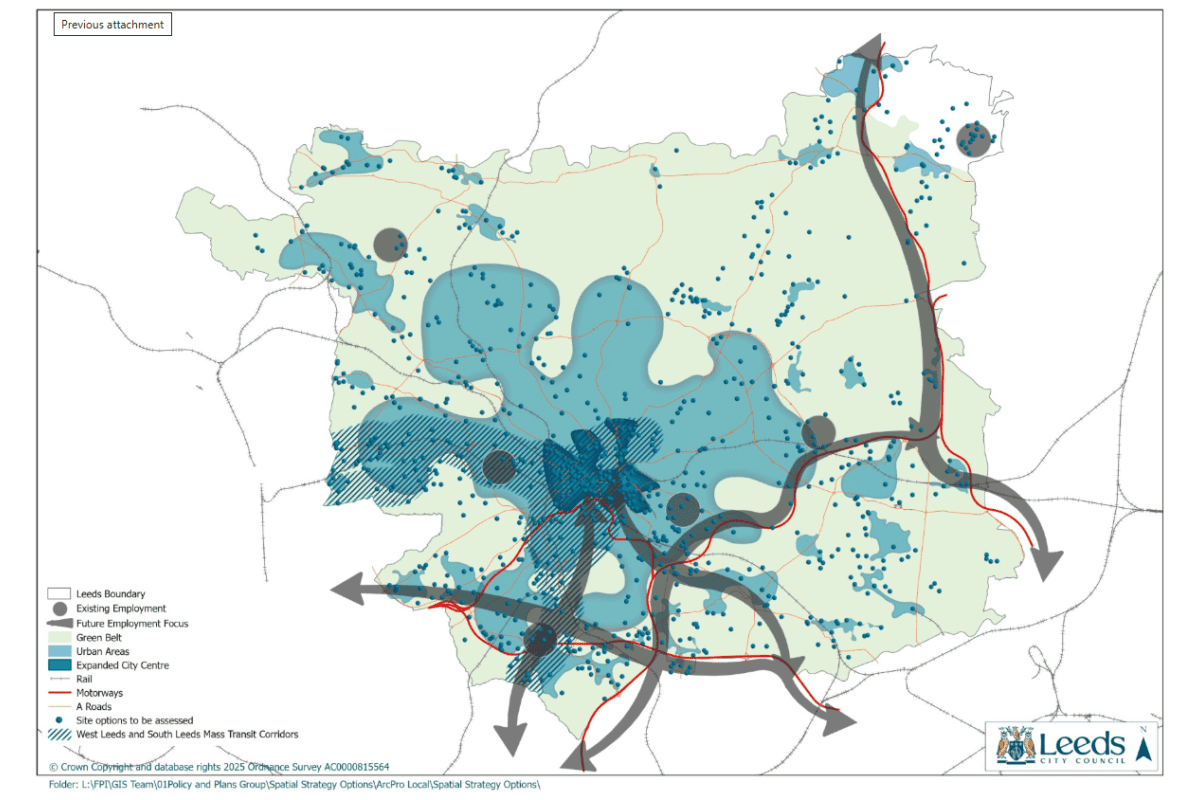
Objective 15 - Be better connected by maintaining and enhancing an accessible and integrated transport system that links people to jobs and services and makes best use of the rail and canal infrastructure for moving freight
achieving a well-connected place with a strong transport system is a key priority for the City Council
the plan will match with other transport strategies, directing development to support sustainable transport options and improve transport infrastructure provision
Leeds Bradford Airport's growth will be supported by sustainable transport
historic freight sites on canals and railways will be protected to reduce road traffic and pollution
Objective 16 - Direct a significant proportion of development to locations where it has potential to stimulate and support wider investment, regeneration and inclusive growth
significant portions of Leeds are still in need of transformation and regeneration, particularly in its city centre and surrounding neighbourhoods, where there remains inequality and a lack of access to some of the city’s jobs and services
a Leeds Vision outlines a 10-year plan to address this, focusing on areas like Mabgate, Eastside & Hunslet Riverside, South Bank, and others
we will unlock new housing and commercial development opportunities on brownfield land that are close to existing communities
we will bring in investment and infrastructure e.g. more greenspaces, better connections, support for local centres
the Local Plan expects around 15,000 new homes to be built within this area alongside existing proposals for around 25,000 homes
Objective 17 - Align development with existing and planned infrastructure investment, ensuring that all development is adequately supported by the necessary social and physical infrastructure.
infrastructure supports sustainable development, including economic growth, community development, and climate mitigation – so is essential to plan for
new development puts pressure on existing infrastructure and we will identify what places have got the capacity for more development or what improvements are necessary
most infrastructure is managed by external bodies and the Leeds Local Plan plays a coordinating role to new infrastructure rather than delivering it itself
funding for future infrastructure will come from various sources: private developers, infrastructure providers, the Mayor and the Government
we will clearly set out the current and future infrastructure needs for the levels of growth planned for
Objective 18 - Ensure that development is located and designed to offer people a genuine opportunity to participate in sustainable and active modes of transport
the local plan will promote walking and cycling (“active travel”) for short journeys, which enhances physical health, mental wellbeing, and environmental benefits of using the car less
the plan will integrate “active travel” with public transport
we will prioritise locations for development where “active travel” can be delivered, matching with the Connecting Leeds Strategy and Local Transport Plan
Objective 19 - Make use of all suitably located, available and deliverable previously developed and underutilised sites.
we will maximize brownfield land and limit greenfield development
we will identify suitable, available, and deliverable locations – we’ve already found over 100 small brownfield sites
the plan will also look at how land in lower value uses, e.g. industrial areas, might be suitable for other uses such as housing, especially in places that are undergoing transformation or might have transport improvements e.g. a tram in the future
Objective 20 - Secure an uplift in the density of development throughout the District, with a particular focus on higher density developments in and around an expanded City Centre, town and local centres, and places that are well served by public transport.
the UK is sparsely populated compared to Europe - the plan will promote higher density development to efficiently use land and maximize infrastructure
high density does not mean high rise and the plan will make sure that design supports healthy and sustainable places
the plan will focus on hubs – increasing density in the City Centre, town and local centres to support shops, services, and sustainable transport with a higher number of customers within walking distance
Objective 21 - Ensure that new developments are located and designed to reduce and mitigate flood risk, and manage water, taking into account the impacts of climate change
winters in the UK are getting wetter, and rainfall is expected to keep increasing, with some parts of Leeds already face serious flood risks, as seen during the record-breaking floods of 2015
the Leeds Local Plan will manage flood risk to ensure safe development amid climate change
we will apply a ‘sequential test’ to prioritize lower flood risk areas for development and limit building in functional floodplains to water-compatible uses or essential infrastructure
the plan will introduce policies for safe evacuation routes during floods and require risk assessments for developments in areas with flood defences
we want developers to better manage water on sites and will encourage Sustainable Drainage Systems to manage surface water and improve biodiversity
Ensuring the quality of places and development
The Local Plan will set some rules about what new development should look like. This is important because new homes, factories and offices should make a positive contribution to places and the way they are built, laid out and connected helps meet wider City Council ambitions for health, accessibility and nature. We want new development to make Leeds a better place to live in and invest in.
These objectives set out the City Council’s draft direction of travel and we want to hear your views. Find out how you can get involved at
Objective 22 - Secure the delivery of high quality, sustainable and resilient places that people of all demographics want to live, work and play in
people expect new development to enhance a place and contribute to its townscape and character
the Leeds Local Plan will ensure high-quality design for buildings and spaces, addressing climate change, energy use, car dependency, community cohesion, and health & wellbeing.
it will embed principles for a Child Friendly City, considering high-quality design, access, and places to play
the City Council is also keen to include design principles for the elderly, those with mobility needs, and gender inclusivity, focusing on safety and access
as part of the Local Plan we will implement a city-wide Design Code with specific area-based codes for significant changes, like the expanded City Centre and major development sites
Objective 23 - Sustain and protect valued community facilities, to maximise social, environmental and economic benefits for residents across the District
the Local Plan will protect and provide community facilities to support social interaction, access to services, and community cohesion
we will plan positively for arts and cultural facilities, including public art, regeneration, and protection of existing assets
the plan will seek social infrastructure through site requirements on allocated sites where deliverable
the plan will also support the Council’s food strategy by promoting local food systems, community food growing, and urban agriculture
Objective 24 - Sustain and enhance important heritage assets in all communities and locations, by maintaining heritage buildings, proactively planning for future maintenance and change and recognising the role that they play in the quality of place and quality of life for District and its people
across Leeds there are over, 3,300 listed buildings and 81 conservation areas, as well as Historic Parks & Gardens and a wide variety of non-designated heritage assets and archaeological sites
the historic environment plays a key role in the character and identity of places
the Local Plan will conserve and enhance the historic environment, including listed buildings, conservation areas, and heritage assets
we will streamline our existing range of heritage policies to align with national guidance and make them easier to apply
the plan will promote reuse of historic buildings for residential, community, economic, and cultural purposes, focusing on sustainability and efficiency
there will be support for growth in heritage-rich areas with a framework for integrating new development that has less harm to local character
Objective 25 - Increase the re-use of buildings and their construction materials
there are hundreds of thousands of existing buildings in Leeds which could continue to provide a role for occupiers – the plan will promote their reuse rather than demolition and rebuild
the local plan will encourage efficient use of construction materials and resources by making homes and businesses more efficient – this helps reduce the need to dig more minerals out of the ground
we will promote what’s called a “Circular Economy” which is about reducing waste and pollution, to retain materials at their highest value, reuse or recycle them
Objective 26 – Protect, enhance and increase the amount of green and blue infrastructure across the District
Leeds’ green spaces, woods, countryside, wetlands and urban green and river corridors are part of what makes up the city’s character and sense of place
the Local Plan will integrate green and blue infrastructure into development planning to enhance sustainability, resilience and quality of life
we will use green and blue infrastructure to help deal with climate change and the resilience of our places to warmer/drier summer and wetter winters, making sure that developers approach sites with the environment in mind first so that benefits can be built in from the start
Objective 27 – Protect and enhance biodiversity throughout the District, particularly by requiring new development to deliver net gains and be designed with the environment as a priority, to maintain healthy ecosystems, ensure healthy residents and address climate change
we know that as a country and a city our nature is severely depleted due to factors like agricultural practices, urbanisation, and infrastructure development, which have led to habitat loss and the decline of various species
we want to set out a framework for nature recovery in Leeds which involves protecting, enhancing and connecting nature to help it better recover
we will do this working through the Leeds Habitat Company, which will help developers compensate for biodiversity harm on sites across the city where improvements efforts can be focussed and bring nature closer to people
Objective 28 - Ensure that development is constructed to sustainable construction standards so that they do not need to be retrofitted in the future and use resources, such as water, wisely as well as protecting the water environment from pollution
fresh and clean water is a basic necessity and household and commercial demands from new development is met by Yorkshire Water
they consider that remedying leakage will be the key means of ensuring that demand for water does not outstrip supply in the future, but with increasing impacts of climate change, including more frequent and severe droughts and hosepipe bans, there is a role for new development to play in making efficient use of water now
the local plan will require new developments to use water efficiently and meet high water efficiency standards
Objective 29 - Minimise the use of carbon through the design of new development including through assessing its whole life cycle carbon emissions and adopting sustainable construction standards to deliver low operational energy buildings that do not need to be retrofitted in the future
the Local Plan has to face up to the challenges presented by the well understood and evidenced changes to global temperatures and their impacts on our health and security
we believe that we should support a transition to a low carbon future and one of the ways of doing that is to reduce the carbon footprint of buildings
the Local Plan will set rules that developments must calculate their total carbon emissions over their lifetime, design energy-efficient buildings to avoid future retrofitting, and adopt sustainable construction standards for heat, power, water use, and design
the Government has yet to publish national rules on these matters and the Local Plan will need to consider these
the City Council will need to balance carbon impacts from new buildings with developers concerns about feasibility and costs
Objective 30 - To maximise local energy resilience by encouraging Heat Networks that take advantage of low carbon heat generated in the District and by encouraging large scale development to create new local networks served by low or zero carbon energy
the Leeds PIPES network provides homes, businesses, and public buildings with heat and hot water that is affordable, reliable, and low carbon
the network already has several connections and new development will be encouraged to connect to these
the Local Plan will also support the growth of the network and identify suitable developments, like data centres, to support more heat being re-used
Objective 31 - Strengthen the role of Leeds city centre and the 62 local centres across the District to improve their vitality and viability and provide a hub for local services for communities
Leeds City Centre is crucial both locally and regionally, while our 62 town and local centres have become even more significant since the pandemic due to changes in shopping, living, and working habits
the Local Plan will encourage the growth, management, and adaptation of local centres to ensure they thrive and continue to serve their communities
surveys and analyses of Leeds’ centres assessed things like environmental quality and accessibility
town and local centres are among the most sustainable areas in the district – the Local Plan will support housing in these centres to boost economic vitality and viability, making sure that this doesn’t negatively affect their retail, cultural and commercial functions
the Leeds City Centre boundary, defined in 2001, needs updating to reflect current and future development needs, ensuring the city centre remains fit for the future
Objective 32 - Promote and protect valued culture, leisure and tourism related development across the district to support a vibrant and sustainable visitor economy and improve health and wellbeing for residents
Leeds is the 4th most visited city for day trips and 5th for overnight trips in England generating £823 million and £489 million for the local economy
our visitor economy is important, and we will use the plan to enhance leisure and cultural offerings
the Local Plan will consult on whether the current approach to leisure and tourism activities is effective and if the City Council's support for hotels and facilities outside the city centre is proactive enough
the Local Plan will promote rural tourism and the role of the District's important waterways in attracting visitors
while short-term lets offer flexibility for tourists and business travellers, they can impact local housing availability and cause anti-social behaviour, so the plan will consult on measures to balance community needs with boosting the visitor economy
Objective 33 - Ensure no development will impose unacceptable effects on the health, amenity or natural environment of the surrounding area, considering existing sources of air pollution in the vicinity.
development can lead to unintended consequences on third parties affecting things like the environment and public health
air pollution can cause respiratory and cardiovascular diseases, significantly contributing to local mortality rates, so the plan will update its air quality policy to ensure developments include air quality assessments and mitigation measures to prevent increased pollution
the City Council will also assess the impact of new developments on residents' visual and residential amenity, including design, privacy, sunlight, noise, and other disruptions
Objective 34 - Protect and enhance areas of landscape importance across the District, from farmland, semi-natural habitats, river valleys and former quarries to former industrial land and urban parks, so as to guide change within landscapes and maintain a sense of place for the District
Leeds is characterised by a rich and diverse landscape, encompassing both urban and rural areas
the current plan identifies areas with high landscape value based on the 1994 Leeds Landscape Assessment, given little change in the rural parts of the city we have no immediate plans to review this assessment
while the overall landscape remains largely unchanged, focused assessments will be needed for growth areas and individual sites
the Local Plan will expect developers to provide evidence to justify and mitigate landscape impacts for potential developments
Objective 35 - Promote the role of the countryside through supporting the rural economy whilst protecting and enhancing local character and the environment
two-thirds of the Leeds district is made up of countryside, much of which is classed as Green Belt but with an area of rural land to the north east
the Local Plan will support the rural economy, recreation, well-being, and climate resilience while protecting local character and the natural environment
the Local Plan will create a headline policy for the countryside, addressing local sensitivities and development pressures
Assessments supporting the Leeds Local Plan
The Leeds Local Plan is a legal document that will be examined by a Government appointed inspector. To make sure that the City Council submits a sound and legally compliant document a number of assessments are needed. These can be found on our web-site.
Sustainability Appraisal - a sustainability appraisal is a method used to evaluate the possible social, economic, and environmental effects of a plan. Its goal is to make sure decisions support sustainable development by finding and reducing negative impacts while enhancing positive ones.
Duty to Cooperate – an obligation on the City Council to make sure it talks to its neighbouring local authorities and Government bodies responsible for the environment, heritage and transport. Its goal is to make sure the plans are effective and that there are no surprises for local people from plans outside of Leeds
Habitat Regulations Assessment – some areas of nature have very high levels of legal protection and the plan has to make sure that it does not harm them, some of these areas are outside of Leeds, but the City Council still has to check the impacts of development in Leeds on them
Evidence supporting the Leeds Local Plan
In support of all the objectives of the Local Plan the City Council is developing an evidence base on a wide range of topics. Some are already completed, such as:
the Strategic Housing Market Assessment – telling us how much affordable homes we need
the Employment Land Needs Assessment – telling us how much land for industry and logistics we need
the Strategic Housing and Employment Land Availability Assessments – telling us how much land is currently available for development but not whether it is suitable
the Strategic Flood Risk Assessment – telling us where in Leeds floods and the role that the flood defences play in reducing the risk of flooding
A Local aggregate assessment - telling us how much aggregate is needed in West Yorkshire
Some evidence is still to be completed, including:
a Green Belt Review – which will tell us how important different bits of the Green Belt in Leeds are and help to decide what the impact of their release for development might be – this is currently in the process of being done using Government methods which have only just been released
a Gypsy and Traveller Needs assessment – this will tell us what the needs of the travelling community are in the district
an updated Green Space audit – looking at the sites that we need to protect as green spaces and where there are gaps in provision across the city
a Viability Assessment – which will look at whether developers can deliver development that meets all the rules of the plan
an Infrastructure Delivery Plan – which will tell us what infrastructure can support development and what more needs to be delivered
further site assessment work – this will include landscape, heritage, biodiversity, contaminated land and environmental health assessment as well as transport impacts
Site Allocations
The Leeds Local Plan will guide development by specifying where and how different types of development (housing and employment) should be located. These allocations help ensure a balanced and sustainable use of land, promote development and provide clarity for developers and local residents.
At this early stage of the plan no decisions have been made on which allocations should come forward for development.
The consultation is seeking your views on sites and to help you reach a view we have done some initial assessments of the pros and cons of sites that we know about.
To help manage the scale of Leeds the City Council has divided it up into 11 sub-areas and each site has been assessed on its impacts on social, environmental and economic factors. Each site has been given a score as follows:
Score | What this means? |
| Lots of positives to developing this site |
| A few negatives to developing this site |
| A lot of negatives to developing this site |
| Some serious concerns to developing this site |
The maps below show the range of sites and initial scores across Leeds. More information is available on these proposals.
These scores are highlighting where sites have problems that would need to be addressed if it was to be brought forward for development e.g. impact on trees or flood risk. Developers can overcome these issues by avoiding potential harm or amending the site boundary.
The City Council will consider multiple factors when deciding which sites to develop, including the assessment scores, sustainability, infrastructure impact, environmental and flood risks, and public input through the consultation.
We will also look at how we can meet local housing needs in each of the 11 sub-areas i.e. what the evidence tells us needs to be built based on levels of growth and need for affordable housing. Find out more about this.
We will prioritise brownfield sites, assess recent housing delivery, and ensure developments align with the overall strategy and those that are attractive to developers.
A separate methodology and site assessment is available for minerals, waste, renewables and energy centre proposals.
Getting involved in the Local Plan
We will hold drop-in events in each sub-area and have a dedicated web-site.
The consultation will follow principles of trust, timeliness, visibility, inclusiveness, and transparency, as outlined in the Statement of Community Involvement.
The City Council aims to receive responses from every ward, get positive feedback on consultations, and increase engagement from young people (under 25)
What can you do next?
You can get in touch and tell us what you think
You can go on-line and have a look at our consultation material – this is broken down by topic so feel free to only tell us about what is important to you
You can attend one of our drop-in sessions or neighbourhood activities
You can speak to your local ward member
We look forward to hearing from you!
Discover more
Statement of Representation
Providing details about the purpose of the consultation, how to view the material, how to submit comments, accessibility and privacy notice.
Archived 2025 Consultation Material
This is for information only

Further information
Explains the work already undertaken on the Plan and the new plan-making process
Leeds Local Plan Issues & Options Consultation Report
Summary of the Leeds Local Plan Issues & Options Consultation Summer 2025

Leeds Local Plan Scoping Consultation Document
We would like your views on which general topic areas the Leeds Local Plan should cover and how you would like to be consulted as the plan is developed.
Stay Informed
Follow our projects to get notified of upcoming engagements and the latest project related news.