
Exploring a Stormwater Management Fee
About
WHAT IS STORMWATER INFRASTRUCTURE?
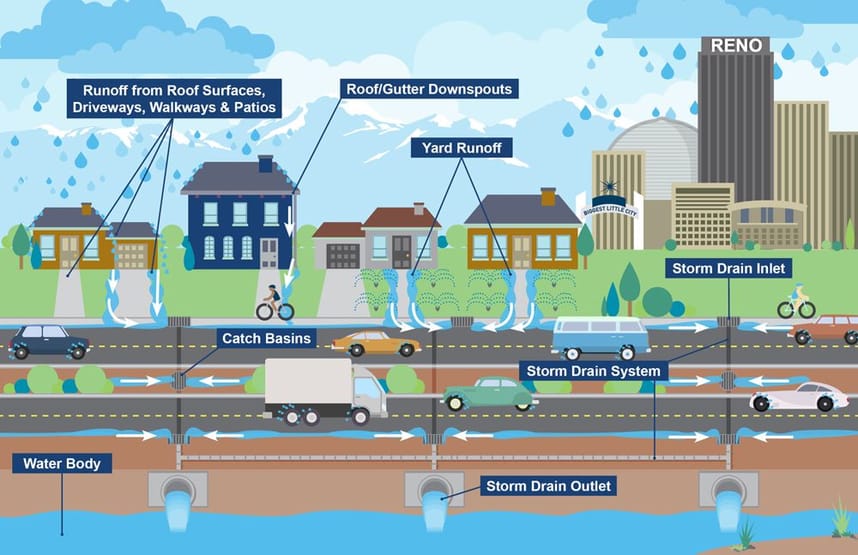
The EPA defines it as the system “designed to move urban stormwater away from the built environment and includes curbs, gutters, drains, piping, and collection systems.” It’s the system that “collects and conveys stormwater from impervious surfaces, such as roadways, parking lots and rooftops, into a series of piping that ultimately discharges untreated stormwater into a local water body.”
HOW LONG DOES IT LAST?
Stormwater infrastructure has a life expectancy of 40 years. That means, after 40 years, underground pipes will have eroded and begin to collapse, street-level inlets will have sunk below the pavement level, manholes will erode from the bottom up, and curbs and gutters will have sunk or have eroded away. Unless you live in one of the most recent streetscape areas of the city, most of us can look in front of our homes or businesses and see that aging infrastructure adjacent to any street. While the inlets and pipes next to and going through the levee were replaced 28 years ago, much of the city’s system began to be installed 70 years ago and hasn’t been replaced since.
HOW DID THE CITY AFFORD TO INSTALL IT TO BEGIN WITH?
When the city originally took on the project of installing curbs, inlets, and underground pipes to carry away rainwater, snowmelt, and eventually discharges from sump pumps, the city paid for it by charging each property owner for the cost of the work adjacent to their property. The city placed a lien on each property and owners were required to make regular payments on the lien. If property owners didn’t, the city could file a writ with the court and collect the money by either forcing the owner to sell assets or the property itself. While heavy-handed, it is one way of securing the funds needed to install and upgrade infrastructure in the city.
SO WHY IS THIS FEE BETTER?
Instead of putting a lien on each property, the city is exploring charging an annual (or quarterly) fee charged to each property called an Equivalent Residential Unit (ERU). The city’s engineers as Gwin Dobson & Foreman reviewed every parcel of land in the city to compare what percent was pervious (like grass), and what percent was impervious (like your home or paved driveway). The pervious areas let rainwater and snowmelt leach into the ground, but the impervious areas create water runoff that is carried away through the city’s stormwater system of curbs, inlets, and underground pipes to the river. The average of all residential properties becomes the ERU. If you have ever lived somewhere that bills your sewer by EDU (Equivalent Dwelling Unit) like Bald Eagle, Castanea, Woodward, and Mill Hall all do, that charge is figured out the same way by having an engineer calculate the average use and then charging everyone that same fee. The ERU could be added as a line-item on your quarterly water/sewer bill for property owners in the city limits.
WILL RESIDENTS AND BUSINESS ALL PAY THE SAME RATE?
While residential properties would pay a single ERU amount per year, commercial or industrial properties would pay a number of ERUs. A commercial building on a completely paved lot with no pervious area at all may be several ERUs, while a small commercial building on a large grassy lot may pay only 1 or 2 ERUs. The engineer would individually examine commercial and industrial properties to assess an appropriate number of ERUs for each property. However, residential properties would only pay the single ERU fee.
WHAT WILL THE CITY SPEND THE FEE ON?
The city would be able to use a portion of the funds each year to address immediate needs where infrastructure has failed (like missing curbs in a portion of a street or sunken inlets); however, the majority of the funds each year would be used to replace (or in some cases install for the first time) the curbs, inlets, pipes, and in some cases sidewalks, in the city’s right-of-way with a modern system engineered to ensure proper sizing to meet the current and future needs of your neighborhood. For example, the smallest pipes would likely be at the top of the hills, but those need to increase in size as you head downhill toward the river where more and more lines will be combined in larger pipes to carry away the water to the river.
The city can also use the money to pursue some “green" stormwater infrastructure which the EPA describes as “designed to mimic nature and capture rainwater where it falls. Green infrastructure reduces and treats stormwater at its source while also providing multiple community benefits such as:
• Reducing localized flooding (like backed up inlets)
• Improving community aesthetics
• Improving economic health by increasing property values and providing jobs opportunities for small businesses
Installations like rain gardens and other attractive natural mechanisms that retain runoff and let sediment settle before the water then flows through pipes to the river would be something that the city could implement where appropriate that would help to improve the water quality of the river.
Stay Informed
Get notified on upcoming engagements and the latest project related news.
