
London Data Week: community research on Haringey high streets
For London Data Week, Neighbourly Lab, a non-profit organisation with a mission to increase social connection in the UK, partnered with the GLA High Streets Data team and Haringey Council to carry out
Cost of Living Community Research Project
For London Data Week, Neighbourly Lab, a non-profit organisation with a mission to increase social connection in the UK, partnered with the GLA High Streets Data team and Haringey Council to carry out a community research exercise. Community research involves members of communities carrying out research in their locality and contributing their own knowledge to deliver more authentic insights. In two stages, the exercise explored and documented experiences of a particular high street in London (Green Lanes).
This initiative will result in a Neighbourly Lab report, highlighting the benefits of democratising civic data to residents (that is, making data more accessible to a wider range of people and breaking down barriers that prevent people from accessing information that could assist them).
As a proud, former resident of Haringey, I am aware of varying stereotypes and have been intrigued by ongoing high street changes. Green Lanes high street is extremely diverse, known for the vibrant collection of Greek, Turkish and Kurdish eateries, wedding boutiques, or just the local pharmacy and Sainsbury’s for residents.
Producing work that ‘fact checked’ any assumptions, showcased what fuels high street transformations and centred resident perspectives of changes, motivated my interest in this research exercise.
Design of research questions & deliberation
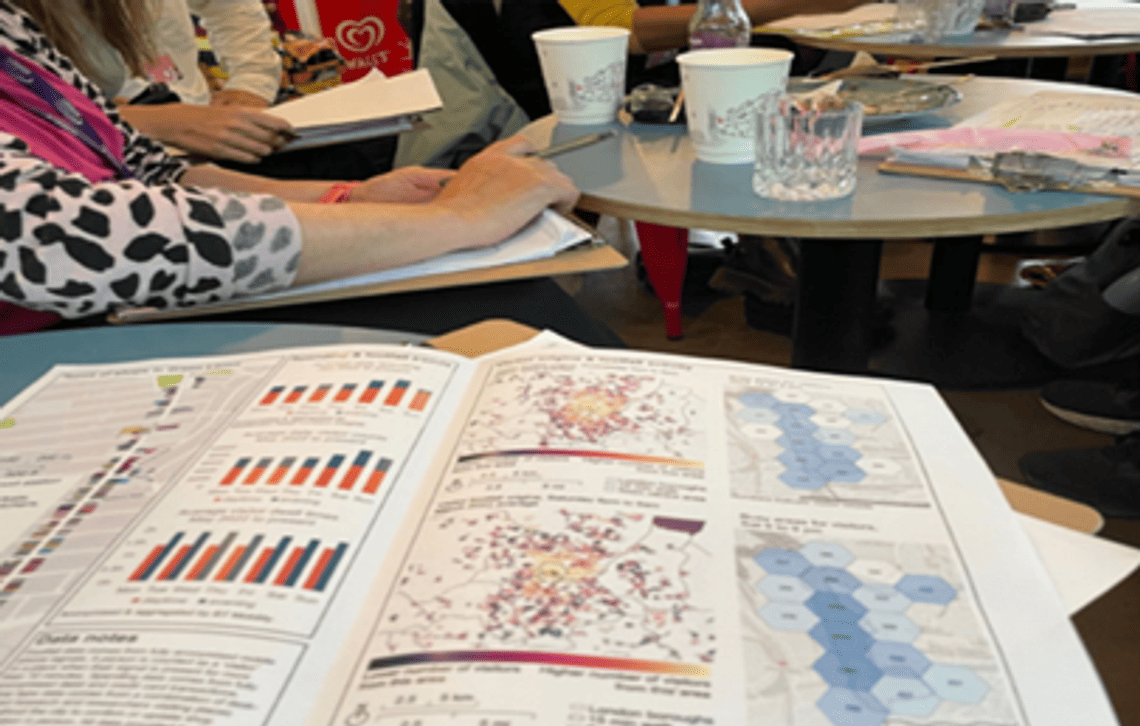
Quantitative data on Haringey high streets
The project began with a workshop analysing the quantitative (statistical) data provided by the GLA High Streets team on two Haringey High Streets: Green Lanes and Seven Sisters. In the form of graphs and figures, the data highlighted which areas most people visit on the high street, the time of day most people visit, and what area of the borough visitors come from. This was central to designing the questions used to connect with individuals during the community research stage.
Researchers were then asked to reflect on the data using their knowledge of the high streets and personal experiences. Surprisingly, the quantitative data told a vastly different story to the residents’ perspectives!
For example, one graph showed that the area of Green Lanes closer to Turnpike Lane was densely populated, suggesting that many people shop in that area. Instead, one researcher attributed this to the traffic on the narrow road, which "practically lives in the area".
All researcher reflections highlighted the importance of incorporating resident opinions into data gathering. This qualitative data – information sourced from non-numerical expressions, opinions and lived experiences – complemented the quantitative graphs.
Without qualitative insights, data can only inform us what exists, but not what it means for Haringey communities or how accurate and representative information is. In turn, decisions impacting residents, if solely reliant on quantitative data, may be less impactful.
Designing the research day included choosing a high street to focus on (Green Lanes) and formulating questions used to ask passers-by and shopkeepers. The research approach taken, matched the community researchers’ interest in outcomes being used to improve the lives of Haringey residents. This included questions that were tailored to centre local experiences, and draw out insights that could potentially be used in the future.
Research day
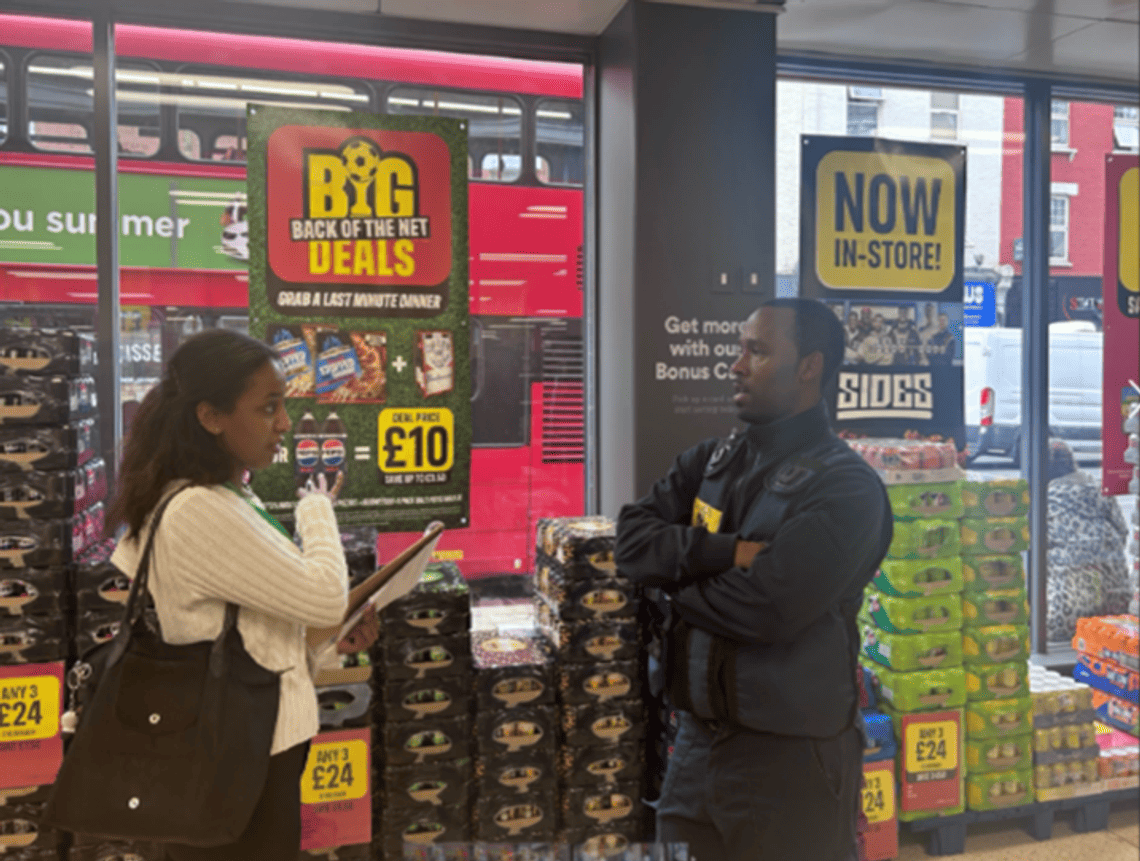
An interview between a participant and a community researcher
As expected, some people did their best to avoid questioning – with the sight of me and a clipboard – put their earphones in, quickened their pace or did the quick smile before looking forward and walking on.
I expected this slight misapprehension, which I counteracted through explaining my motivations as a community researcher and lived experiences in Haringey within my introductory approach. This, alongside, explaining how the research could improve their experience, contributed to a conversational and honest interview. It felt more relational, rather than transactional and one sided. If this format is modelled for further research projects, I feel this would improve the perception and trust towards the council.
Most people were friendly, with the diversity of commerce, crime and the debate over using cash or card, being common talking points. While there is a rising trend of sophisticated crime in London, it was intriguing to see the impact of this in Haringey was slightly mitigated by the strong sense of community amongst individuals. Asking questions on the street may not give an accurate depiction of everyone situated on Green Lanes, but the fact that many spoke about keeping an eye out for others and even warning me of some crime hotspots spoke volumes.
On reflection, I am curious about the people who did not participate in the exercise and this makes me question the viability of in-person street interviews. The initial research approach included tailoring questions to centre on local opinions. However, the opinions of those who rejected questioning due to time constraints, or due to discomfort with the weather, were not recorded. Those people have also experienced Green Lanes and may have supported or challenged the opinions recorded that day, resulting in more balanced, accurate results.
Another researcher echoed this, noting they had "fundamental qualms about the methodology" despite acknowledging, "the research outputs suggested quite clearly that qualitative research is a necessary complement to quantitative data which is what we most often rely on".
Finally, I’d like to thank my fellow community researchers who were involved in the research. The process, for those of us who have lived in Haringey, was extremely rewarding. Ensuring the locals we questioned had their thoughts documented, and clarifying in-person that their opinions were not invisible, was personally enriching.
I would highly recommend taking on any community research opportunities, if available.
Stay Informed
Follow our projects to get notified of upcoming engagements and the latest project related news.