
Conservation and history
Find out more about the local conservation and the historical significance of the site of Ladywell Playtower.
Ladywell Playtower
Conservation and history
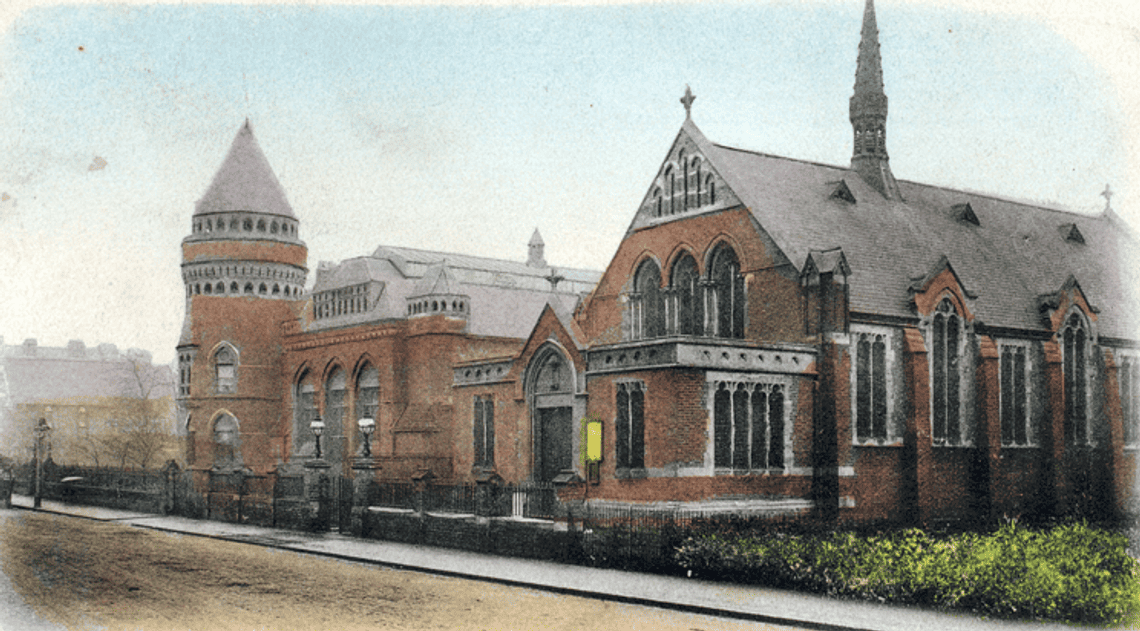
Left: Ladywell Baths and Coroners Court, Ladywell, Lewisham, c1900s, LEW PH70/3803, Courtesy of Lewisham Heritage, Lewisham Council
Right: Ladywell Recreation Ground, 1979, LEW PH79/8796, Courtesy of Lewisham Heritage, Lewisham Council
History
Ladywell Baths was listed at Grade II* in November 2006, shortly after a fire that badly damaged the building in the same year.
The Ladywell Baths were erected in 1884 to the designs of Wilson & Son and Thomas Aldwinkle. The Baths were built on a site owned by the vicar of adjacent Grade II St Mary’s Church. The site was chosen as it is on the main road into Ladywell from Brockley, Catford, Lewisham and Hither Green and afforded a position close to other civic buildings, such as the former Coroner's Court, Police Station and Fire Station.
Ladywell Baths was nationally designated at Grade II for the following principle reasons:
- Historic interest
The Playtower is one the earliest surviving baths in the capital, built shortly after the 1878 amendment to the Baths and Warehouses Act. - Architectural interest
With its imposing façade to Ladywell Road, it has an attractive design in a muscular Gothic style, a bold architectural statement strongly expressed. It's first-class pool interior was one of the largest of its time. The characterful details in the turret-like sections flanking the pool hall and the oriel window in the tower also provide plenty of visual interest and a local landmark. - Degree of survival
It has surviving historic fabric and plan, with its entrance to the lobby north with rooms for a caretaker on upper floors, first class pool hall running north to south, second class pool hall (badly damaged and now of less interest) to rear of building and a series of changing and bathing rooms with surviving slipper baths to the east. - Group value
The building has group value, with the surrounding municipal buildings holding 19th century architectural significance.
Other notes
- The front boundary wall is part of the building’s curtilage and its setting and therefore forms part of the listing.
- There are no Tree Preservation Orders (TPOs) on this site. However, the established trees on site are important to the buildings setting and conservation area and would be considered a material consideration in the planning process.
- Most of the windows in the building are original. Original fabric also exists within the building, including in the slipper baths and changing rooms, which are not mentioned within the listing description.
- Careful illumination of the building could be incorporated to bring it to life at night to highlight its landmark qualities.
- The first-class swimming pool hall is of significant interest and is therefore likely to be the most sensitive area within the building. The railings from the raised balcony were removed to allow access to repair the roof timbers and are in storage for reinstatement.
- Most sensitive views are looking down Ladywell Road from Lewisham High Street and looking north towards Lewisham High Street from Ladywell Bridge leading to the baths themselves. Surrounding streets such as Church Grove and Wearside Road offer distinct views to the building and which are focal points at the end of their roads. Longer views of the Playtower and surrounding buildings are important and are described further in the conservation area appraisal.
To note: Ladywell Baths is the name used in the listed building description. Since the 1970s the building has been more commonly known as Ladywell Playtower.
St Mary's Conservation Area
The details below were taken from the Council’s St Mary's Conservation Area Appraisal and relate specifically to the area where Ladywell Baths are located, or to the building itself.
- St Mary’s Conservation Area centres around around the Grade II* listed St Mary's Church and was the birthplace of Lewisham town. Its former late 17th century Vicarage, listed at Grade II, and the small church and the small mid 19th century houses on Ladywell Road are reminders of historic Lewisham.
- The conservation area is characterised in particular by St Mary’s Church, its churchyard setting and the strong group of Edwardian civic buildings which stretch almost uninterrupted from St Marys School and the former library in Lewisham High Street to the former Ladywell Baths (Playtower) and St Mary’s centre in Ladywell Road. These buildings are of high quality individually, but particularly special as a group.
- Lewisham Vestry (the local administration at that time) was progressive in 1882 in appointing seven commissioners to build two swimming pools ahead of other authorities. Ladywell Baths built in 1884 is one of the earliest surviving public swimming pools in London.
- The small terrace houses on Ladywell Road opposite the site and their cottagey front gardens, give the conservation area a village feel. Again, the tower of the former baths is a key focal point imposing on the streetscape and leading the eye to other brick buildings and the fire station tower further on. A green space between the former baths and the coroners court provides a soft foil to the bright red brick of the buildings as well as adding spaciousness and visual relief. The space is enclosed by a continuation of the wall from the baths.
- Approaching the area from the south the church and its churchyard provide an immediately recognisable presence. At this point a footpath leads off the high street through the churchyard behind the "Coroners Court", former Ladywell Baths (Playtower) and St Mary’s centre to Ladywell Fields and Ladywell Road. The churchyard provides the setting for the church as well as the rear of the Ladywell baths site.
- Character area 1: the civic centre is the dominant part of the conservation area with Victorian and Edwardian buildings neighbouring each other from the former public library on Lewisham High Street to the former Ladywell Baths (Playtower) on Ladywell Road. These are fine civic buildings which are all the more important as a group. The predominant building material is red brick with stone dressings with the building height varying slightly according to need.
- The condition of Ladywell Playtower detracts from the appearance of the conservation area, and significant enhancements could be achieved through the refurbishment of it, its wider site and its boundary wall.
Key views (as identified within from the Council’s St Mary’s Conservation Area Appraisal)
Approaching the conservation area, from the south the church and its churchyard, provides an immediately recognisable presence. At this point, a footpath leads off the high street through the churchyard, behind the coroner’s court and former Ladywell Baths (Playtower) to St Mary’s Centre, Ladywell Fields and to Ladywell Road. The churchyard provides the setting for the church as well as the rear elevations of these buildings.
The grain of development alters subtly through the conservation area with tightly packed three and four-storey terraces to the west side of Lewisham High Street, reducing to tightly packed two-storey terrace houses in Ladywell Road.
The eastern side of Lewisham High Street is more varied in height and grain than the west with several buildings of different periods having been fitted together without space between them. Here, there are small two storey 18th century houses, except the large three storey HE Olby building. The southern side of Ladywell Road shows a pattern in its seeming irregularity, where large, detached buildings of similar periods and styles vary gently in height according to their function and are set in their own plots leaving space between them.
Stay Informed
Follow our projects to get notified of upcoming engagements and the latest project related news.