About the project
Why do we need quieter residential streets to support walking and cycling?
With lower traffic levels during lockdown, we have seen more people with the confidence to walk and cycle around the borough. However, as the government restrictions are lifted, traffic volumes are increasing again, particularly with fears and pressures on the use of public transport.
Responding to these challenges is now a critical element of our responsibilities as a local authority to protect public health and safety as a result of the COVID-19 pandemic. Creating enough space for people to make their everyday journeys safely on foot and by bicycle is a vital part of our COVID-19 response.
An increase in cycling and walking trips has been observed and air pollution has dropped all over London since the COVID-19 lock down restrictions were put in place. However, with most footways not wide enough to safely accommodate two people passing one another whilst keeping 1m plus apart, people are having to frequently step into the carriageway or cross the road, which puts them at increased risk. Concerns about public transport capacity and use also mean that people need safe and attractive alternatives, in the form of walking and cycling. A car based recovery from COVID-19 is not a viable or sustainable option.
What if we did nothing?
When the requirement for social distancing was 2m, Transport for London (TfL) said that due to social distancing, capacity on the Tube will be reduced to 15-20% and 20-25% on buses. Although the social distancing requirement has reduced there will still be a significant impact on public transport capacity.
If nothing is done, TfL has done modelling has shown that there would be a doubling of car use in central London, assuming a third of pre-lockdown journeys return and those who cannot get on to public transport shift to their cars. This will result in increased car journeys outside of the central area.
To support this we are acting on advice from central government and TfL, by rolling out a series of schemes to ensure that people feel safe enough to walk and cycle whilst socially distancing. Creating quieter residential streets is one part of this.
Lewisham Council will be delivering a series of cycle and pedestrian only access 'modal filters' all over the borough to help keep traffic flows on residential streets to appropriate levels for safer and more comfortable walking and cycling. This is becoming more urgent as more restrictions are lifted and car trips continue to increase. This means residential streets are more likely to experience rat-running from ‘through traffic’ that is simply passing through an area rather than travelling to or from it.
We have provided some questions and answers on this programme below:
What is a modal filter?
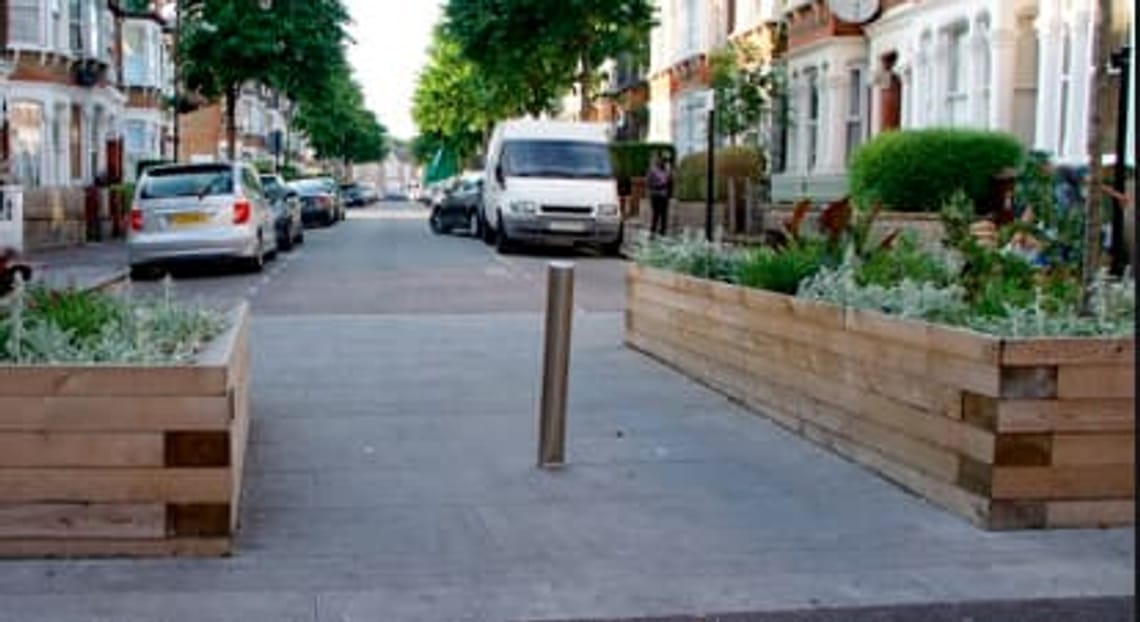
A modal filter is a traffic management measure that stops the majority of motor vehicles passing but allows pedestrians and cyclists through.
We will be installing 2 types of modal filters based on the specific location:
Type 1 = Planters and de-mountable bollards/barriers (see example in photo below). These will be used on roads that are not on emergency service priority routes or the bus network. A number of wooden planters with either trees or plants in them will be placed on the carriageway either side of a drop-down bollard or barrier. This design is simple and adaptable, allowing the filters to be used in many different locations and road widths.
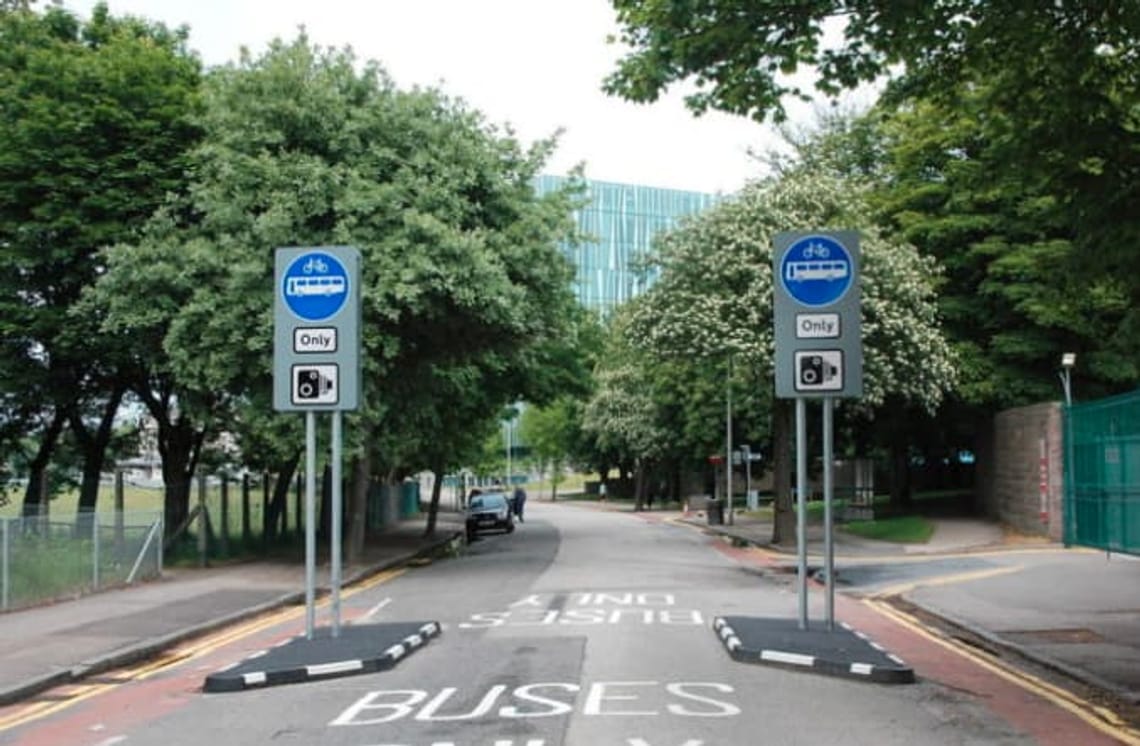
Type 2 = Camera enforced (see example below). These will be used at locations on bus routes which will restrict all traffic apart from buses and emergency service vehicles. Any other traffic passing
Will the restrictions be 24 hours a day, 7 days a week?
Once implemented the majority of modal filters will be active 24 hours a day, seven days a week. While areas may be most affected by through traffic during rush hour there is likely to still be a need to reduce traffic at other parts of the day to allow for social distancing.
How will emergency services be affected by the measures?
During the design phase the emergency services (ambulance, police and fire brigade services) are consulted on any proposed road changes and have the opportunity to feed into the design. All filters will retain emergency access, as described above. It should be noted that some boroughs who have already implemented modal filters, have seen decreases in some emergency service response times, or have received letters of support from their local hospitals for such measures in recognition of the role they play in helping key workers travel safely to work, and in wider public health.
How are we engaging with residents and businesses?
Due to the need to implement measures as a matter of urgency to protect public health and safety, there is insufficient time to run a pre-engagement process before we publicise details of the locations of the measures and then implement them shortly afterwards. In addition, due to social distancing requirements the borough is unable to hold any public meetings/drop in events before the schemes are installed.
However, we have provided an overview of the programme early on, with this publicised through the Council’s usual communication channels. There will be a dedicated project page for each location on our digital platform at https://lewishamcovidtransport.commonplace.is/ , including a list of frequently asked questions, which will enable you to provide feedback. Please sign up to ensure you are kept up to date with proposals.
Residents and businesses within the immediate vicinity of any measures will be notified by letter in advance of the measures being implemented. There will also be advanced warning notices and signage placed on affected streets.
What if there is an issue during the trial? Who do I contact?
During the trial each scheme will have a dedicated webpage which you can explore here and leave feedback on the locations, which will be closely monitored. However, if urgent, please contact the council switch board on 020 8314 6000 .
Unfortunately the Council does not have the officer resource to respond to every enquiry received which is why we are referring people to submit comments via the Commonplace page for each filter, listed by road name. We will be providing regular updates on any emerging issues and how these are being addressed. We will also add any common questions to this list on a regular basis.
Will the Council be adding further modal filters?
The first set of locations are not intended to stop every rat-run on residential streets, but focus on some of the key routes. This is based on traffic data, resident complaints, and/or officer observations. The footways in these locations are also below 3m. The Council will be carefully monitoring traffic data and the feedback received to identify if further locations are required to facilitate social distancing and safer walking/cycling. Locations will be prioritised based on a range of criteria including traffic volumes, footway widths, whether the location is on a busy cycle route, proximity to key facilities and volume of requests.
I am a business with regular deliveries by a large vehicle, how will these deliveries be affected?
Direct access to all properties will be maintained, but the restrictions may require a different route to be taken to get to your property or business. In addition, it could be an opportunity to review your deliveries to see if you could reduce the frequency or change the method of delivery to help us to make this a success. We are looking to put together a support package for high street businesses, subject to resources and funding. In the meantime, there are some useful case studies of where businesses have already achieved this on the Clean Air Villages project page, which the council was involved in with other partners - https://crossriverpartnership.org/projects/clean-air-villages-1/
I run a business where I am picking up and dropping off goods across different sites all within quite a tight timeframe – how will I be affected?
In some cases your journey times may be slightly higher as you may need to take a longer route to your destination. However journey times for some drivers may be lower as there should be less traffic during peak hours on local roads making it easier to travel in the local area.
Does this mean that I have to drive a lot further and down busy roads? Will this cause more pollution?
There will always be those essential car journeys that people need to make by vehicle, and for mobility impaired residents this may be every journey. However, for the rest of us the transport choices we make have a direct impact on not only our local community, but that of our neighbours.
So while initially journeys may feel longer and counter intuitive we expect that some of those journeys in the future will be made by more sustainable modes such as walking, cycling or public transport. So overall we expect there to be a reduction in car trips and therefore a positive impact on congestion and air quality.
I am a resident who uses my vehicle in the evenings due to concerns over the personal safety of me and my family – how will I be impacted by the trial?
All car journeys will still be able to be made but in peak hours these journeys may take slightly longer. At night, outside of peak hours, there may well be less traffic on the roads meaning quicker journey times. It is also expected that we will see an increase in cycling and pedestrian numbers which will help with improving natural surveillance. This will be monitored closely during the trial.
Plumbers, builders, electricians need to drive
These schemes don’t stop any property from being accessed by motorised forms of transport. With fewer unnecessary trips being made by car, journey times should improve for essential users who have less flexibility over their time/mode of travel.
Bin Lorries won’t be able to turn around
There are already numerous dead-end streets around the borough which are serviced by bin lorries. Depending on the layout of your street, they will either be able to drive through the restriction, reverse down the street (as they already do in many places), or turn around.
Road closures will just push all the traffic onto the main roads, causing longer journeys, traffic jams and more pollution
Previous studies have demonstrated that the filtering of a road, results in an adjustment of driver behaviour. Some people will stop making particular trips, combine multiple trips into one, travel at a less congested time, or switch to public transport, walking or cycling.
Initial figures from Walthamstow Village in north-east London, where modal filters have been introduced, shows levels on main roads initially increased by between 3% and 11%, but the number of vehicles in filtered roads has decreased by 56%. This means that across the overall area, there are around 10,000 fewer vehicles every day, an overall reduction in traffic of 16%. Over time, traffic levels have started to fall back to previous levels on main roads too. This is called “traffic evaporation” and has been observed in similar traffic reduction schemes across the world.
To summarise, over the long-term overall motor traffic capacity and volume has been reduced by filtering, but the increased congestion that can be seen in the first months of their operation is a temporary effect.
I can’t change my caring responsibilities or job routine in a week, how do you justify that?
It is recognised that people will need to rapidly adjust to the new arrangements, and some are more in position to do so than others – for instance, where they have flexibility on journey timings and mode choice. As explained, above, as this happens it is anticipated that we will not see a significant increase in journey times. However, in the initial stages, people may need to allow more time for any essential car trips.
How and when will the schemes be implemented?
Due to the temporary nature of the measures, Temporary Traffic Regulation Notices (TTRN) or temporary traffic orders (TTOs) will be used to implement the scheme. A TTRN allows a restriction to be in place for up to 21 days before it is either removed, extended or replaced with a TTO. The latter may be in place for up to 18 months.
Implementation of the first phase of 'Type 1' filters commenced from 15th-16th June. Details of subsequent modal filter locations will be provided on each project page upon launch. Advanced warning signage will also be in place.
How will you assess the effectiveness of the measures?
The immediate objective during the current pandemic is to install temporary schemes that aid social distancing and that create safe conditions for walking and cycling. This is a based on guidance from central government (click here for further info) and Transport for London (TfL) .
When we implement a scheme to improve an area for walking and cycling, we monitor its effects on traffic and air quality, including in the surrounding area, and work on new schemes to improve those areas and mitigate any possible consequences.
A successful scheme is one where the benefits of the changes to the area outweigh any dis-benefits, taking into consideration all the factors such as traffic flows, air pollution and community feedback. Traffic flow and pollution levels would be carefully monitored and taken into account when assessing the success of any scheme, and changes would be made accordingly. We will also continue to work with the emergency services to monitor the impact on emergency response times.
How are the measures funded?
The schemes are expected to be funded by Transport for London through their London Streetspace Programme, which has replaced Local Implementation Plan funding, at least until the end of September 2020.
TfL has advised that they intend to allocate funding for projects that fall within the three different areas below:
Quickly building a strategic cycling network, using temporary materials and including new routes, to help reduce overcrowding on the tube and trains and on busy routes;
Changing town centres so local journeys can be safely walked and cycled where possible, for example with wider pedestrian areas on high streets to give space for queues outside shops as people safely walk past while socially distancing; and
Reducing traffic on residential streets by creating low-traffic neighbourhoods right across London so more people can walk and cycle, whilst maintaining social distancing, as part of their daily routine.
There are also further funding streams available from the Department for Transport.
Will the Council consider making these measures permanent?
It is recognised that there may be an appetite amongst communities for some of the measures that are being put in place on an emergency basis to be retained on a more permanent, non-emergency basis. As these measures help to facilitate walking and cycling, this would be in line with the Council’s longer term policy objectives. Subject to future funding guidance from TfL, it is currently anticipated that the traffic data and public feedback gathered during the period of the TTRN/TTO could be considered in determining whether to use the Experimental Traffic Order (ETO) process to explore the viability of the long-term or permanent introduction of these and other measures. The timescales for considering this transition is likely to be linked to the easing of the lockdown restrictions and travel patterns therefore settling towards a 'new normal'.
How long would an Experimental Traffic Order (ETO) work?
An ETO may be in force for up to 18 months, forming a statutory consultation period, and during which time changes can be made to the scheme. Further data collection and consultation with residents would take place during this period to evaluate how the scheme had operated and whether any of the measures should therefore be made permanent. A review would be undertaken after six months. Once this had been understood, it would be given consideration in the context of the Council’s Healthy Neighbourhoods programme, which could be reframed accordingly and in line with any revised TfL guidance on the use of Local Implementation Plan funding. A formal decision would be taken on this by Mayor and Cabinet.
Stay Informed
Follow our projects to get notified of upcoming engagements and the latest project related news.