
Landscape and public realm
The addition of new landscaped public spaces will improve the look and feel of Forest Road, encouraging people to spent time in the area, shop locally and have pride in where they live. New paving materials and upgraded footways will help improve accessibility along and across Forest Road.
Proposals include:
• Retain existing healthy trees in the area and aim to plant at least 100 new ones
• Approximately 500 sqm of ornamental planting
• New seating areas and individual benches
• New on-street cycle parking
• Clear separation of uses between cyclists, pedestrian and vehicles
• New signage, wayfinding and traffic signals to help people travel along the route safely.
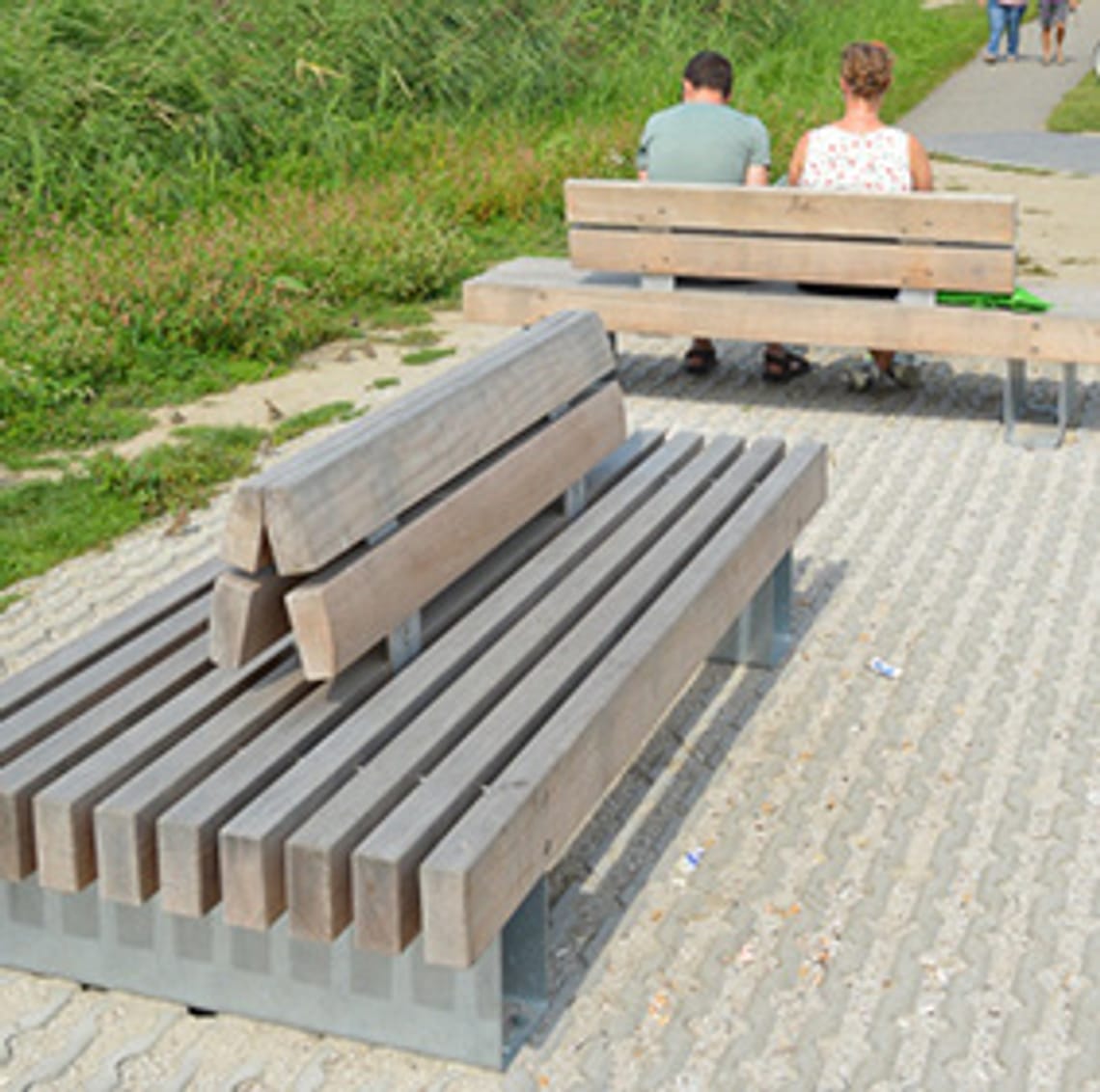
Seating example
SuDS proposals include:
• Aiming for up to 1,920 sqm of low-level SuDS (Sustainable urban Drainage Systems) and rain gardens that will be designed with drainage specialists
• Boulevard tree planting in tree pits and soft planting areas
• Existing trees retained
• 440m2 SuDS - permeable paving
• Potential for underground storage cells to be included in the design to further increase surface water attenuation and storage. This is currently being investigated as part of the design process.
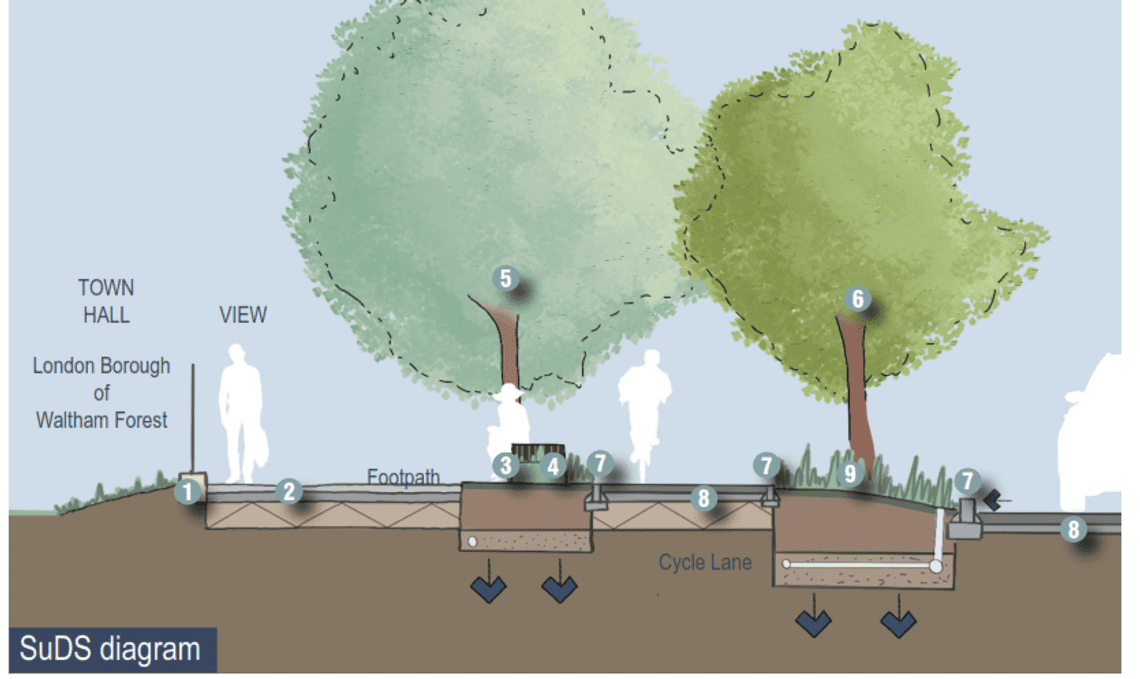
Key:
- Railing
- Paving
- Proposed biodiverse planting
- Proposed seating
- Retained trees
- Proposed trees
- Kerbs
- Asphalt
- SuDS and rain garden
Inclusive public realm
The public realm will be designed to be as accessible and inclusive as possible. The design takes into consideration and aims to meet Waltham Forest, TfL and National design guidance including London Cycling Design Standards (LCDS), Local Transport Note 1/20, Healthy Streets Indicators, and pedestrian comfort levels.
The following public spaces have been identified on Forest Road as areas we would like to improve with the help of the local community:
• Farnan Avenue / Town Hall junction (western end of the Town Hall)
• Forest Road Town Hall junction (eastern end of the Town Hall)
• Main Town Hall entrance – a proposed civic space and seating area
• Waltham Forest College / Forest Road interface
• Clocktower Square enhancements
• Interfaces with the new and existing residential developments, including at Winsbeach and Fulbourne Road.
Parking and Loading
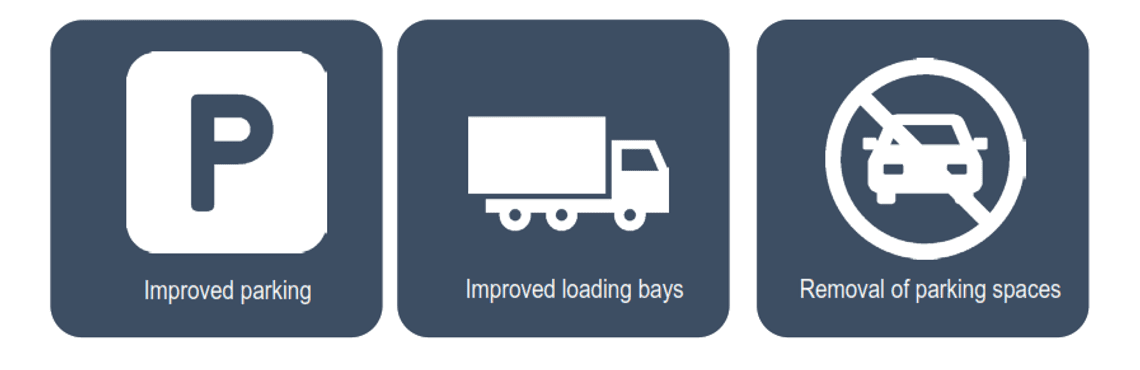
It is essential that parking and loading improvements meet the needs of residents as well as local businesses that are vital to the community and local economy. We have undertaken parking, waiting and loading surveys to understand current kerbside use and demand, and this has been used to inform the changes proposed as part of the scheme. We will continue to work with local businesses in particular to ensure their needs are considered.
Proposals include:
- Maintain existing access to off-street parking across the cycle track including drop kerb access
- No changes to waiting and loading restrictions
- Remove 3 parking bays on Forest Road between Fulbourne Road and Hale End Road to allow space for the segregated cycle track. The Car Club Bay at this location is no longer in use
- Remove 8 of the existing 18 parking bays on the Fulbourne Road to make space for the cycle track opposite the bus stop (Forest Road/Wood Street Library). The average utilisation rate of the existing bays is 59 percent. This will reduce the parking provision in this area to 10 bays
- Remove 2 parking bays on Woodstock Road (one from each side of road) near to the junction with Forest Road to create a vehicle turning area
- Remove 2 of the existing 6 parking bays on Forest Road between Woodstock Road and Ulverston Road to accommodate the relocated bus stop. The average utilisation rate of the existing bays is 56 percent. This will reduce the parking provision in this area to 4 bays
- Remove 4 of the existing 17 parking bays on Forest Road between Fernhill Court and Hylands Road to accommodate the eastbound cycle track, bus bypass and proposed planting. This will reduce the parking provision in this area to 13 bays
- Relocate the existing disabled parking bay outside 7 Fulbourne Road to outside 15 Fulbourne Road
- Retain the Disabled Bay opposite 822 Forest Road
- Retain the Disabled Bay opposite 1027 Forest Road
- Relocate the Car Club bay on Woodstock Road approximately 5 metres north.
Improved junctions and crossings
The scheme will introduce the following road safety and junction improvements to prioritise pedestrians and cyclists and slow down traffic:
- Reduce road width along the entire corridor to support lower vehicle speeds
- Increase the number of formal crossings (signal and zebra-style crossings) to provide safer places for people to cross the road
- Introduce continuous ‘single stage’ signalised crossings at junctions, to allow people walking and cycling to cross the road in one go rather than crossing in two or more stages
- Introduce blended ‘Copenhagen’ crossings that extend the pavement across side streets at key junctions, giving pedestrians a continuous pavement. This encourages vehicles to slow down when entering or exiting the side road, ensuring pedestrians and cyclists have right of way, as per the Highway Code. These crossings have been used across the borough since 2015
- Introduce dedicated cycle and pedestrian crossings to provide safe places for people to cross the road
- Introduce more raised tables to encourage vehicles to slow down when approaching the crossings.
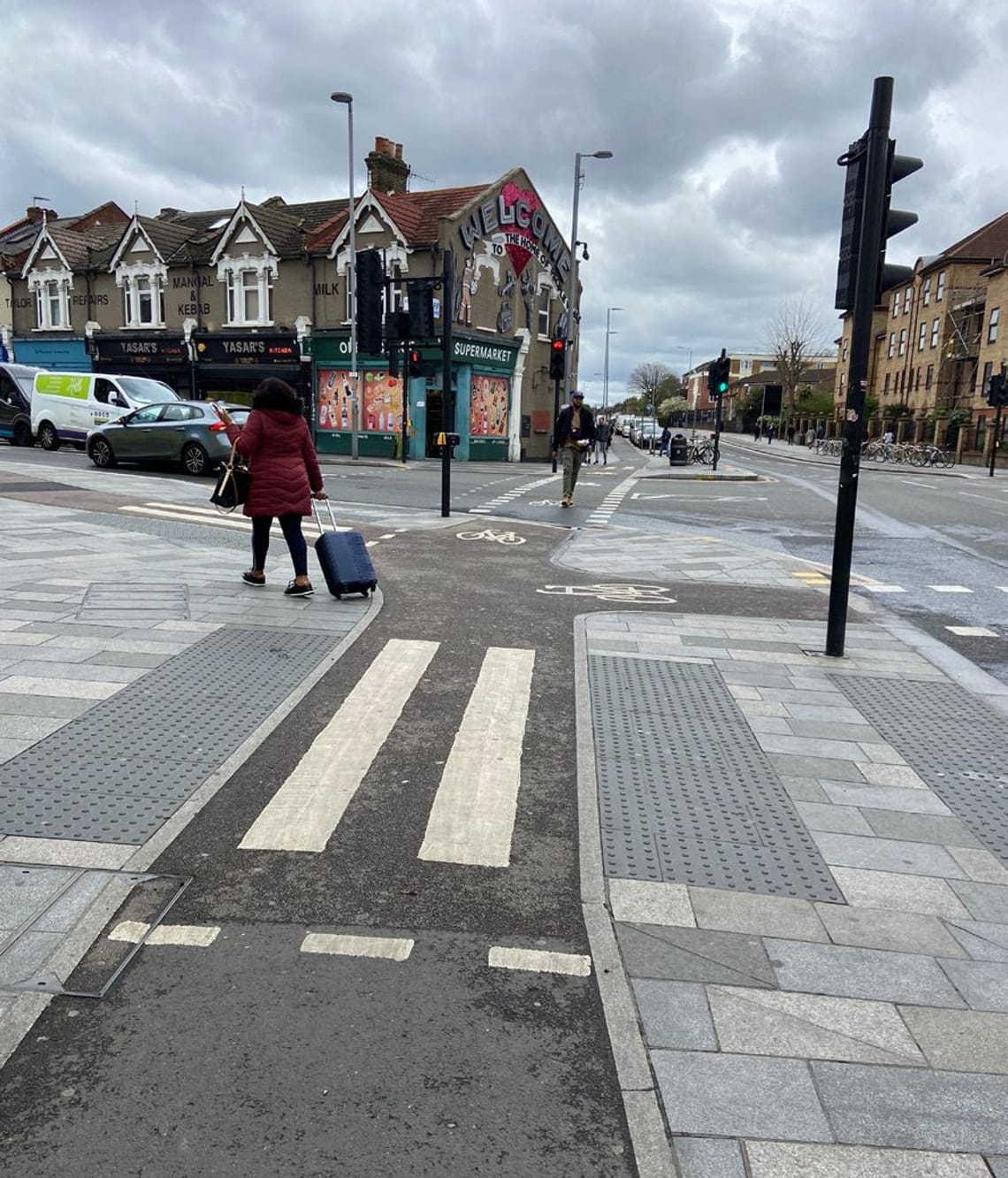
Crossing example
Improved cycle tracks
The scheme will introduce continuous separated cycle tracks along the entire corridor, including all junctions and the section between Hale End Road and Beacontree Avenue where there is currently no protected space for cycling. The tracks will mainly be single direction, but with two-way sections at key locations to provide key cross connections. The new cycle tracks are built lower than the footway but higher than the carriageway to keep people cycling separated from people walking and driving which helps to reduce confusion and conflict among all road users.
Proposals include:
- One-way cycle tracks along the route, with two-way sections at key locations such as outside the Town Hall and near to the Shernhall Street junction to help people cycling easily connect onto adjoining cycle routes and the wider cycle network
- Separation of cycle tracks from the carriageway with low level planting and trees, where space permits, to improve safety for users. In areas where there is less space, the cycle track will be a stepped track alongside the carriageway separated with a kerb, which is similar to the recently completed cycle tracks in the western section of Forest Road.
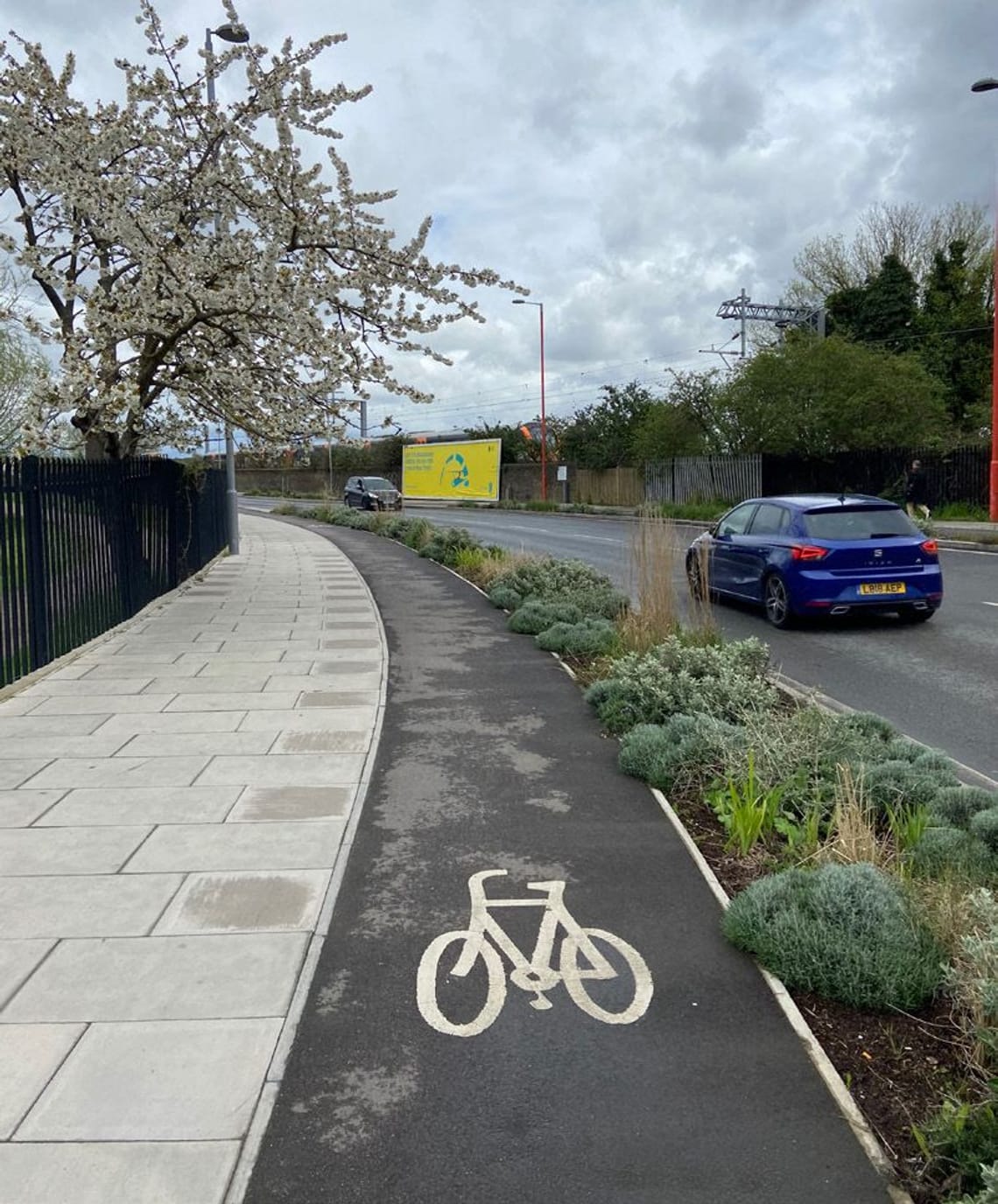
Cycle track example
Changes to bus stops
We want to help improve the reliability of bus services and meet TfL’s accessibility standards to help passengers with reduced mobility, as well as people with push chairs and mobility aids, to access public transport with ease. To achieve this, the below changes will be made to bus stops, which have been designed in conjunction with the new cycle tracks. By improving public transport facilities in the area, we hope to encourage more local people to choose this mode of transport over private motor vehicles helping to relieve congestion on the road.
We have been working with TfL on these designs and have used traffic data, passenger boarding and alighting data, and average bus journey times (peak and off peak) to understand how Forest Road may be impacted.
Proposals include:
- Retain the total number of existing bus stops within the area
- All bus stops along Forest Road will have a cycle bypass
- Two bus stops located near to Woodstock Road will be relocated to make way for the new cycle tracks.
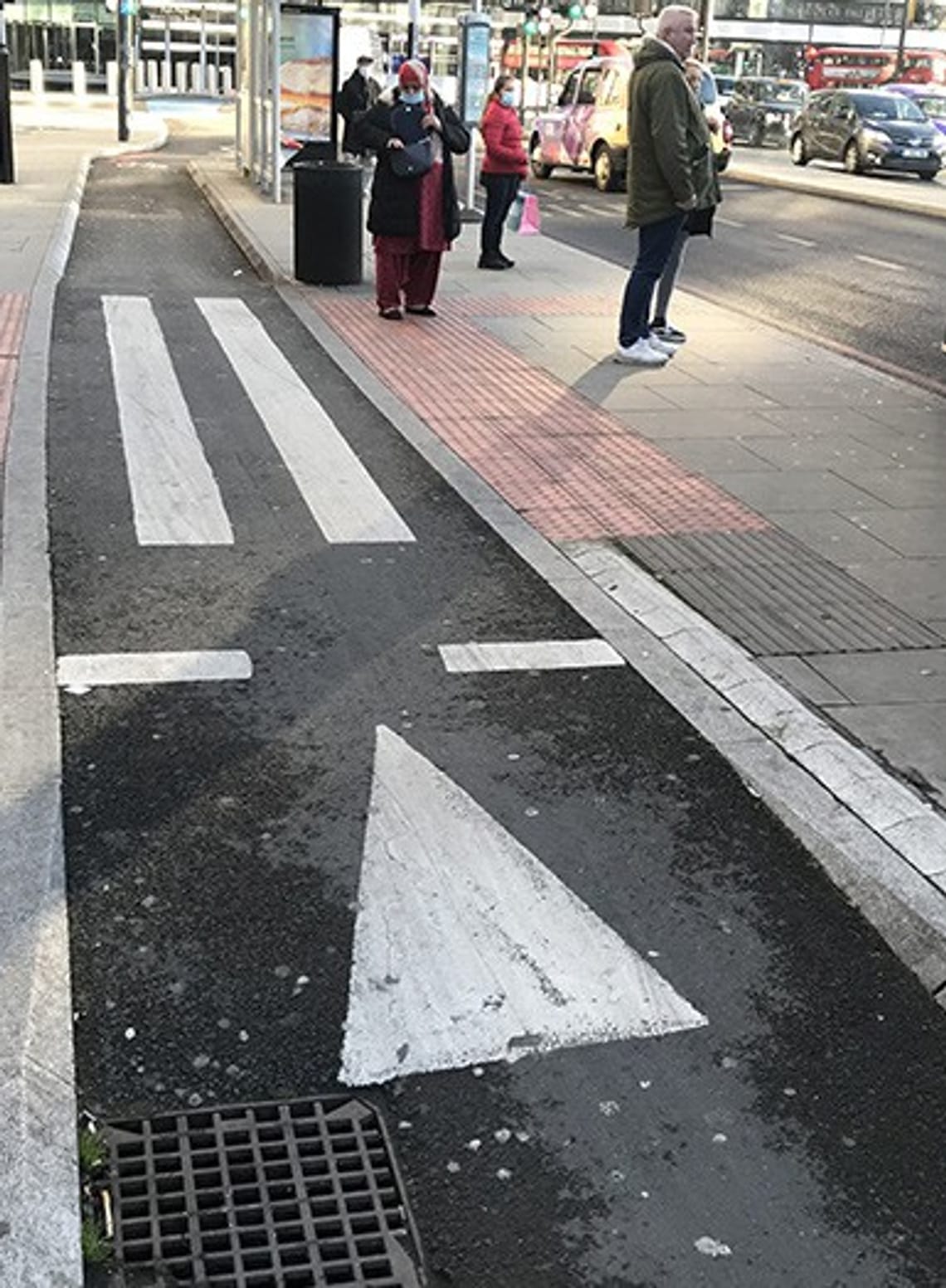
Bus stop cycle bypass example
Stay Informed
Follow our projects to get notified of upcoming engagements and the latest project related news.