Background
The Council is committed to creating streets and neighbourhoods that are safe, attractive and actively encourage walking, cycling and the use of public transport. Walking and cycling in particular can have significant benefits for our personal health and the environment, and are a means to help tackle key priorities for the Council including the public health, air quality and climate crises within the borough. Creating streets and spaces that support and enable active and sustainable travel, particularly for local journeys, is a fundamental part of the Council’s 15-minute Neighbourhoods approach and Climate Action Plan
During 2018 and 2019 we prioritised some of our annual funding from Transport for London (TfL) to deliver a number of highway and transport improvements across what we referred to as the Lloyd Park and Higham Hill area. This is defined as the predominantly residential area bounded by Forest Road (A503) to the south, Blackhorse Lane (B179) to the west, Billet Road (B179) to the north, and Chingford Road (A112) to the east. The improvements we delivered at the time included new and upgraded traffic calming on a number of roads across the area and a number of new or improved pedestrian crossings at key locations. These improvements were delivered in response to growing calls from the local community to reduce the speed and impact of traffic and to also support increased active travel.
At the same time we developed and submitted a major funding bid to TfL in late 2019 for a comprehensive neighbourhood, highways and transport improvement plan for the area, as part of the TfL Liveable Neighbourhoods funding programme. The bid was developed and shaped using early feedback from the local community regarding key local transport issues and concerns, and the types of improvements local people would like to see. Of those that responded to the Higham Hill and Lloyd Park area perception survey in autumn 2019, the top three concerns raised were that the area felt unsafe to travel around, was difficult to get around and was unattractive. The top three changes people wanted to see were slower traffic, less traffic, and safer crossing points. Full statistics from the previous perception surveys are available in the 'Previous engagement' section.
Unfortunately, the bid to TfL was unsuccessful and the impact of the pandemic over the last 2 years has meant that the Council has had very limited funding for highways and transport improvements across the borough.
However, since 2020 we have been able to introduce several further improvements in the area, including traffic reduction measures in Bromley Road, Bedford Road and Dudley Road as part of our scheme to upgrade and transform The Bell junction, and a School Street around Hillyfield Primary Academy. Our monitoring of these schemes has shown that they have generally performed well, achieving many of the original objectives such as an overall decrease in traffic volumes and speeds on roads within the scheme areas, fewer injuries caused by road traffic collisions and an increase in cycling trips.
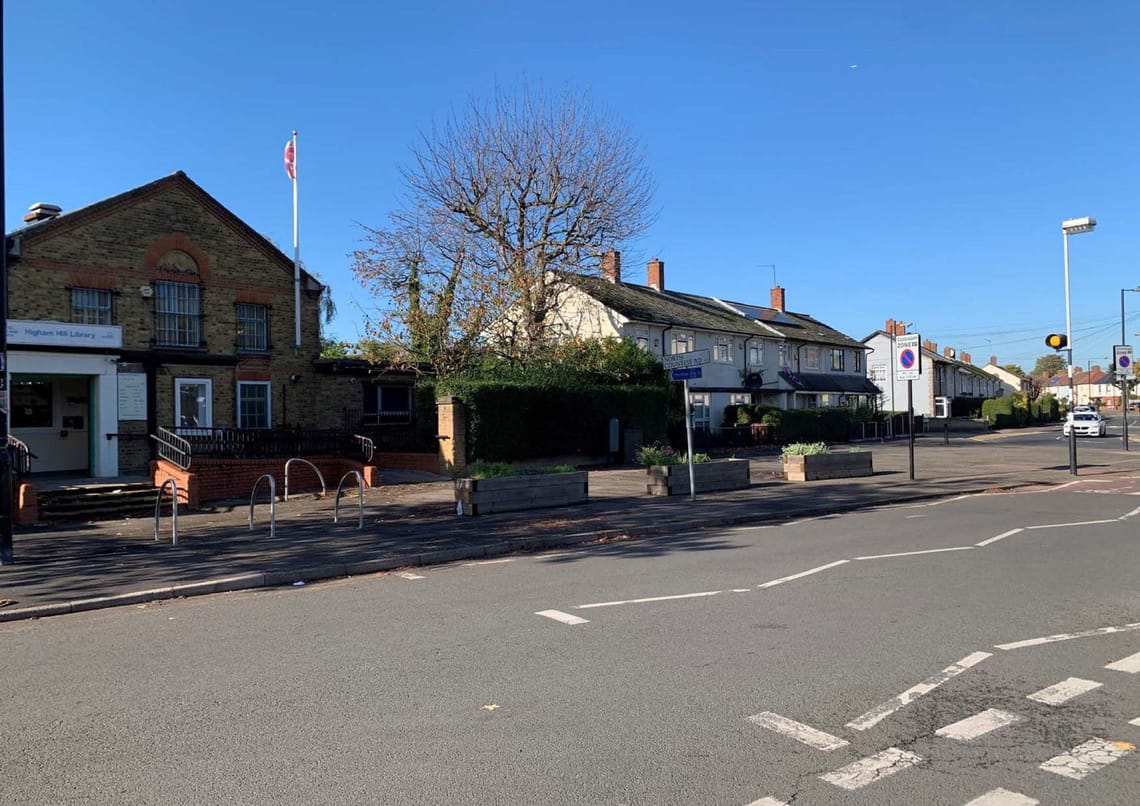
Higham Hill Library, North Countess Road (See Illustration 2 in the Proposals Section for proposed improvements)
We do of course realise that there is much more to be done across the wider area to help reduce the impact of traffic and create safer, more inviting, attractive and accessible streets for local people. This is why we have been working on the next phase of highway and transport proposals for the area. These aim to address some of the key ongoing concerns around the volume, speed and impact of traffic; help further support and enable walking and cycling and public transport use in the area and enhance the look and feel of the area.
This next phase of proposals focuses on the following areas
- Series 1 - bounded by Billet Road, Chingford Road, Forest Road, and is also bounded by but includes North Countess Road, Priory Court and South Countess Road.
- Series 2 - bounded by Forest Road, Higham Hill Road and is also bounded by but includes Queen Elizabeth Road, Blenheim Road and Blackhorse Lane.
Full details of the scheme can be viewed in the 'Proposals' page.
Improvement ideas and options for Higham Hill Road and the wider Higham Hill ward are currently being investigated and will be developed further and consulted upon as a later phase of the scheme. This is likely to include a specific public realm improvement scheme along Sutherland Road and St Andrews Road.
Changing travel behaviour
We all need to do our bit to improve our health and the quality of the air we breathe. By making small changes to how we travel for short journeys we could see huge personal benefit to our health, our wellbeing and our pockets.
Londoners make 7.3 million car trips as a driver or passenger in London on average per day, and of these trips over 50% are made for shopping, leisure and personal business purpose, 5% for schools and education and 19% for work.
We understand that there are many reasons why people feel they need to travel by car, such as time saving, weather, distance, safety, convenience and so on, however, driving is not always the quickest, easiest, or best option for all journeys, especially when travelling locally.
A report on the “Health impact of cars in London” from the Greater London Authority (GLA) highlights that a third of car journeys in London are less than 3km and two thirds are less than 5km. We also know that many journeys are not in fact made for work or commuting but are for other trips such as shopping, leisure, seeing friends and family or the school run. On average, it can take up to 12 minutes to walk 1km and 3km can take around 15 minutes to cycle. If we made a change and choose to walk or cycle for journeys less than 3km, then we could see a huge reduction in the number of people driving daily, and at the same time improve our personal health by being more active and help reduce congestion and air pollution in our neighbourhood.
While there will be many residents happy to join the walking and cycling revolution, there will be some people who may not have the confidence or are unable to make the switch. If the majority of people make the switch for some journeys, then roads will be freed up for the people who have greater need to use them.
While there will be many residents happy to walk, cycle and use public transport more there will be some people who are unable to make the switch for a variety of reasons, and we completely understand this. If we can get some people to switch some journeys, then roads will be freed up for the people who have greater need to use them.
Stay Informed
Follow our projects to get notified of upcoming engagements and the latest project related news.