
Redondo Beach Boulevard Metro Active Transportation Corridor Project
Discover how a transformative, multimodal corridor project is set to enhance safe connections and accessibility for pedestrians and cyclists across Torrance and neighboring communities, supporting vibrant mobility options and fostering connectivity to key destinations like El Camino College.
Introduction
The Redondo Beach Boulevard Metro Active Transportation Corridor Project is intended to improve walking and bicycling opportunities in Torrance, Redondo Beach, Lawndale and the unincorporated Los Angeles County community of El Camino Village.
The approximately 3.3-mile project is designed to improve safety and access for multiple transportation modes and provide connections through the corridor, including toward El Camino College. Within Torrance, the project corridor includes portions of 190th Street and Redondo Beach Boulevard.
Status Update
The Redondo Beach Boulevard Metro Active Transportation (MAT) Corridor Project is currently in the 35% design phase, with community outreach and public meetings anticipated to begin during the 60% design phase.
The City of Torrance continues to work with the City of Redondo Beach, the project’s lead agency, and its design consultant through ongoing coordination and monthly design meetings. The project design is still being refined and is not final.
As the design progresses, Torrance is working to ensure that the portion of the project within the City addresses roadway operations, parking, maintenance, access and other community needs while expanding bicycle and pedestrian opportunities.
Funding and Project Scope
The project is funded primarily through a $7.605 million Regional Measure M allocation awarded to the City of Redondo Beach as the lead agency. Redondo Beach subsequently requested an additional $4 million in Measure M funding in 2025.
The funding is intended to support design and a portion of construction across the participating jurisdictions. The project does not require a local funding match. Ongoing maintenance costs are not included in the grant funding.
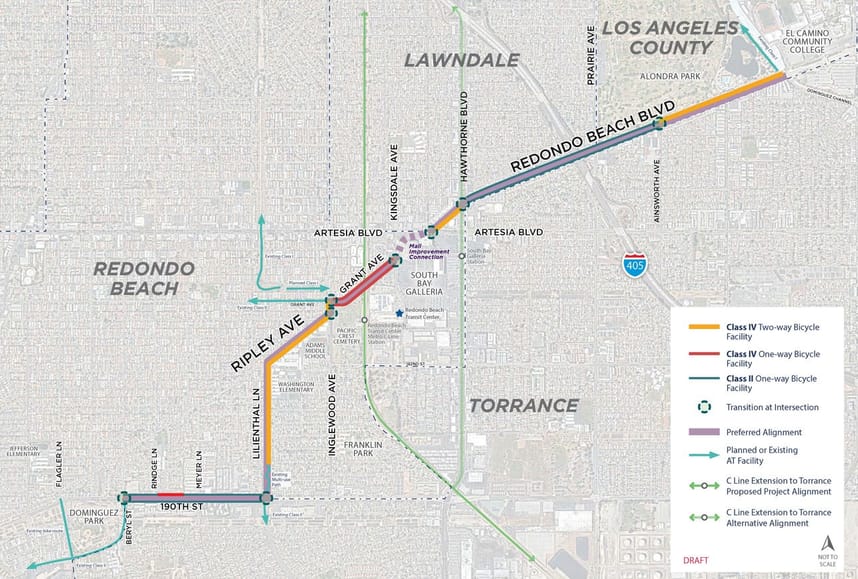
Within Torrance, the proposed improvements include bicycle lanes, approximately 0.75 miles of Class IV protected bikeways, ADA improvements, traffic-signal timing modifications, and signing and striping.
Frequently Asked Questions
Frequently Asked Questions
Bicycle Facilities in Torrance
The proposed project includes a combination of Class II bicycle lanes and Class IV protected bikeways.
Class II bicycle lanes (Striped) provide a dedicated space for bicyclists identified through roadway striping and pavement markings.
Class IV protected bikeways (Seperated) provide additional physical separation between bicycle and vehicle traffic through features such as curbs, delineators or other barriers.
The appropriate facility can vary by location depending on available roadway width, parking, traffic operations, access and long-term maintenance requirements. The project therefore does not use a single bicycle-lane design throughout the entire Torrance corridor.
Proposed Class IV Segments
The current design includes Class IV protected bikeway segments within Torrance.
One proposed Class IV segment would provide protected bicycle facilities in both directions on West 190th Street between Entradero Avenue and Anza Avenue, a section where red-curb and existing no-parking restrictions make physical separation more feasible.
Two proposed Class IV segments are located on the south side of Redondo Beach Boulevard, one east of Hawthorne Boulevard and the other between Osage Avenue and Prairie Avenue.
Together, the proposed design incorporates protected facilities where roadway conditions can accommodate them while using Class II facilities in other portions of the corridor.
The proposed Class II portions are also consistent with the adopted South Bay Bicycle Master Plan, which identifies Class II bicycle lanes along 190th Street and Redondo Beach Boulevard. The proposed Class IV portions go beyond the facilities originally identified for those sections.
Project Considerations
Maintenance Considerations
The type of bicycle facility also affects long-term maintenance.
Class II bicycle lanes can generally be swept using the City’s standard street-sweeping equipment and restriped as part of normal pavement-maintenance work.
Class IV facilities can require additional maintenance because physical separators may limit access for standard sweeping equipment. Depending on the final design, specialized equipment or manual cleaning may be necessary, and damaged delineators or other separation features may require replacement.
Physical improvements within the roadway can also add complexity when streets are slurry sealed or repaved because infrastructure may need to be protected, removed or reinstalled during the work.
Maintenance responsibilities and long-term maintenance considerations remain part of the ongoing discussions with Redondo Beach.
Parking and Community Considerations
Torrance has requested that parking impacts associated with the project be fully evaluated, including impacts immediately outside City boundaries that could affect Torrance residents.
The current proposal would remove approximately 169 on-street parking spaces on the north side of Redondo Beach Boulevard within unincorporated Los Angeles County to accommodate a proposed Class IV facility.
Although those spaces are outside Torrance jurisdiction, some are currently used by Torrance residents. The City therefore wants those impacts clearly communicated and considered as part of the community-engagement process.
The 35% design plan indicates an estimated loss of approximately 13-15 on street parking spaces in Torrance. We are working with the City of Redondo Beach on an alternative design to minimize the parking loss and explore opportunities to add on street parking at other locations to offset the loss.
Community Engagement
Community outreach specifically focused on affected Torrance residents and businesses has not yet occurred.
Before the project advances through Torrance’s approval process, the City plans to provide opportunities for affected community members to learn about the proposal and provide input.
Potential outreach tools may include community meetings, targeted surveys, mailers and other methods designed to reach residents and businesses along or near the project corridor.
The project will also require review by the Torrance Traffic Commission and approval by the Torrance City Council.
Stay Informed
Get notified about new projects, the latest updates, and new opportunities to engage.
Next Steps
The current anticipated next steps are:
- Continue design coordination between Torrance and Redondo Beach.
- Conduct outreach to affected Torrance residents and businesses.
- Continue discussions regarding maintenance responsibilities.
- Present the project to the Torrance Traffic Commission.
- Present the project to the Torrance City Council for consideration.
The project remains in the design and public-review process.