
Understanding Local Taxes
Ever wonder where your property tax dollars go? Discover how your contributions fuel local services in Yorktown and gain a clearer picture of your community’s financial landscape.
Introduction
How Your Property Tax Bill Is Distributed Locally
Property taxes play a vital role in sustaining the services and infrastructure that keep Yorktown thriving. From maintaining our roads and schools to funding emergency services and community resources, your contributions directly impact the quality of life for everyone in our town.
This resource is designed to help residents gain a clearer understanding of how property taxes are calculated, where your dollars are allocated, and the role of tax districts in determining how funds are distributed.
By breaking down the process, we aim to build transparency and empower you to see how local taxes shape the future of our community.
Every property in Yorktown falls within a specific tax district, which determines how your property tax payments are distributed among essential public services and taxing entities.
To make property tax distributions understandable start by identifying your tax district, learn which organizations benefit from your support, and get a sense of how much of your tax bill funds each service.
What Property Taxes Fund Locally
Unique Taxing Districts and Services in Yorktown
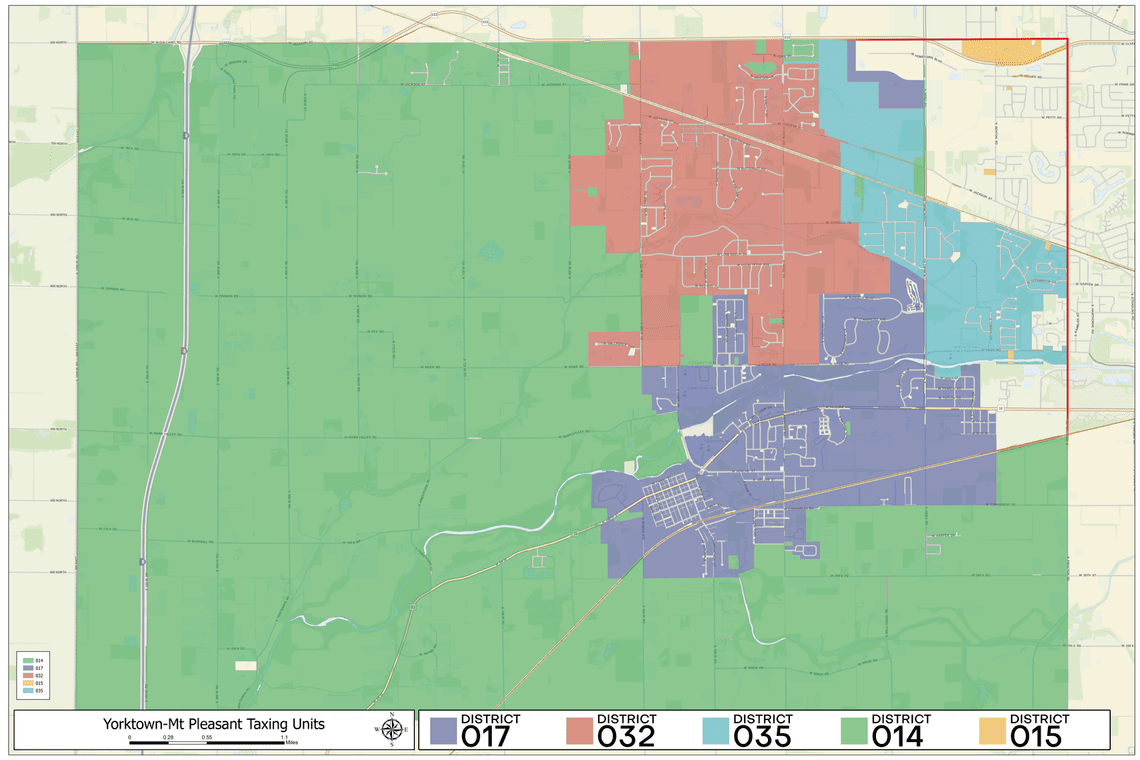
Each color on the map below represents a different tax district. While many of the taxing entities are the same across districts, the portion allocated to the Town of Yorktown may vary depending on the services provided in that area.
The districts shown include:
Tax District 014 // Tax District 015 // Tax District 017 // Tax District 032 // Tax District 035
These districts exist because some areas receive a full set of municipal services from the Town of Yorktown, while others receive only limited services.
What Does the “Town of Yorktown” Portion of Your Property Taxes Fund?
A portion of your property tax bill supports services provided by the Town of Yorktown. The specific services funded depend on which tax district your property is located in.
While every district contributes differently, this portion of your taxes helps fund essential services that support safety, infrastructure, and day-to-day operations across the community.
Tax Districts 017 and 032
Full Town Services
Although these are separate taxing districts, they pay into and receive the same level of Town services. The Town portion of your property taxes support:
- Yorktown Police Department (YPD)
- Fire Department (YFD)
- Streets and infrastructure maintenance
- Parks and recreational spaces
- Administrative services
- (zoning, planning, development services, Clerk-Treasurer, and Town Manager’s Office)
- Cemetery operations
- Community Assistance
Tax District 035
Full Town Services (with different trash service structure)
In this district, the Town portion of taxes supports:
- Yorktown Police Department (YPD)
- Fire Department
- Streets and infrastructure maintenance
- Parks and recreational spaces
- Administrative services
- (zoning, planning, development services, Clerk-Treasurer, and Town Manager’s Office)
- Cemetery operations
- Community Assistance
Additional Notes:
- Trash service is not provided by the Town
- Trash services are handled through the Muncie Sanitary District portion of your property taxes
Tax Districts 014 and 015
Limited Town Services
In these districts, the Town portion of your property taxes supports:
- Fire Department
- Community Assistance
Additional Notes:
- These areas do not pay into or receive full municipal services from the Town
- Police services are provided by the Delaware County Sheriff’s Department
- Town-operated trash service is not available
- In District 015, trash services are provided through the Muncie Sanitary District portion of property taxes.
Important Distinction Across Districts
The key difference between districts is whether properties receive and fund:
- Limited services (014, 015), or
- Full municipal services (017, 032, 035)
This difference is reflected in how much of your property tax is allocated to the Town of Yorktown.
Special Area: Muncie Residents Within Yorktown Schools & Library District
The map also highlights a red-outlined area representing properties located within the City of Muncie that:
- Pay into Yorktown Community Schools, and
- Pay into the Mt. Pleasant Township Public Library
These properties are not within the Town of Yorktown and do not receive/fund Town services, but they are part of the same school and library districts. This is why their property taxes still contribute to those shared community resources.
Yorktown's Taxing Districts
Taxing District Allocation Graphics
Estimating Your Property Tax Distributions
Your Property Tax Distribution
Property taxes in Indiana are based on your home's assessed value, but most homeowners do not pay taxes on that full amount. If the property is your primary residence, you likely receive deduction-such as the homestead deduction and supplemental deduction-which reduce the taxable value of your home before taxes are calculated. This is why two homes with the same market value may have different tax bills depending on how they are used and what deductions apply.
Indiana also has property tax caps that limit how much you can pay, no matter how the rates change. For most homeowners, taxes are capped at 1% of the home's assessed value. Rental properties and businesses are capped at 2%, and industrial properties are capped at 3%. If your calculated tax exceeds that cap, it is reduced to stay within the limit. This helps keep property taxes predictable and protects homeowners from large increases.
How to Estimate Your Property Tax Distribution
Example: Tax District 035
This example shows how to estimate where your property tax dollars go using two different home values.
Step 1: Start with Assessed Value
Your property tax bill is based on your Net Assessed Value (NAV) after deductions.
For this example, we’ll use:
- Home A: $350,000 NAV
- Home B: $125,000 NAV
Step 2: Apply an Estimated Tax Rate
A typical effective property tax rate in Yorktown is around 1.0% for homestead properties after deductions and caps.
- Home A ($350,000) → Estimated tax: $3,500
- Home B ($125,000) → Estimated tax: $1,250
Step 3: Apply District 035 Distribution Percentages
Using the Tax District 035 breakdown (from your chart), we can estimate how that total is distributed across services.
Home A — $350,000 Property
Estimated Total Tax: $3,500
- Yorktown Community Schools (≈55%) ~$1,925
- Town of Yorktown (≈20%) ~$700
- Delaware County (≈15%) ~$525
- Muncie Sanitary District (≈5%) ~$175
- Mt. Pleasant Township Public Library (≈5%) ~$175
Home B — $125,000 Property
Estimated Total Tax: $1,250
- Yorktown Community Schools (≈55%) ~$688
- Town of Yorktown (≈20%) ~$250
- Delaware County (≈15%) ~$188
- Muncie Sanitary District (≈5%) ~$63
- Mt. Pleasant Township Public Library (≈5%) ~$63
Step 4: Adjust Using Your Actual Bill
To get a more accurate estimate using your own tax bill:
- Start with your total property tax
- Subtract stormwater fees, ditch assessments, homestead deductions, supplemental homestead deductions, the over 65 deduction, and disability/special status deductions.
- Apply the percentage breakdown from your district chart
- Important Notes
- These are illustrative examples, not exact tax bills
- Actual amounts vary based on:
- Deductions (homestead, mortgage, etc.)
- Tax caps
- Individual property assessments
- Water and sewer are not included in property taxes; they are billed separately
What This Helps You Understand
- How your tax dollars are distributed across services
- Why higher-value homes contribute more overall, but follow the same percentage breakdown
- How to estimate your own breakdown using your actual tax bill