

Survey results
Residents and residents views about dog access to Churchfields Meadow.
Churchfield Meadows Access
Survey results
A total of 498 respondents took part in the survey, conducted between 6 October and 2 November 2025.
- 80.9% live in the area, and 6.9% work there.
- 45.8% are dog owners.
Views on Dog Access to Churchfields Meadow
- 59.2% opposed allowing dogs access.
- 38.3% supported the proposal.
Analysis Approach
The findings were reviewed using two methods:
- Combined analysis – including responses from both dog owners and non-dog owners.
- Separate analysis – showing results for dog owners and non-dog owners individually.
Comments from open-ended questions were analysed using the combined approach.
Combined analysis
These results include responses from both dog owners and non-dog owners.
Frequency of visits to meadow:
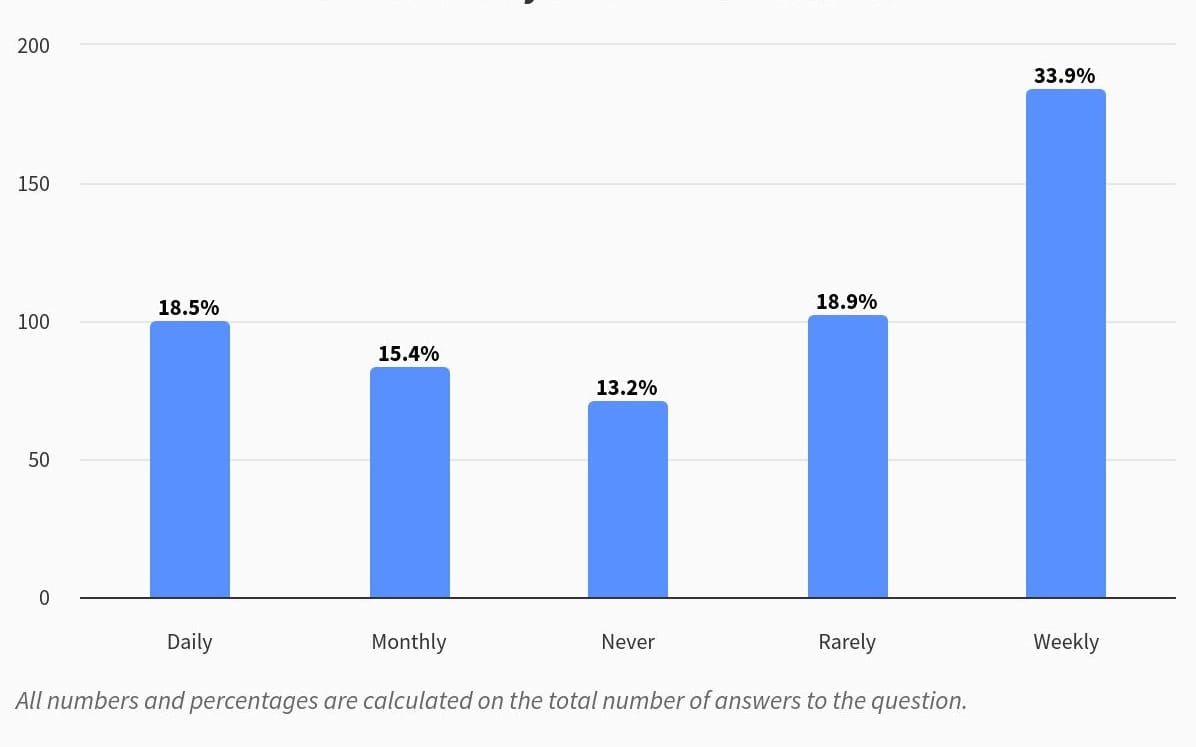
Most respondents visit the meadow regularly, with weekly visits being the dominant pattern, while only a small portion never visit. 33.9% of respondents visit weekly visits. Daily visits account for 18.5% and Rarely is close behind at 18.9%.
Reasons for visiting
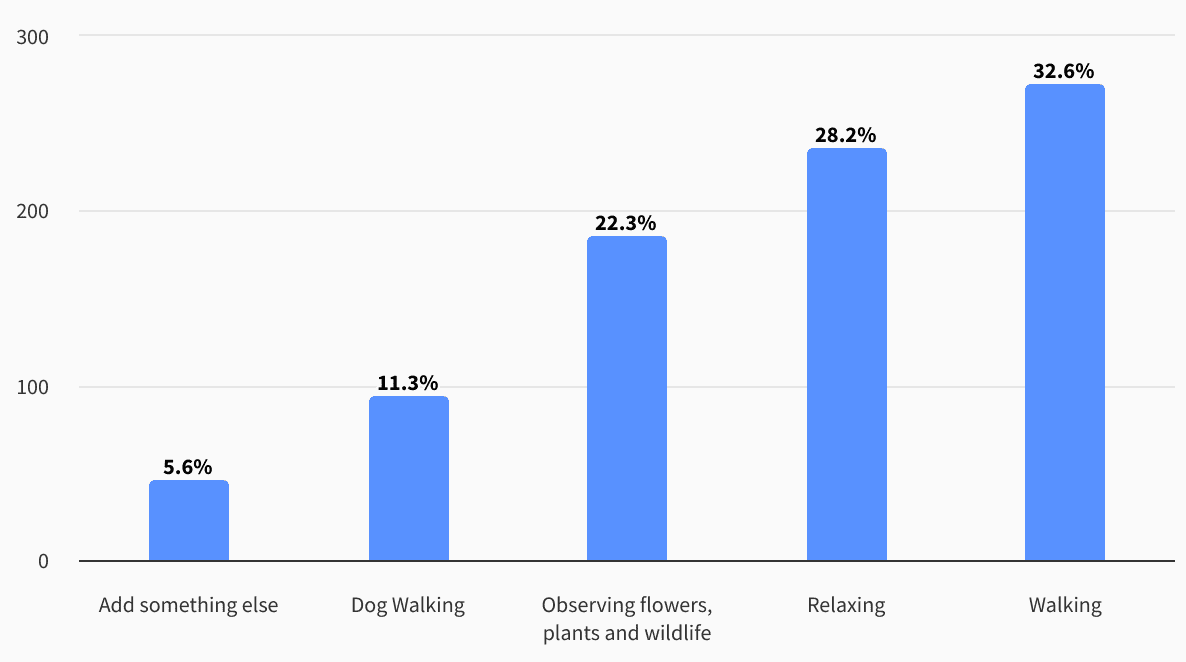
Most visits are for general walking and relaxation, with nature observation also significant. Walking is the most common reason, chosen by 32.6% of respondents. Relaxing follows at 28.2%, making it another major motivation. Observing flowers, plants, and wildlife accounts for 22.3%. Dog walking and other reasons are relatively minor, chosen by 11.3% of respondents.
The 'Add something else' option included:
- Litterpicking
- To see how the meadow is used and how long the grass is
- Could not visit as I am a dog owner and dogs are not allowed in the meadow
- Use a meadow as a shortcut
Extent to which respondents agree or disagree with allowing dogs access to the wildflower meadow
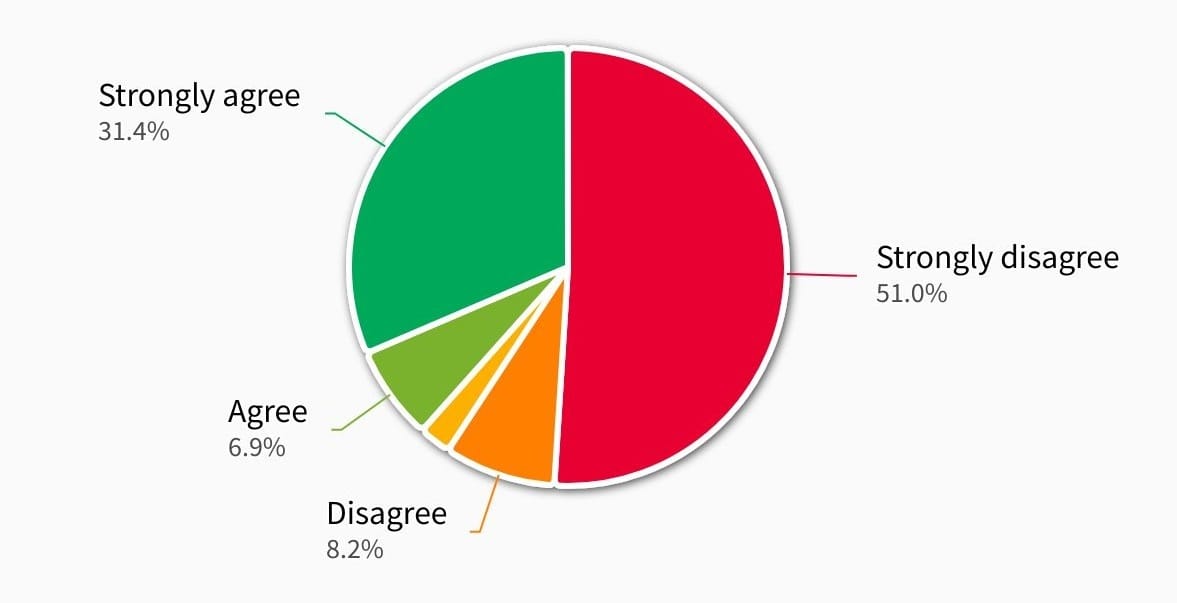
Over half of respondents oppose allowing dogs entirely (59.2%), while about 38.3% support access.
Concerns about allowing dogs in the meadow
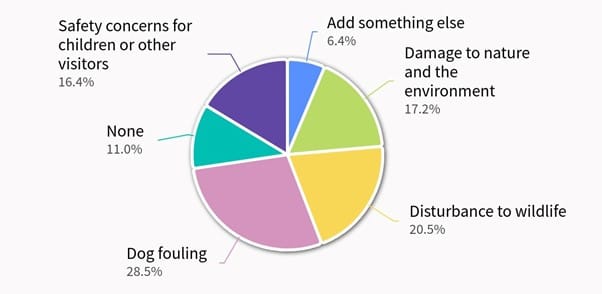
The majority of concerns relate to environmental impact and cleanliness, with dog fouling being the most significant issue, accounting for 28.5% of respondents, closely followed by damage to nature and the environment accounts for 17.2%, and safety concerns for children or other visitors are close behind at 16.4%.
*Add something else (as per respondents' coments)
Dog owners who allow their dogs in the area and disturb the quiet of the area.
Dog fouling and chaos
Would you be more likely to visit the meadow if dogs were allowed?
No | 56.8% |
Yes | 37.1% |
Same | 6.1% |
Do you believe allowing dogs into the wildflower meadow would have a positive or negative impact?
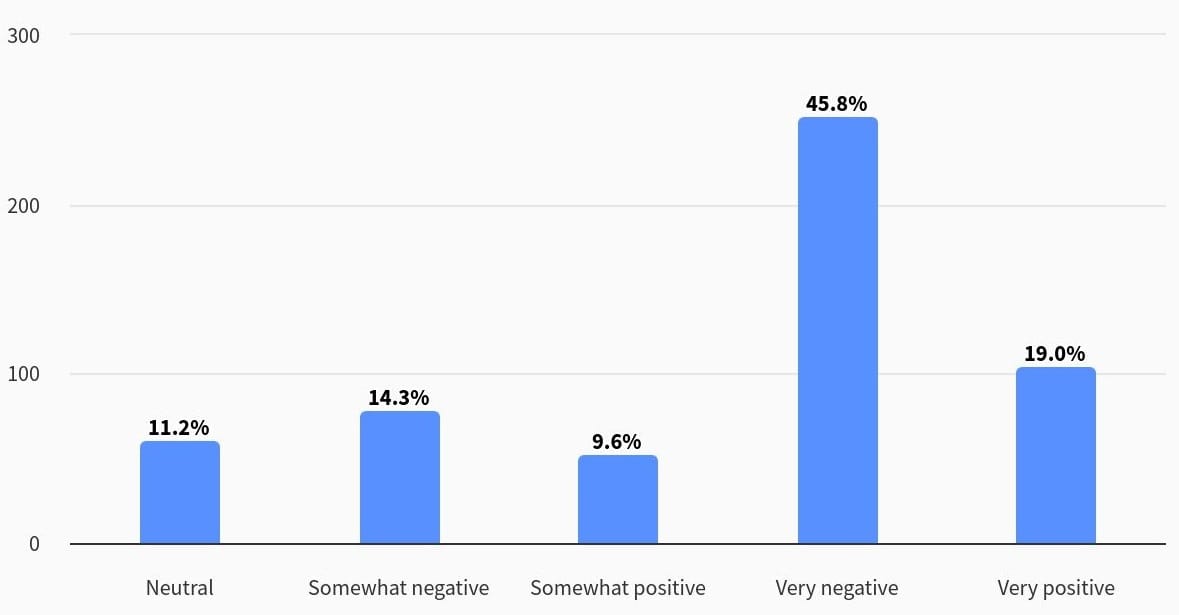
Nearly half of respondents believe allowing dogs would have a very negative impact (45.8%) or somewhat negative (14.3%), while positive views are much less frequent, though 19% strongly support the idea.
Which of the following best describes your view on dog access to the wildflower meadow
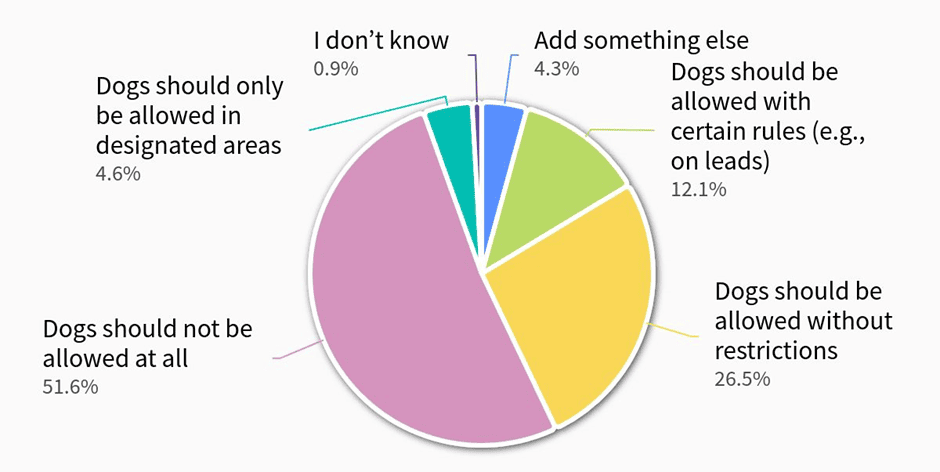
Comparative analysis dog owners and non-dog owners
The results include a separate analysis, presenting findings for dog owners and non-dog owners individually
To what extent do you agree or disagree with allowing dogs access to the wildflower meadow:
Dog owners | Non-dog owners | |
Strongly disagree | 24.4% | 73.4% |
Disagree | 4.8% | 11.1% |
Neutral | 2.8% | 2% |
Agree | 9.2% | 5.1% |
Strongly agree | 58.8% | 8.4% |
Dog owners overwhelmingly support dog access (68% agree or strongly agree). Non-dog owners strongly oppose dog access (84.5% disagree or strongly disagree). Neutral responses are minimal in both groups.
Frequency of visit
Dog owners | Non-dog owners | |
Daily | 20% | 17.3% |
Weekly | 23.2% | 43.1% |
Monthly | 8% | 21.7% |
Rarely | 22.8% | 15.6% |
Never | 26% | 2.4% |
Dog owners show a split pattern regarding visits: about 43.2% visit regularly (daily or weekly). A significant 26% never visit, likely due to the dog-free rule.
Non-dog owners visit more frequently overall: 60.4% visit weekly or monthly, with only 2.4% never visiting. Weekly visits dominate (43.1%), suggesting strong engagement.
Reasons for visiting
Dog owners | Non-dog owners | |
Walking | 29.5% | 34.5% |
Relaxing | 18.7% | 33.9% |
Observing flowers, plants and wildlife | 14.3% | 27% |
Dog walking | 29.5% | 0.4% |
Other reasons* | 7.9% | 4.2% |
*Other reasons (as per respondents' comments): Litterpicking/ To see how the meadow is used and how long the grass is/ Could not visit as I am a dog owner and dogs are not allowed in the meadow/ Use a meadow as a shortcut
Dog owners split their visits mainly between walking (29.5%) and dog walking (29.5%), with less emphasis on relaxing or observing nature. Non-dog owners visit primarily for relaxing (33.9%), walking (34.5%) and observing wildlife (27%), showing a strong nature and leisure focus.
Concerns about allowing dogs in the meadow
Dog owners | Non-dog owners | |
Disturbance to wildlife | 17% | 22.4% |
Damage to nature and the environment | 13% | 19.4% |
Dog fouling | 26.5% | 29.5% |
Safety concern for children or other visitors | 10.2% | 19.5% |
None | 27.2% | 2.6% |
Others concerns* | 6% | 6.6% |
* Other reasons (as above): Dog owners who allow their dogs in the area and disturb the quiet of the area/ Dog fouling and chaos
Dog fouling is the top concern for both groups (≈26–30%). Non-dog owners express much higher concern about wildlife disturbance (22.4%), environmental damage (19.4%) and safety (19.5%) compared to dog owners.
Dog owners are more likely to report no concerns (27.2%), versus only 2.6% of non-dog owners.
Would you be more likely to visit the meadow if dogs were allowed?
Dog owners | Non-dog owners | |
Yes | 72% | 7.5% |
No | 23% | 85% |
Same | 5% | 7.5% |
This highlights a clear position: dog owners support access, while non-dog owners overwhelmingly reject it.
Do you believe allowing dogs into the wildflower meadow would have a positive or negative impact?
Dog owners | Non-dog owners | |
Very negative | 22.2% | 65.7% |
Somewhat negative | 7.5% | 20% |
Neutral | 17.%% | 6% |
Somewhat positive | 17.1% | 3.3% |
Very positive | 35.7% | 5% |
Dog owners lean strongly toward positive impact: 52.8% positive (very + somewhat), only 29.7% negative. Non-dog owners overwhelmingly see negative impact: 85.7% negative (very + somewhat), just 8.3% positive.
Which of the following best describes your views on dog access to the wildflower meadow
Dog owners | Non-dog owners | |
Dogs should be allowed without restrictions | 49.2% | 7.5% |
Dogs should be allowed with certain rules (i.e., on leads) | 17.2% | 7.8% |
Dogs should only be allowed in designated areas | 4.3% | 4.9% |
Dogs should not be allowed at all | 23.8% | 74.8% |
I don’t know | 1.6% | 0.3% |
Other* | 3.9% | 4.6% |
*Other: blank responses
Nearly two-thirds of dog owners (70.7%) favour some form of dog access, with 49.2% wanting no restrictions. Non-dog owners show an overwhelming opposition (74.8%) to any dog access, with only 20.2% supporting access under any conditions.
Analysis of literals/comments
Comments from open-ended questions were analysed using the combined approach.
Question 1: Is there anything else you’d like to share regarding dog access to the wildflower meadow?
Overall sentiment:
- Oppose dog access: majority of comments strongly favour keeping the meadow dog-free. 271 comments.
- Support dog access: minority view, often stating underuse and desire for enclosed dog space. 44 comments.
- Conditional support 34 comments: some respondents suggest compromises (e.g., dogs on leads, restricted zones, enforcement of fouling rules).
In more detail:
Key Themes:
- Dog Fouling and cleanliness (116 mentions)
- Health risks for children and adults.
- Difficulty maintaining cleanliness in long grass.
- Overflowing bins and lack of enforcement.
- Wildlife and environment (105 mentions)
- Dogs disturb birds, foxes, pollinators.
- Dog waste changes soil nutrients, harming wildflowers.
- Flea treatments toxic to insects.
- Mental Health and peaceful space (85 mentions)
- Meadow valued as a quiet, reflective space.
- Noise and activity from dogs seen as incompatible.
- Safety concerns (32 mentions)
- Fear of dogs among children, elderly and autistic individuals.
- Reports of dog attacks and uncontrolled behaviour.
- Accessibility and inclusion (15 mentions)
- Provides safe space for those with disabilities or phobias.
- Rare dog-free zone in Weybridge.
- Underuse of meadow (11 mentions)
- Some argue the space is underutilised and could serve dog owners.
Common Suggestions
- Maintain dog-free status to protect wildlife and provide inclusive space.
- If access allowed:
- Dogs on short leads only.
- Ban commercial dog walkers.
- Provide dog waste bins and enforce fines.
- Consider trade-off: restrict dogs in main park if meadow access granted.
Question 2: Do you have any suggestions for how dog access could be managed to protect the meadow and its wildlife?
Overall sentiment
- Strong majority oppose dog access entirely:~80–85% of comments
Most comments state “No,” “Don’t allow dogs,” or similar, emphasising that the meadow should remain dog-free. - Minority support conditional access~10–15%.
A small number suggest compromises such as dogs on leads, designated paths, seasonal access or fenced areas. - Very few support unrestricted access<5%.
Only a handful of comments advocate for dogs running free.
Key Themes:
- Maintain dog-free status
- Frequent statements like “Keep dogs out,” “No access,” “Ban dogs completely.”
- Reasons: wildlife protection, tranquillity, safety for children and lack of enforcement capability.
- Wildlife and environment
- Concerns about disturbance to ground-nesting birds, foxes and pollinators.
- Mentions of chemical runoff from flea treatments harming biodiversity.
- Dog fouling and cleanliness
- Widespread worry about dog mess in long grass.
- Comments highlight existing issues in nearby parks and difficulty enforcing cleanup.
- Enforcement challenges
- Scepticism about managing rules effectively.
- Comments note signage vandalism and lack of enforcement.
- Conditional access suggestions
- Dogs on short leads only.
- Restrict commercial dog walkers.
- Provide dog waste bins and impose fines.
- Seasonal or time-limited access.
- Designated fenced or mown paths.
- Alternatives spaces
- Many point out that Churchfields Recreation Ground and other parks already allow dogs.
- Argument: “Why change when dogs have plenty of space?”
Representative Quotes:
- “Keep the meadow dog free please.”
- “It’s not possible to protect the meadow with dogs having free access.”
- “If allowed at all, then dogs should only be allowed access if on leads.”
- “Perhaps certain times of the year depending on wildlife in the area.”
- “Dogs have the large park next door, please keep them out of the meadow.”
Question 3: Do you have other suggestions for the management of the open space?
Overall sentiment
- Majority want the meadow to remain as it is. Many comments emphasize keeping it dog-free, quiet and natural.
- Strong emphasis on wildlife and biodiversity. Calls for proper wildflower management, planting more species and creating habitats for pollinators and birds.
- Minority suggest changes for increased use
Ideas include picnic benches, seating, signage and community activities. - Very few propose dog access. Some suggest trial periods or designated dog areas but these are rare.
Key Themes
- Preserve dog-free status
- Frequent comments: “Leave it as it is,” “Keep it dog-free,” “Do not allow dogs.”
- Reasons: wildlife protection, mental health benefits, safe space for families.
- Wildflower and habitat management
- Requests for more wildflower planting, proper mowing schedules and biodiversity improvements
- Suggestions for bug hotels, bird/bat boxes and hedges for wildlife shelter.
- Enhance visitor experience
- Add picnic benches, shaded seating and bins.
- Improve signage to promote the meadow and explain its environmental benefits.
- Maintain cleanliness and litter removal.
- Community engagement
- Involve schools and local groups in planting and maintenance.
- Educational activities: nature clubs, mindfulness classes, forest school.
- Accessibility
- Suggestions for wheelchair-friendly gates and paths.
- Clearer pathways and signage from the main park.
- Alternative uses (minority view)
- Ideas like outdoor gym, bandstand or designated dog area.
- Some propose trial dog access with strict conditions.
Indicative sentiment breakdown for question 3
- Keep as is (dog-free, natural): ~70–75%
- Enhance for wildlife & education: ~15–20%
- Add amenities (benches, bins, signage): ~10–15%
- Allow dog access (conditional or trial): <5%
Representative suggestions
- “Manage the area as a wildflower meadow with professional advice.”
- “Add picnic benches and shaded seating.”
- “Encourage schools to use the space for outdoor learning.”
- “Leave it as it is – peaceful and beautiful.”
- “Install bug hotels, bird boxes, and plant more wildflowers.”
Conclusion
The survey reveals strong community support for maintaining Churchfields Meadow as a dog-free, peaceful and biodiverse space. While dog owners express interest in access, the majority of respondents, especially non-dog owners, highlight significant concerns about environmental impact, safety and enforcement challenges.
Discover more
Stay Informed
Follow our projects to get notified of upcoming engagements and the latest project related news.