Communications and engagement strategy
This draft strategy outlines Elmbridge Borough Council’s approach to informing, consulting, and engaging with local communities and stakeholders throughout the development of the new Elmbridge Local Plan.
The new Local Plan making system sets a 30-month time frame for the plan making process and sets out a sequence of tasks we need to undertake when preparing a local plan, this includes three periods of consultation:
• Scoping consultation (this consultation)
• Consultation on proposed Local Plan content and evidence
• Consultation on the proposed Local Plan and the evidence to support the plan
Our aim is to deliver an inclusive, transparent and responsive consultation process that maximises participation and supports meaningful consultation feedback. To support this, we will work towards a clear set of goals:
• raise awareness of the Local Plan’s purpose and significance
• deliver timely, accessible, and accurate information to help communities and stakeholders understand and engage at the appropriate stages
• enable meaningful participation from individuals, groups, and organisations across the borough, and managing expectations through clear, open, and consistent communication
• encourage diverse representation, including voices from underrepresented and seldom-heard communities.
Our principles
To achieve our objectives, we will be guided by the following principles:
Identifying key stakeholders
Cross-boundary collaboration
Councils no longer have a legal ‘Duty to Cooperate’ when preparing Local Plans. This was removed as part of wider changes to the plan-making system introduced through the Levelling-up and Regeneration Act 2023 (LURA) However we are still working closely with neighbouring councils and other organisations on issues that affect more than one area. This could include things like housing, transport and infrastructure. When preparing a Local Plan, we need to show how we have continued to work with neighbouring areas and considered these wider issues.
To demonstrate evidence of collaboration we will;
• send out notification to invite feedback on the new Local Plan Scoping Consultation starting engagement in November 2026 to neighbouring authorities, Surrey County Council, and relevant organisations outlining the start of the Local Plan
• engage early and consistently with relevant organisations and neighbouring authorities throughout the Local Plan process
• identify and address cross-boundary strategic issues, particularly those that cannot be resolved within Elmbridge alone
• maintain a Statement of Common Ground or similar evidence, which will document the strategic matters discussed, the parties involved, and the outcomes of those discussions, including any areas of agreement or ongoing dialogue.
Consultees
To ensure consultations are appropriately targeted and generate the most meaningful feedback, stakeholders have been organised into two specific groups:
Communication methods
To engage effectively with our audience, we will use a multi-channel communication strategy that supports wide visibility, accessibility, and participation. This strategy will be achieved through:
• direct mail and email updates
• press releases and local media coverage
• social media platforms
• online and printed consultation materials
• Elmbridge Borough Council website and dedicated consultation platform (Zen City)
• online and in-person workshops and drop-in events
30-month plan-making timeframe
The Levelling Up and Regeneration Act (LURA) 2023 introduces powers to prescribe mandatory timetables for Local Plan preparation through regulations, with government policy proposing that plans should be prepared and adopted within 30 months.
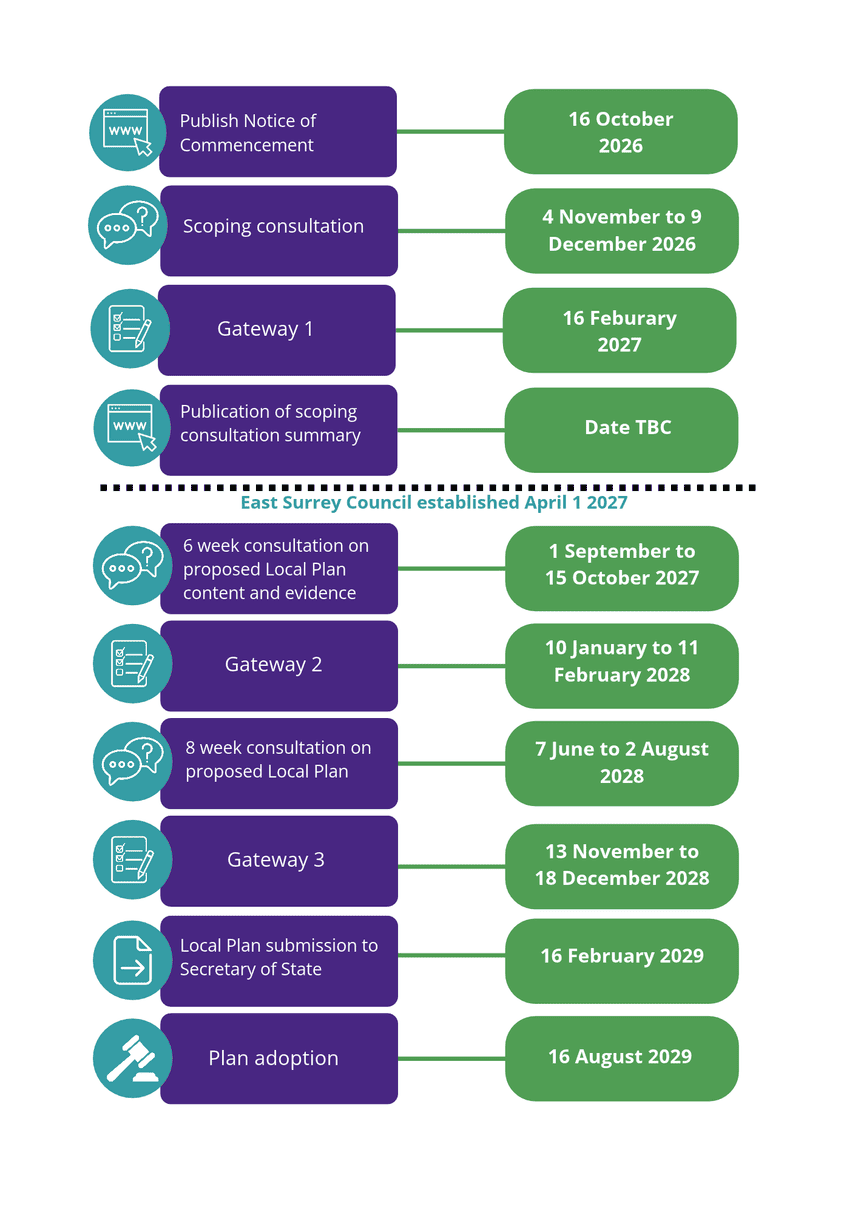
The above images illustrates the tasks sequenced along the Local Plan timeline as follows:
- before Gateway 1 - prepare timetable, issue notice of plan-making, undertake scoping consultation
- Gateway 1- publish self-assessment summary. This stage does not involve Gateway Assessors. Also publish the scoping consultation summary immediately after Gateway 1
- before Gateway 2 - consult on proposed plan content and evidence, and publish summary (8 weeks)
- Gateway 2 – advice sought from Gateway Assessors to check the Plan is going in the right direction
- before Gateway 3 - consult on the proposed Local Plan and publish summary, including consultation on conformity with the spatial development strategy where applicable. (6 weeks)
- Gateway 3 – Gateway Assessors to advise if the Plan has followed the prescribed approach to proceed to submission and examination
- submission, examination and adoption.
Engagement process
The engagement process will be tailored to different audiences and stages of plan-making, ensuring that residents, businesses, and stakeholders can engage in ways that are convenient and accessible to them.
Key engagement methods will include:
Engagement stages and methodology for consultation
This section outlines how the council will communicate and engage at key stages of the plan-making process.
Each stage of the plan-making process presents different opportunities for involvement, tailored to the purpose and requirements of that stage. By aligning communication and engagement activities with the Local Plan timetable, we aim to encourage active participation in shaping the future of Elmbridge.
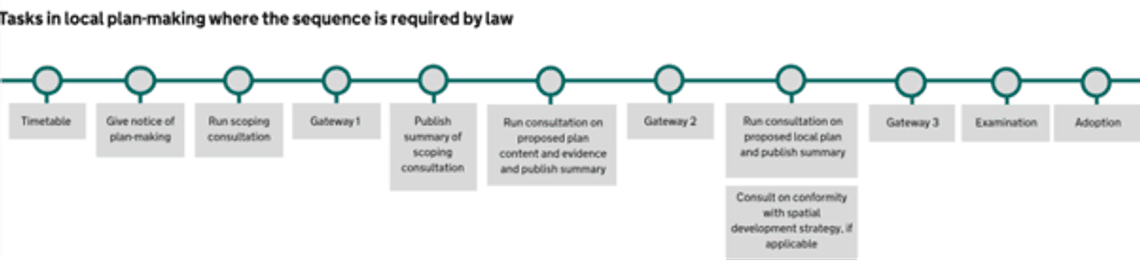
Table 1 below, outlines the different consultation methods that may be used at different stages of the plan making process.
We will use the most effective methods for the topic and stage being consulted on to effect positive participation throughout the plan making process.
| Key stage | Purpose | Engagement methods |
|---|---|---|
Preparatory Evidence Gathering & Scoping (Early Engagement) Notice of commencement and scoping consultation. | Establish context, collect baseline data, and initiate informal discussions. |
|
Vision and Strategy Development Consult on proposed content and evidence Publish summary of consultation responses | Present emerging vision and spatial strategy options and gather feedback |
|
| Evidence and Draft Plan Development (Gateway 2) | Keep stakeholders informed during drafting and technical analysis |
|
Pre-Submission Draft Plan Consultation Consult on draft Local Plan and submission documents - test of soundness Publish summary of consultation | Invite formal representations focusing on legal and soundness matters |
|
| Gateway 3 (check for examination readiness) | A submission readiness check.to PINS to check whether the plan has been prepared correctly with evidence that engagement has been undertaken appropriately |
|
Submission and Examination Publicise examination and hearings | Keep stakeholders informed and engaged during formal examination |
|
Adoption and Implementation Publish adopted Plan and adoption statement | Communicate adoption and outline next steps clearly |
|
Gateway assessments
After passing Gateway 2, the council will consult on the proposed Local Plan and submit relevant evidence to the Planning Inspectorate for assessment. The purpose of Gateway 2 is to support progress in preparing the plan by identifying and addressing potential issues at an early stage, including matters that may affect the plan's ability to satisfy examination requirements. The assessment will consider progress towards meeting the prescribed requirements for Gateway 3 and provide observations and advice on the plan's preparation, evidence base, strategy, deliverability, and approach to strategic planning matters.
The Gateway 2 assessment is intended to support:
- the early identification and resolution of potential issues that could affect the successful examination of the Local Plan
- progress towards meeting the prescribed requirements that must be satisfied before the plan can proceed through Gateway 3
- consideration of whether the plan is supported by an appropriate evidence base and whether its strategy is capable of being implemented and delivered
- effective engagement and strategic cooperation with neighbouring authorities, infrastructure providers and other relevant bodies
- alignment with national planning policy and legislative requirements.
After passing Gateway 3, the council will submit its proposed submission Local Plan and supporting evidence to the Planning Inspectorate (PINS). Gateway 3 is a submission readiness check. It is not the examination itself and does not determine whether the plan is sound; rather, it checks whether the plan has been prepared correctly and is ready for submission.
The Gateway 3 assessments focus on;
- whether the plan has met the prescribed requirements set out in the regulations
- whether all required submission documents have been prepared
- whether the council is ready to proceed to examination.
Elmbridge Borough Council's Local Plan timetable
The Local Plan timetable sets out the key stages and estimated timeframe for developing the new Elmbridge Local Plan, guiding the process from initial evidence gathering to final adoption. It serves as a clear roadmap to inform communities, stakeholders, and statutory bodies about when and how they can engage throughout the plan-making journey.
The indicative timetable below aligns with the 30-month plan preparation and examination timeframe requirements, aiming to deliver a timely, inclusive and legally compliant planning process.
| Local Plan stage | Date |
|---|---|
Publication of Notice of Commencement (Regulation 19) | 16 October 2026 |
Scoping Consultation (Regulation 20), including publication of the ‘Notice of Scoping Consultation’ (Regulation 20(1)(b)) | 4 November 2026 to 9 December 2026 |
Gateway 1 publication of self-assessment summary/ Commencement of Plan-making (Regulation 21) | 16 February 2027 |
Public Consultation on proposed local plan (content, draft vision, evidence base) (6 weeks) (Regulation 23) | 1 September 2027 to 15 October 2027 |
Gateway 2 Observations and advice sought from Gateway Assessors (Regulation 26) | 10 January 2028 to 11 February 2028 |
Proposed Local Plan consultation (8 weeks) (Regulation 27) | 7 June 2028 to 2 August 2028 |
Gateway 3 Prescribed Requirements assessment by an appointed person (Regulation 31) | 13 November 2028 to 18 December 2028 |
Local Plan Submission to Secretary of State for Independent Examination (Regulation 34) | 16 February 2029 |
Plan Adoption (Regulation 39) | 16 August 2029 |
Visibility and tone
Visibility and tone are about ensuring our communications are seen by the people who need them, using the right channels and level of prominence. and communicating in a way that suits our audience while remaining clear, accessible, and consistent.
Inclusivity and accessibility
To reach all communities, events will be held at various times and locations, which may include evenings and weekends. The council may use a range of the listed engagement methods and partner with local leaders and groups to engage underrepresented audiences, including rural and isolated residents.
The chosen engagement approach will be tailored to the specific stage of the Local Plan and the needs and context of the targeted community.
Engagement methods for
The Local Plan engagement website
The council will maintain a dedicated webpage throughout the preparation of the new Local Plan to provide ongoing updates and easy access to key information. This webpage will be regularly updated and will include:
- a webform allowing residents and stakeholders to register their contact details to be included on the mailing list.
- a live ‘Call for Sites form’ enabling landowners and interested parties to submit details of potential development sites at any time. Submissions will be used to update further iterations of the Land Availability Assessment (LAA).
- an ‘Evidence Library’ section on the webpage, where supporting documents will be published as they become available, ensuring easy access to the evidence base.
- a dedicated webpage containing the Local Plan programme setting out key dates and milestones in the plan-making process.
- an engagement hub where we will list upcoming engagement events and sessions. The information will be updated regularly with dates, locations, and participation details.
Our feedback process
Feedback will be provided through the publication of a report at the end of the consultation period, on the council’s consultation platform, Commonplace/ZenCity.
All respondents who have signed up for updates will be notified when updates are available.
We will provide clear guidance to the public and key stakeholders on the proper methods for submitting representations. Comments received via social media will not be treated as formal representations.
Each respondent will be assigned a unique reference number, and their representation will be recorded in a database.
We will send an email to acknowledge receipt of each representation.
We may contact respondents to clarify points raised or to explore specific issues further.
We will fully consider all representations, and where appropriate, will engage in further discussions to help shape the emerging Local Plan.
We will summarise each representations received and produce a consultation report setting out these summaries along with the council’s response. The report will be published on the council’s website and the consultation platform.
Once the report is ready, we will notify consultees through the Local Plan webpage, the council's social media platforms, email, the resident’s newsletter and other communication channels.
Risk management
We will manage risks by identifying, assessing, and addressing potential challenges that could impact the successful delivery of the Local Plan. This approach will allow us to take proactive steps to minimise disruption and respond effectively to any unforeseen issues.
To counteract misinformation, we will provide appropriate rebuttals using FAQs and social media updates.
We will mitigate low participation by using multiple engagement formats and promoting consultations through targeted local outreach.
To address challenges with technical language, all materials will be simplified and supported with plain English summaries.
For those without digital access, we will offer printed materials on request and provide assistance through libraries and community hub.
Discover more
Stay Informed
Follow our projects to get notified of upcoming engagements and the latest project related news.